Showing posts with label religion. Show all posts

Friday, April 06, 2012

Death to Jesus

DEATH TO JESUS!


I logged on to Facebook early this morning to post some photos of our beautiful Maundy Thursday service to the parish page and there on the screen near the top of my newsfeed, one of my friends had posted “DEATH TO JESUS!” as a status update.


He wasn’t kidding or being ironic. He means it.


What should our response be?


Do we shrug, like Paul in his first letter to the Corinthians and just accept that “the message about the cross is foolishness to those who are perishing”? Do we rejoice, as Jesus suggests in the Sermon on the Mount, “Blessed are you when people revile you and persecute you and utter all kinds of evil against you falsely on my account”?


Do we argue? Do we point out the amazing humanitarian work being done by so many Christians in the world? Do we try to find the weakness in his argument and beat him rhetorically with citations of scripture? Do we point to leading lights like the Rev. Dr. Martin Luther King?


Well, let me tell you something about my friend. He’s heard it. Trust me.


You see, this isn’t some guy who was raised in a radically atheist household, brainwashed from an early age to think that religion – and Christianity in particular – is dangerous hogwash.


Nope, he’s the son of a minister. The gay son of a Pentecostal pastor, from a community that is sometimes casually referred to as “Bible beaters.” It’s not a bad aphorism, actually, since short of being actually struck with the book itself, my friend has endured all manner of assault and abuse. He has had the Bible hurled at him mercilessly. He has been threatened, pummeled, humiliated, shamed and wounded in the name of Jesus Christ.


In fact, if anyone is to be blessed for being reviled and persecuted and for having all kinds of evil uttered against them on Jesus’ account, it’s my friend.


How does someone get so angry that they put “DEATH TO JESUS!” on their Facebook page on Good Friday? Easy. They grew up in a church.


“Oh, but,” you say, “not all churches are like that. My church is not like that.” Well, yes it is. There isn’t really “this church” and “that church.” There is only “the church,” the whole body of believers. The whole, universal church is the Body of Christ, and the wounds that Thomas demanded to see are right there in front of us, gaping and raw and ugly. Like Pilate, we want to wash our hands of the things that are done to the Body of Christ. “That’s not our fault,” we say.


The ancient Israelites understood that sin was communal, rather than individual. That’s why God destroys entire cities, why all the Egyptians suffered plagues even though it was really only the Pharaoh causing problems. And so in Holy Week when we sing


Who was the guilty? Who brought this upon thee?

Alas, my treason, Jesus, hath undone thee.

‘Twas I, Lord Jesus, I it was denied thee: I crucified thee


it’s not just about our private but also our collective failures. The church has left a trail of victims in its wake. When the Bible is used to denigrate, insult, marginalize, subordinate, exclude, diminish, we cannot remain silent.


When I say “we cannot remain silent” I’m not talking about rising up in righteous indignation and pointing more fingers and saying “You all did this, clean up your mess.” We can’t draw imaginary lines across the wounded Body of Christ and say this part belongs to the Episcopalians, and that part belongs to the Catholics, and this part belongs to the ELCA and this part to the Missouri Synod, this part to the Southern Baptists and this part to the American Baptists. We’re responsible for this, and you’re responsible for that. All we’re doing is breaking the Body of Christ over and over and over again.


When the Samaritan came upon the man bleeding and dying by the side of the road, he didn’t chase down the Levite and the priest and shame them for their carelessness that almost resulted in an innocent man’s death. He went and ministered to the wounded man. It’s easy to see the Christ-figure in the Samaritan, the unreasonably generous comforter and the healer, but we shouldn’t miss the Christ-figure in the wounded and dying man, too.


DEATH TO JESUS!


As the nails were being driven through his hands and feet, Jesus said, “Father, forgive them. They don’t know what they are doing.”


Tonight it will be my great privilege to chant the Passion Gospel at the Solemn Liturgy of Good Friday. Personally, it is the most important thing I do all year. I’ve always had kind of a hard time imagining this strange, blood thirsty crowd demanding an innocent man’s death. Crucify him! Crucify him!


Well, now I’ve actually seen it. I have a face and a name to put on that crowd. I’ve seen someone calling for Jesus’ death. In exactly the way that we say, “Jesus died for our sins,” this man is standing there basically shouting “Crucify him!” because of the pain that we have inflicted on him; he’s that hurt and that angry because for him the church has never been anything but a horrendous source of torment. And he just wants this whole Jesus thing to die.


He doesn’t need us to forgive his blasphemy, we need him to forgive ours.


And, fortunately, strangely, wonderfully…Jesus’ death on the cross will work the healing that we need.

Wednesday, February 22, 2012

What Santorum Gets Wrong

When I decided some months ago to start blogging again, I intended to avoid politics; I was just going to write responses to the lectionary.

However, when the current frontrunner for the Republican nomination feels that it's appropriate to criticize President Obama for a "phony theology" that is "not based on the Bible," I can't help myself.

When Republicans in Congress can summon an all male panel of clergy to complain that their rights are threatened by insurance coverage for women's healthcare (and simultaneously deny an opportunity to speak to a woman who was prepared to speak to how the laws impact her), something has gone off the rails.

When I say "what Santorum gets wrong," I don't plan to do a point-by-point rebuttal of his various statements and claims. The last thing the world needs is more Christians pointing fingers at each other and saying, "I'm right, you're wrong."

Today, however, is Ash Wednesday, the first day of Lent. While there is a heightened focus on sin and all our various collective and individual failures, there is also necessarily an emphasis on forgiveness and salvation. What Santorum and people like him appear to have not understood - perhaps conceptually, intellectually, but clearly not in their hearts - is that salvation isn't up to us.

Oh, we can have a long argument about salvation by faith versus salvation by works, but that misses the point, too. It's not up to us. It's salvation by God.

The writers of the New Testament reached a pretty clear consensus that grace is a gift, freely given. We don't earn it, and in fact, we can't earn it. There is no person so good, so pure, so virtuous that they can enter into eternal life by their own efforts. No one deserves to go to Heaven. The astonished disciples asked Jesus, "Well, then who can get into Heaven?" He said, simply, "For mortals, it is impossible." Remember, this is the guy who also said, "If you have faith the size of a mustard seed, you can tell a mountain to uproot itself and fall into the ocean." But Heaven? "For mortals, it is impossible."

And then he says, "For God, all things are possible."

A lot of people - hopefully most people - concede this, even if they maybe don't really believe it. The most self-righteously pious, judgmental blowhard televangelist will also probably be the first person to say he's a sinner, but he's also a lot like that pharisee in the classic parable, pointing at the tax collector and saying to God, "I may not be perfect, but at least I don't sin as much or as badly as that guy." That's really where we find ourselves. "I may not be perfect, but at least I do not have sex outside of marriage/I do not use birth control/I have not had an abortion/[fill in the vice of your choice]." That's basically Rick Santorum: I assume he wouldn't dare say (and doesn't believe) that he's not a sinner, but at least his theology is "based on the Bible," not like that other guy's. It is a classic case of "holier than thou," in the most pathetic and literal (if illiterate) sense.

So it begs the question: if no one is perfect, then just how imperfect can we be, and still get into Heaven? And if that sounds like we're framing the question too much in a "works-based" theology, then let's rephrase: no one fully understands God or gets everything right, so...how wrong can we be and still be "right enough"?

But there again we fail to remember it's not up to us.

The Bible, which is sometimes described as a record of the history of salvation, is not a book full of inspiring, feel-good stories about virtous people, or, at the very least, that would be a grotesque oversimplification. It's a book full of troubling - but ultimately inspiring - stories about a whole lot of very real human beings who say and do all kinds of dumb, mean, fearful, selfish things. What we're meant to take away is that people are complicated, and that God can work with us and through us even though we screw up in ways big and small, all the time. Our brokenness is not an obstacle for God. Paul strenuously insisted that nothing can separate us from God's love, one of many verses the literalists prefer to pretend come with an asterisk.

And so, even laying aside the incredibly sad state of affairs that a self-professed defender of the Constitution does not understand why it's irrelevant, inappropriate and offensive to comment on whether the president's "theology" is sufficiently orthodox for the office, Santorum's own biggest mistake is failing to understand that no one's theology is sufficient.

You just can't legislate people into heaven, Rick.

Sunday, January 29, 2012

Having Trouble With Genesis

No profound insights or conclusions here, just something that I noticed recently that has been nagging at me.

The Old Testament readings appointed for the Daily Office in Year 2 begin with Genesis so that by the time we get to the end of Lent we are reading about the plagues in Egypt and, in the first week of Easter, the story of the Exodus.

Last night, the eve of the fourth Sunday after Epiphany, Abraham was visited by the "three angels" (about which I have some things I do want to say in another post that was meant for yesterday but for which I didn't have time...), and today God (at least in the text...) turns his attention toward Sodom and the evil people who live there. In a remarkable exchange, Abraham wants to know if there might yet be any "righteous" people in Sodom, and whether God intends to destroy them along with the evildoers. As it is rendered in the KJV (18:25), "That be far from thee to do after this manner, to slay the righteous with the wicked: and that the righteous should be as the wicked, that be far from thee: Shall not the Judge of all the earth do right?"

Abraham gets God to agree that if there are fifty righteous people in Sodom, he will spare the city. "But...what if there are only 45?" asks Abraham. God concedes that is close enough. "What if there are only 40?" God says, "Okay, for forty righteous people, I will spare the city," and so forth, on down to 10. (And now I want to ask Abraham, why did you stop at 10? What if there is only one righteous person in Sodom?)

Here's my question: how does God define "righteousness" at this point?

Just before the story of Abraham we have the story of Noah, where the Bible tells us that the entire world, save Noah, was so awful and wicked that every last human on earth had to be destroyed; and not only the humans, but all of the animals, except for a breeding pair of every kind, to be taken into the ark to start over.

I have a LOT of questions, of course. Like, what is the point, really, of killing off all the animals because of the wickedness of humanity? And, even if that were necessary, why can't God just start over with a new creation? And why does there have to be a natural disaster, a physical cause for the death of all life on the earth -- couldn't God just snap his fingers and presto! everybody's gone?

But all of that is secondary and trivial in the shadow of my larger question: how does God define "righteous" and "unrighteous" and "evil"?

There are no ten commandments. There's no torah. Certainly no Gospels. God has told people to "be fruitful and multiply," but that's about it. He has, so far as the Bible tells us thus far, not sent any prophets to teach or warn people. If God has not yet set forth laws and expectations and given humanity some frame of reference upon which to determine morality, then how does he condemn them as immoral? As so hopelessly evil that they have to be destroyed?

I'm probably missing the point. The Bible, I know well -- particularly this part of it -- cannot be read too literally, or you'll miss the forest for the trees, as I am almost certainly doing.

My guess, at this point, is that there is an assumption that even if it hasn't yet been written out on stone, God's law (which can be summed up as: love God, love your neighbor), was already written on the hearts of humanity. That humans came with at least a vague understanding that "God is good." That's how Abraham can question God's intention to destroy Sodom: "Surely the judge of all will not destroy the good with the wicked?"

I often think that the reason that there is so much emphasis on "Adam and Eve" and "creation" and "Sodom and Gomorrah" is because many people who set out to "read the Bible" start with page 1 and just keep going until they can't -- which I'm guessing is somewhere toward the end of Exodus, or somewhere in Leviticus, or certainly by Numbers. What starts as a series of really dramatic stories becomes an endless list of strange and repetitive regulations, many of which are irrelevant to modern life. So this is the part of the Bible with which they are most familiar (and also because the stories of Genesis and the patriarchs form the basis of a lot of early Sunday School education).

It's easy to get the idea from Genesis that God is easily angered and that the result is terrible destruction. I think this is why so many "casual Christians" buy easily into the notion that God sends plagues like HIV/AIDS to destroy the sexually immoral; in their limited understanding, it seems perfectly consonant with the story of Sodom and Gomorrah. And it's easy to understand why so many people turn away from Christianity altogether; if stories like the flood and Sodom and Gomorrah are what you know, then it seems in rather hopeless conflict with the idea that "God is good."

Just thinking out loud.

Sunday, January 01, 2012

The Rock of our Salvation

I was especially stressed out today. For some reason, I am always, always depressed on New Year's Day. No idea why, it just happens every time. This year the depression seemed also to manifest itself in a sort of short-tempered, uncharitable outlook on the world, and every time I wondered what was wrong with me for being so unreasonably mean-spirited it seemed I found a new reason to be angry with someone or something else.

Fortunately I had the presence of mind to deliberately take time to stop and break the cycle; to sit, close my eyes, and just focus on my breathing. No thoughts, just breathing.

Eventually a thought did come into my mind, but it was a pleasant one, so I let it stay...and that was to wonder whether God, who is so good and so full of love, ever maybe does get exasperated with us, if his patience ever wears thin, if he tires of hearing nothing but constant prayers of complaint from billions of people the world over, some of whom really, really need some serious help, but many others -- like myself -- can't ever seem to just be content with all the amazing blessings in their life, there's always something to want or to fear, something to be dissatisfied with. Does he ever get tired of my silly, self-centered prayers?

And then I saw in my mind the image of a small rock. Not a big boulder or heavy stone, just the sort of small rock you might find along the edge of any garden. And my mind seemed to be asking me if I thought this rock, small and unimpressive, ever got tired of being hard. Of course the answer was no, hardness is the rock's essential nature. It doesn't ever become soft and pliant from exhaustion of being hard, it takes no energy, it uses no resources to sustain its hardness. It's just hard.

God is the same way. God is good, God is love. It is his essential nature.

Monday, December 26, 2011

Food for Thought: Christmas Edition

Does "the Christ" really need to be in "Christmas"?

Maybe that sounds like an absolutely idiotic question coming from a Christian person, but bear with me for a moment. This is, unfortunately, not a fully-fleshed out essay, just an idea/question I'm sitting/wrestling with for the moment.

Two of my absolute all-time favorite Christmas stories are It's a Wonderful Life and, of course, Charles Dickens' A Christmas Carol.

Last night, for whatever reason, it suddenly occurred to me that I could not recall a single mention of "Jesus" in either story. So...off I went to the interwebs.

And...it's true. The text of A Christmas Carol does not mention Jesus even once; there is a single mention of Jesus at the very beginning of It's a Wonderful Life, in a voice-over prayer for George Bailey by Mr Martini.

Does this strike you as strange? It seemed astonishing to me. And then I went and checked Miracle on 34th Street and White Christmas: no mention.

So for an entire day I've been kind of preoccupied with this. Can these be considered "Christian" stories, however much they have to do with our modern conception of "Christmas," if they don't directly deal with the person of Jesus Christ?

Moments ago I had an answer/idea: well, none of the parables mention Jesus, either. Jesus told many, many stories to illustrate the nature of God and God's kingdom, and he never mentioned himself by name in these stories and, in some of them, I believe, he doesn't even appear, at least not as a character in the drama.

So, then, despite the lack of explicit reference to Jesus, these are, nonetheless, Christian stories, because they definitely are parables. And now I feel better. Maybe I will have more to say later.

Tuesday, December 20, 2011

God's Promises & Our Expectations

Luke 1:26-38

The Gospel appointed for the Fourth Sunday of Advent this year* (Lectionary Year B) was Luke's tale of the Annunciation, the Archangel Gabriel's visit to young Mary to announce that she will conceive a child by the Holy Spirit.

Last night I was talking to a friend who attends a different parish, which had their Christmas pageant this past Sunday. It was a hilarious story of confused children and general chaos; things definitely did not go as expected. "It was a complete zoo," he remarked, and then both of us suddenly remembered that Jesus was born in a barn in the middle of the night, and decided that probably hadn't been exactly what Mary had envisioned, either.

This set me to thinking about Gabriel's announcement. The angel tells Mary that her son "will be great, and will be called the Son of the Most High, and the Lord God will give to him the throne of his ancestor David. He will reign over the house of Jacob for ever, and of his kingdom there will be no end."

What must Mary have imagined that would look like?

I'll bet, as she knelt and said, wonderfully, "Here am I, the servant of the Lord," that it never occurred to her that nine months later, after having endured a long, arduous journey in the last days of her pregnancy, she wouldn't even be able to give birth in a house, but out in the stable, surrounded by animals, and they'd have to sleep outside. Could she have imagined having to put her newborn into a trough for his first cradle? What must that have been like for her faith? Did she say to herself, as she reclined or squatted in the hay and the mud among the stalls, "Oh, who cares, I'm giving birth to the Savior!" or, perhaps, did she feel a sense of frustration and resentment? "The angel didn't say anything about this!"

Did it give her pause? I suppose the fact that she got pregnant while still a virgin gave her sufficient proof that God was at work in her life in a pretty spectacular way, but she must have wondered why God would want or even allow the future king of Israel to be born in such inconvenient and somewhat shameful circumstances; as St Ambrose wrote in his famous Advent hymn, "Marvel now, both Heaven and Earth, that the Lord chose such a birth." Did she perhaps think maybe she was entitled to a slightly easier time of it, having agreed to carry God's son in her womb for nine months? The Gospel of Matthew tells us that for a time Joseph considered divorcing her, and we can only imagine what the reaction from her family and friends might have been. Did they lie and say the child was Joseph's? Or did she say, "No, an angel visited me and told me I would become pregnant by the Holy Spirit, and, voila!" Would her friends and family have believed her? It was probably a very difficult time, and now, after putting up with all that, here she is in the mud, in the cold, no comfortable place to lie down, no place to wash up. Ugh.

"The Lord God will give to him the throne of his ancestor David. He will reign over the house of Jacob for ever."

How did Mary imagine herself, as mother of the king? Did she envision Israel free from its Roman occupiers, free from the corrupt, violent, illegitimate Herodian rulers? Did she see herself living in a palace -- in Jerusalem, or maybe on the coast? Did she imagine a future life of peace and prosperity, with her son reigning into his old age, the father of an unbroken dynasty of Davidic kings? In her darker, weaker, frustrated moments did she say to herself, "Someday, you'll be in the palace"?

Instead, she got a son who was, certainly, wonderful in many ways, but must also have been a source of worry and frustration. He just sort of wandered around, and while he was a great teacher and healer, he didn't seem to be getting himself ready for the promised kingship. As the years wore on it must have gotten harder and harder to imagine that Israel would ever be free from the Romans. Every popular revolt against them was mercilessly and bloodily crushed. How was her son who was maybe in Capernaum today, maybe in Samaria, maybe in Bethany, going to end up being chosen king? No one even knew who he was. Was he somehow going to figure out how to lead an army into Jerusalem? His friends certainly weren't going to be much help; a couple of fishermen, a former tax collector and others of uncertain backgrounds. Bunch of slackers, all of them -- heck, James and John actually left their father in the boat and went and followed Jesus around the countryside.

The one time he did come home to visit, he went into the synagogue and told the assembly that he was the fulfillment of Isaiah's prophecy; the villagers were so outraged they nearly pushed him off a cliff and chased him out of town. Mary and her other children went to go see Jesus where he was teaching, and when told that his mother, brothers and sisters were here, he could only say, "Who is my mother? Who are my brothers and sisters?"

"Do not be afraid, Mary, for you have found favour with God."

Well, he has a funny way of showing it.

And then came the end, suddenly, out of nowhere. One day you hear a rumor that he's headed for Jerusalem, and then a message -- maybe a friend or relative, maybe one of the apostles. "Jesus was arrested late last night and taken to Pilate."

That could only mean one thing.

There was no habeas corpus, no bill of rights. Commentators over the centuries have marveled, like Pilate himself, that Jesus didn't seem to want to say much in his defense. But truly, what could he have said that would matter? It was a show trial, a pretense of justice. No appeals. No right to a jury, no attorney. And by the next afternoon, he was dead.

And not just dead; arrested in the dark of night, dragged before the officials and an angry mob, summarily condemned and then beaten, viciously. Flogged. A crown of thorns mashed onto his head. Spit on, hit with reeds and poles. Forced to carry the instrument of his own execution through the city streets. His friends, terrified for their lives, had mostly abandoned him.

But there, on that gory hill, was John, Mary Magdalene, perhaps a couple of other women (the Gospels have different accounts), and his mother. There they watched him stripped and nailed - nailed! - to a cross, where he hung for a few hours among criminals, and then he died.

"He will be great, and will be called the Son of the Most High, and the Lord God will give to him the throne of his ancestor David. He will reign over the house of Jacob for ever, and of his kingdom there will be no end."


One of the most famous recurring images in religious art is the Pieta, depictions of a grieving Mary holding the body of her son after he has been taken down from the cross.

What must she have thought?

Had she misunderstood? This was not what she was promised. Had God been defeated? Had God deceived her? "Do not be afraid, Mary, for you have found favour with God." How? How is this favor? He's dead! He's not king. Far from assuming the throne of David in a liberated Israel, he was brutally murdered by its occupiers and Jewish collaborators. He's dead. It's over.

"My soul proclaims the greatness of the Lord, my spirit rejoices in God my savior." How empty and bitter the remembrance of those words must have seemed. "All generations will call me blessed." Ha.

But we, on the other side of Easter, know that Gabriel's announcement and God's promise were true. In this last week of Advent, we recite or chant or sing the Magnificat every day: "For he has remembered his promise of mercy, the promise he made to our fathers, to Abraham and his children for ever."

Many of the appointed lessons in the Advent season are apocalyptic in tone; as we prepare for the celebration of Christ's first coming into the world, we anticipate the second, and we imagine what the coming reign of glory will look like.

If Mary's experience is any guide, we haven't got a clue.

* Turns out it is also the Gospel appointed for today in the daily lectionary! Because the Sunday cycle is three years and the daily cycle is two years, it only happens once every six years that this passage will be appointed twice for the same week.

Saturday, December 17, 2011

Eve of Advent IV...or VII...

I'm not terribly proud of the earlier post this week on the parable of the talents. I think I'm "on" to something there, but I don't feel at all confident that I articulated it well, let alone proved my case. I wish that I had had more time to work on it, but there's so much going on this Advent season. It wasn't my best writing, and I'm out of practice. Recently I have also found that my extemporaneous speaking is not what it used to be, and I think there's a connection: I need to write more to practice training my thoughts to be both succinct and eloquent, and also, frankly, to "rehearse" talking points. I used to be better at this. May I find more time and energy to devote to this in the new year.

Today, however, was a special day. Today really felt like Advent. Come, Lord Jesus.

Friday, December 16, 2011

The Parable of the Capitalist Jerk

Matthew 25:14-30

The Gospel appointed for today is the "parable of the talents," the story of the rich man who went on a journey and left some of his money with his servants. To one he gave five "talents," to another two, and to a third just one.

I feel like most explanations say that the master is Jesus, who has blessed each of us with certain "talents" (though we don't all get the same talents, in the same quantities), and expects us to do something with that treasure. We will have to give an account to Jesus/the master when he returns of what we did with the "talents" he gave us. According to this interpretation, it's pretty clear from the end of the story that we are expected to do something with those gifts. The story shows up in the lectionary in Advent season, and following as it does immediately on the heels of the story of the wise and foolish maidens waiting for the bridegroom, sounds like it is alluding to the second coming and the judgment.

But I just don't see how that can possibly be.

Here's how the story unfolds: the first two servants take the money (five and two talents, respectively) and invest it, doubling the initial amount. When the master returns, he praises them ("Well done, good and faithful servant!") and says, "You have been trustworthy in a few things, I will put you in charge of many things; enter into the joy of your master."

The third servant simply returns the original talent, having buried it in the earth, and then rather brazenly says, "I knew that you were a harsh man, reaping where you did not sow, and gathering where you did not scatter seed; so I was afraid, and I went and hid your talent in the ground. Here you have what is yours."

The master furiously responds, "You wicked and lazy slave! You knew, did you, that I reap where I did not sow, and gather where I did not scatter? Then you ought to have invested my money with the bankers, and on my return I would have received what was my own with interest." The master takes the talent back and gives it to the first servant (so that he now has eleven, total) and then dismissing him as "worthless," orders that he be thrown "into the outer darkness, where there will be weeping and gnashing of teeth."

Where is Jesus in this parable? Frankly, I don't think he's in it at all.

The story is also told in Luke (19:11-27), and I think there are several clues that reinforce the suggestion that this "master" is the furthest thing from Jesus. Luke says that the reason Jesus tells them the story is "because [the people] supposed that the kingdom of God was to appear immediately." This time, rather than "a man going on a journey," Luke is specific that the master is "a nobleman [who] went to a distant country to get royal power for himself."

Again, it seems that the easy allusion here is to Jesus, who has "gone on a journey," so to speak (or is, at least, not physically present with us as he was with the disciples) and will return crowned as the King of Heaven. But I am uncomfortable with Luke's actual language here: "to get royal power for himself." Jesus, who is and who was and who is to come, was always the king; hence the magi who bowed before the child and presented royal gifts. Jesus did not have to die and "go away" in order to claim his kingship; he doesn't have to "get" royal power. And does he do this for himself?

I don't think Luke prefaces the parable meaning to explain that the kingdom of God is not near because the master still has to go on his journey, so listen up to what y'all are supposed to do with the "talents" he's going to give you. I think he sets it up this way precisely to illustrate that the Kingdom of God is not near because this is the sort of story that is happening right now, all around us. Luke and Matthew are saying that the kingdom and our relationship with God will be very, very different than the master/servant paradigm to which we are accustomed.

Here's the test for me in this story: let's say the third servant had taken that talent and used it to buy food for hungry people. What do you think this master's response would be?

Is Jesus a harsh man, reaping what he does not sow and gathering what he doesn't plant? And wherefore is this slave "wicked"? Wicked? Which commandment has he violated? What sin has he committed? What law has he broken?

"You ought to have invested my money with the bankers, and on my return I would have received what was my own with interest!" says the master. Do you know, in the KJV, instead of "interest" it says "with usury"? I would have received what was my own, plus what was not. That is exactly what the servant is saying: you make money from money. You don't make anything, you don't plant anything, you don't do anything for anyone, you just put your money in the bank -- or have people do it for you -- and you get more money. After all Jesus has told them during his ministry: sell all your possessions and give to the poor, it's easier for a camel to go through the eye of the needle, blessed is the widow who donated two cents because it was all she had, pass out free food to five thousand people, take people you find lying by the side of the road and pay for their lodging and medical expenses...all of that, and now suddenly Jesus is warning us that come judgment day, he will be mighty pissed off if we haven't wisely invested his money?

I think our discomfort with what seems like a cognitive dissonance has caused us to read this story metaphorically, that Jesus is not really talking about "money," he's talking about "talents." Do something with the "talents" God gave you. But this story is, emphatically, about money. A story can have multiple layers of meaning and can make sense literally and metaphorically, but if you have to read it metaphorically because the literal reading is nonsensical, then something is wrong.

What's "wrong," what does not make sense, is Jesus as this particular master. "For to all those who have, more will be given, and they will have an abundance; but from those who have nothing, even what they have will be taken away."

This is not the Kingdom of God, this is the world we live in right now. This is not an illustration of what is to come, this is a scathing indictment of what is already wrong. It is a parable right out of Occupy Wall Street.

Monday, December 05, 2011

The Length of Advent

SUNDAY, DECEMBER 4


ADVENT 5

The sign at the entrance to my suburban Episcopal parish might well have puzzled visitors. Advent 5? There are only four Sundays in Advent...and three more weeks to go until Christmas. What gives?

Advent, for readers not cued in to the liturgical tradition, is the first "season" of the Christian year; for most Christians, Advent begins on the fourth Sunday before Christmas Day. It is a time of introspection, waiting and preparation. As "Retail Christmas" now starts earlier and earlier and becomes an increasingly cheap orgy of gaudy materialism having essentially nothing to do with Jesus at all, Christians are finding renewed meaning in Advent. The Christmas "season" in American culture, which begins to appear in stores by mid-November at the latest and explodes on Thanksgiving weekend in a flurry of print and TV ads and the media frenzy of "Black Friday" shopping, has become an extended period of stress and chaos, so that by December 25 we are exhausted and bored and sick of it all.

The frustration with the way Christmas has been robbed of its joy and beauty and co-opted for the glory of the Dollar Almighty (and become a tedious culture-war touchstone for the fundamentalists) has led many Christians to reconnect with the traditions of Advent, and some are advocating expanding the season to seven Sundays instead of four. The Eastern Orthodox Church has long celebrated Advent for the 40 days prior to Christmas, just as Lent is the 40 days prior to Easter. Our parish is one of several around the country experimenting with a longer Advent this year.

I was skeptical at first, but my priest is a very wise (and liturgically generally very conservative) man and I wanted to be open-minded; I also believe the church does itself no favors with blind adherence to tradition. In explaining his decision to give this a try, the priest pointed out that the lectionary (the three-year cycle of Bible lessons appointed for Sunday worship) already begins pointing to Advent themes in November, and gave voice to the kind of inchoate general Christian sense of helplessness in the face of Retail Christmas by making a bigger deal out of Advent.

Without heading off into a complicated tangent about the Christian calendar (which I could easily, passionately do), let me just point out that the calendar is meant to be cyclical, not linear. We don't "number" our years, and we don't celebrate a "New Year's Eve" when Pentecost passes into Advent again. In figuring out that "lectionary" system for appointed readings for various holidays and seasons of the Christian year, the ancient church drew a parallel between the coming of Christ into the world as a newborn at Christmas and the anticipated second coming at the end of time. And so, while it may seem ironic and incongruous in the weeks leading up to Christmas at the beginning of the year, the worship directs our attention to the End.

This was the angle that most piqued my interest; not only am I in favor of Christians standing up and telling the world to slow the heck down before Christmas because they are really missing the point, the crazy eschatology (theology of the "end times") of some of our fundamentalist brethren has so dominated the popular imagination that the orthodox understanding of the Second Coming has been almost entirely eclipsed. Complicated timelines and checklists for identifying "the Antichrist" and predicting the Second Coming are so common that even wild-eyed crackpots like Harold Camping can make international news by predicting -- as he did twice this year -- the "precise" date of the End of the World. (He was, not surprisingly, wrong both times, and made himself and every other Christian look like fools in the process.) So, yes: the mainline churches standing up to counter the perversions of fundamentalist eschatology and reclaim Christmas from Wall Street? Count me in!

In practice, however, this experiment has been disappointing. I think, frankly, that my beloved priest overestimated the cultural impact of bringing out the blue altar cloths three weeks early.

Instead of feeling like a counter-action to the ever-earlier creep of Retail Christmas, starting Advent early seemed like surrender. And while we dutifully sang the traditional Advent hymns like, "Sleepers, Wake!" and read the appointed lessons full of warning, that seemed all we were able to muster. Granted, we still have two Sundays of Advent left so maybe I should not throw the manger out with the four-candle Advent wreath, but so far this process has not deepened in me a greater awareness of or appreciation for eschatology or supported my interest in a truly counter-cultural Advent. We have had no fiery sermons on the end-times texts or passionate calls to resist secular culture's idea of Christmas. We've not had any meaningful parish activities to further either goal. It's been Advent just like every other year, except longer. And no wreath.

Ultimately, I don't think I'm going to come down on one side or another as to how long Advent should be. The folks who support an expanded Advent have the right idea, and I am completely, totally and utterly in favor of making a much bigger deal out of Advent. But I'm also afraid my initial misgivings were correct: if you want to do Advent better, you have to really do it better, not just longer.

Tuesday, October 11, 2011

Bringing Down the House

The first opera I ever saw was Camille Saint-Saëns' Samson et Dalila. I was 16 and just starting to take voice lessons, with no interest or view at all to taking on opera as a potential career. I just thought maybe I should go hear what "real" singing sounded like, and figured this one was safe because even though I didn't speak French (and this was pre-supertitles), I knew the basic story.

I was transfixed.

The real Samson saga, however, as told in the book of Judges, is pretty appalling. Samson strikes me as a thoroughly unlikeable person. Maybe it's because he took three hundred foxes, tied them two-by-two, tail-to-tail, set them on fire and sent them running through the Philistines' crops. (15:4-6) That, and he was a philandering mass-murderer.

For no apparent reason the other day I found myself thinking about him.

We all know how his story ends; seduced and betrayed by the Philistine woman Delilah, Samson is captured, blinded, shorn of his hair (the secret source of his strength) and chained up between two columns in the pagan temple to be mocked and abused by his captors. After a final prayer, he regains his strength, pushes against the pillars, collapsing the temple on himself and the Philistines.


It is awfully hard to reconcile ugly stories like this with the God who sent us Jesus who taught us to love our enemies, pray for those who persecute us, turn the other cheek, etc. What to make of this passage? Does God sometimes show His love and righteousness by empowering people to a mass-murder/suicide?

Then that still, small voice asked me to step back a pace from the details of this story and see it in more symbolic terms. Samson at this point is a deeply troubled, broken, penitent person. Despite his many failings, it remains that he himself has been betrayed by someone he trusted, tortured and humiliated. Robbed of his strength (literally), he turns to God. Now we may not like much what happens next in the story; it certainly fills me with discomfort. But what I began to understand in my meditation was that Samson didn't just casually lean against the columns and with a gentle nudge knock them over, though that might have been the case in his earlier days. No, in great pain, using every last fiber of his strength, both mental and physical, battling his own certain fear of ugly, imminent death and straining against his limitations, he did the unthinkable: with his bare hands he brought down a building.

The lesson, I think, is not that God empowers us in our desperation to commit awful crimes as long as the intended victims are judged even less worthy than ourselves. I think what we are to take away here is that when we are at our absolute nadir of weakness, God gives us the strength that is necessary, not so that things are easy, but merely so they are possible.

Saturday, July 23, 2011

Proper 11, Saturday, Year 1


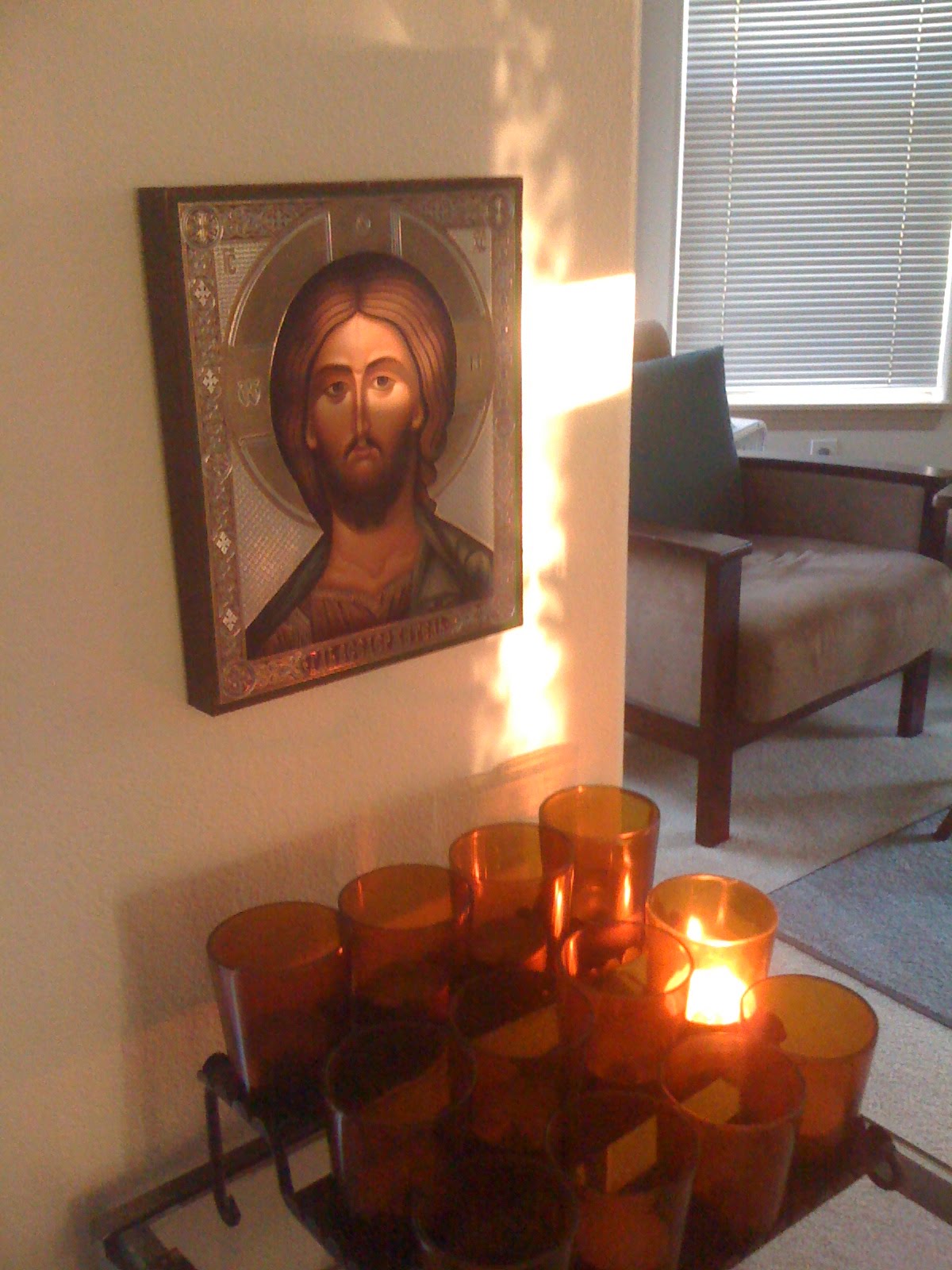
The image above was taken tonight with my iPhone as the brilliant mid-summer sunset light streamed through the blinds in the kitchen and struck this icon in this rather unique way...what comes to mind is the Phos hilaron, one of the most ancient hymns of the church, traditionally sung/recited at the beginning of vespers or evening prayer:

O gracious Light,
pure brightness of the everliving Father in heaven,
O Jesus Christ, holy and blessed!

Now as we come to the setting of the sun,
and our eyes behold the vesper light,
we sing your praises, O God: Father, Son, and Holy Spirit.

You are worthy at all times to be praised by happy voices,
O Son of God, O Giver of life,
and to be glorified through all the worlds.

Today was interesting. I am the chair of the board of directors of the Oregon chapter of the Episcopal Church's outreach ministry to GLBT people, and today we had a much needed, long overdue board retreat. It wasn't a full-on retreat in the best sense of the word, but we spent a good six hours sequestered away in the basement of a suburban parish working out together what we think our mission is going to be in the coming year and some concrete strategies for doing that. It was a very inspiring afternoon. It's a really incredible, interesting, diverse group of people that God has brought together for this special ministry in this time and place. O God, you manifest in your servants the signs of your presence, says the BCP in one of the collects for mission at evening prayer.

The lectionary for today was interesting, as well.

The Saul-David-Solomon saga is only read during the season after Pentecost in Year 1, so once every other year. Yesterday's lesson, the last chapter of 1 Samuel, told of the deaths of Saul and his sons. Today, with the beginning of 2 Samuel, David is given the tragic news, and tomorrow he will sing "The Song of the Bow," his epic lament, in which he proclaims that his love for Jonathan surpassed his love for women. I find that a hard verse for the fundies to explain away; try as they might to dismiss it as poetic hyperbole, don't you agree that it's a very strange choice of words, of all the possible ways he might find to describe his friendship with Jonathan? "I love you more than I love women...no homo!" just doesn't seem to be credible...

Sigh...there's more I could say, but it was a long day with full on mental investment, and I'm fried. So I'll just leave it there. : )

Thursday, July 21, 2011

Proper 11, Thursday, Year 1

Mark 5:1-20

I have vague memories from Sunday school at the Lutheran Church where I was brought up of a video of the story of the demons that were cast into the herd of swine; I remember the image of pigs tumbling down an embankment into water, and I remember thinking that was pretty hilarious and strange.

Today, however, I find this story one of the most beautiful, moving, compassionate and terrifying segments in all of the Gospels.

So, last we talked about Jesus, he and the disciples were crossing the Sea of Galilee when a terrible storm arose and threatened to sink the boat and drown the passengers. Jesus calmed the winds and the waves, and the disciples were terrified.

Now they come at last to the far shore, and immediately they encounter a naked lunatic. This has to be one of the scariest images in the Bible, especially in the New Testament (outside of the Revelation): a naked man who lives in the hills among the tombs, howling incoherently, so violent and strong that he cannot even be chained down, for he rips the fetters apart, and he cuts himself with stones.

Do you believe in demonic possession?

For my part...yes, at least I think so. But there is also the reality of mental illness, and I think it's entirely possible that conditions which are diagnosable today would have been inscrutable in the first century and, not unreasonably, attributed to demons. Today I think maybe the opposite is true, that possession is often considered merely mental illness. I do not think they are the same thing, but they probably share many external characteristics.

My heart breaks reading about this man. For some reason, the image I have is of a young, strong adult who, if he weren't filthy and deranged, would be considered exceedingly attractive. He's bright, he's sensitive, and he's deeply troubled. He cuts himself with stones! And people are frightened by him.

I certainly get that. Having lived in Manhattan for many years, and now back in Portland which has a famously large street population, I've certainly beheld many people suffering from mental illness, and it can be very scary; it's that level of unpredictability and the knowledge/fear that you can't necessarily reason with them.

For me, the most terrifying part is when Jesus asks "the unclean spirit" what his name is, and the response comes, "My name is Legion; for we are many." It's the stuff of cheap horror movies, and yet I just...I can't quite articulate it. I really believe it. It raises the hair on my neck.

There is also a very deliberate political subversion happening here. A "legion," of course, was the basic unit of the Roman military; Rome was the violent occupier of Palestine and the empire that murdered the Christ. Scholars tend to think that the author of "Mark," whatever his (her?) name really was, was a follower of Peter (also murdered by Romans, in Rome), and the Gospel may even have been written in Rome. This is loaded and rich language, associating the demonic possession of a human with political and military occupation.

So, the demons negotiate a deal with Jesus to be cast into the swine, the herd of pigs leap into the sea and drown, and the man becomes his old self again.

Then what happens? Then people came to see what it was that had happened....and saw the demoniac sitting there, clothed and in his right mind, the very man who had had the legion; and they were afraid.

Once again, we are shown how people witness the healing and saving power of God in spectacular fashion, and their response is not joy or comfort, but fear.

Wednesday, July 20, 2011

Proper 11, Wednesday, Year 1 - Elizabeth Cady Stanton, Amelia Bloomer, Sojourner Truth & Harriet Ross Tubman

Mark 4:35-41

Alas, I don't have much to say about the amazing women who are remembered in the calendar today, other than just how proud I am to be part of a church that recognizes their contributions to our modern world and honors them with a regular religious observance.

Instead, I have another reflection on the value of reading multiple translations of the Bible. Today's Gospel passage is the familiar story, found in all three synoptic Gospels, of Jesus and the disciples crossing the Sea of Galilee in a boat, only to have a terrible storm arise, threatening to swamp the boat and drown them. Jesus is asleep in the back of the boat, and the apostles wake him in terror and cry, "Do you not care that we are perishing?"

Jesus "rebukes" the wind and says to the sea, "Peace, be still." The wind dies down and the sea becomes calm, and Jesus says, "Why are you afraid? Have you still no faith?"

The reader, of course, has the benefit of knowing who it is in the boat with them and, also, of not being in a small, fragile craft in the middle of a tempest. It's easy for us to scoff and think, "Pfft, they were with Jesus, really...what did they think could happen?"

But from their perspective, they were on the verge of imminent and unpleasant death, and their leader was not only not concerned or trying to help, he was asleep. It's not so strange that they were panicking.

The lesson for us is that Jesus asks us to trust that even now, right now, Jesus is in that boat with us. And yet, do we live our lives like that? How many of us have confidence to weather the storms, as the metaphor goes, without anxiety? That's hard, because to us it often does seem that perhaps Jesus is asleep or not paying attention; we need help, we want assurance of safety, and we want it right now. The Bible asks us to believe that we do have it, right now and always. "Have you still no faith?"

Note, however, the disciples' collective response to this miracle.

The King James Version has Jesus ask, "Why are ye so fearful? how is it that ye have no faith?"

And they feared exceedingly, and said one to another, What manner of man is this, that even the wind and the sea obey him?

Beautiful. Why are ye so fearful?....And they feared exceedingly. So typical, right? It doesn't seem to matter how often God comes to our rescue in life, or how spectacularly obvious the intervention is, we cling to our fear. In this case, the miracle not only didn't inspire faith and confidence in the disciples, they became more afraid.

The language here matters, and this seems to be yet another occasion when the KJV, for all its shortcomings, strikes closer to the original Greek, which can be translated, "And they feared a great fear." "Fear" is the important word, we are to note that "fear" is the response to "why are you afraid"?

The NRSV, however, phrases it, "And they were filled with great awe." No!

I understand the editors' desire in many places to use "awe" instead of "fear" because this common phrase "fear of the Lord" doesn't make much sense in the context of God's repeated invitation, "Fear not." Awe, not fear, is the appropriate response in the presence of the Divine.

But the disciples do not respond appropriately; they are not filled with holy awe at the miracle they have just seen, they are filled with fear. That matters for the meaning of the story.

Tuesday, July 19, 2011

Proper 11, Tuesday, Year 1 - St Macrina

1 Samuel 25:1-22

I have mentioned before that for this two-year lectionary cycle I am studying with the King James Version. This evening I was reading along, following a typically awful Old Testament-style story of betrayal and bloodshed in 1 Samuel (the chapter which begins, by the way, with the death of Samuel...even though there are five more chapters to go, plus 2nd Samuel) but was taken aback when I got to the last verse of the lesson where David is praying to God for assistance in avenging an insult by slaughtering a bunch of innocent people, vowing by morning to have killed "any that pisseth against the wall."

Come again? LOL.

Curious, I turned to the other translations on my shelf (the NRSV, the NIV and the NKJV), all of which instead simply (and preferably...) refer to "men" or "males."

I Googled the phrase, and while admitting it's not like I spent hours of research on this, it does appear that in fact the King James has the more literal rendering of a Hebrew idiom for "men." (The phrase "that pisseth against the wall" appears in the KJV a second time in 1 Samuel 25, and in four verses of 1 & 2 Kings.)

But what really blew my mind was a video that came up of a Baptist pastor citing these verses to insist that God wants men to pee standing up. I won't link to it, you can find it yourself, if you're of a mind.

He relates a story about visiting Germany and seeing signs over toilets asking men not to pee standing up, and, explaining that his wife is German, he asked her, "Is this a joke?" and she apparently said, "No man in Germany pees standing up." "That's where we're headed in this country," says Pastor Steven L. Anderson.

Where to start?

I lived in Switzerland for a year and have visited Germany a couple of times. I lived in a university dorm in Zurich and, yes, there were signs over the toilets in the restrooms saying that peeing standing up was verboten. Now, this isn't because Switzerland has been taken over by anti-Christian feminist zealots, it's because, well, some men have really terrible aim, and no one likes to have to wipe someone else's pee off a toilet seat before using it. Duh. It's called etiquette.

But the idea that there is some sort of Teutonic cultural prohibition against urinating in a vertical position on principle is ridiculous. Any public restroom -- especially in train stations, etc -- will have urinals. In fact, in Switzerland, where the German dialects are sprinkled with French words, the common name for a men's restroom is a pissoir, where there's not a toilet in sight, and not even individual urinals, but just one long porcelain wall (!!!) with a drain at the bottom.

Moreover, "Sitzpinkler" -- which literally means "one who sits to pee" -- is a very common German derogatory word for a less-than-manly man, specifically one who can't stand up for himself.

Anyway, this has nothing to do with poor St Macrina, whose feast unhappily coincides this year with this particular lesson, and who deserves a better post.

Pastor Anderson goes on to caution his listeners against judging him for using bad language by arguing that this word "pisseth" comes directly from the mouth of God, via the Bible. He rails against other translations, including the New King James, for rendering the euphemism as "males" instead of keeping the word-for-word idiom, and cites this as evidence of the extent to which anti-Christian feminizing political correctness has infested even the church itself, in what basically amounts to a xenophobic, sexist, homophobic rant where a holy concept of "masculinity" can be so narrowly defined as to require certain orthodox, patriotic postures for peeing.

I lament that this is the sort of sermon that gets regularly posted to YouTube, and this is what has the potential to go viral. When I think of the hundreds or even thousands of thoughtful sermons that must be given in all kinds of churches every Sunday, to think this is the sort of pathetic nonsense that will form or reaffirm some people's ideas about Christianity and the Bible, I am filled with anger and despair.

Sunday, July 17, 2011

Ezekiel Goes to a Funeral

So that post on Psalm 51 I've been kicking around in my head never got written. Another time, maybe.

The Gospel lesson appointed for the Office today (Matthew 25:14-30, Proper 11, Year 1) is the Parable of the Talents, where the guy goes off and leaves three of his servants with various amounts of money, each according to their abilities, and when he comes back he is full of praise for the two who invested the money and made interest, and furious with the one who buried it in the dirt and returned the original amount. That's another passage I just don't really get. Something really troubles me about the third servant, who accuses the lord of being 'harsh' and reaping what he hadn't sown and gathering what he had not planted, and the vitriolic response of the master -- "You wicked and lazy slave" -- seems to indicate that maybe he was on to something. I Googled the parable and looked for commentaries to help, but it seems the consensus really is that the traveling master is understood to represent Christ and that the third servant is duly punished for not doing something with the gift he was given. It still doesn't sit right with me, though, and I am unsatisfied. So that's all I can say about that.

This afternoon I went to the funeral of a beloved teacher from high school, who had also been a good friend and colleague of my parents. The funeral was at a Foursquare church, where apparently he was very active, and within the confines of my own ignorance and prejudice and snobbishness I am still trying to reconcile the memories I have of this very free-thinking, well-educated, objective, progressive person (who gave no hint that I ever picked up on that he was remotely spiritual) with the discovery that he was active in a Pentecostal community.

I confess to some ambivalence about going, not really sure what the worship experience would be like there, and wondering what kind of strange ideas, cheap theology and corny music I might hear. I thought fondly of Ouiser in Steel Magnolias, who declines to visit Annelle's church because "they'd probably make me eat a live chicken," to which Annelle responds, "Not on your first visit." But my mother needed to go, and I was more than willing, out of respect for this great man.

Well, it definitely wasn't an Anglican rite. But as the pastor got up to speak about the importance of community and God's healing power even and especially in times of great pain and bewilderment, I just had this sense that we really were talking about the same God. And then, suddenly, I heard that "still, small voice," and what came into my mind was a phrase from Ezekiel: "I will remove from your body the heart of stone and give you a heart of flesh," and I cried through the rest of the service.

Thursday, July 07, 2011

Maybe Less Discipline is Good Discipline

Oh, dear, I have really fallen off the disciplinary wagon.

I attempted to write something last week for the Feast of Saints Peter & Paul, one of my favorites, but it was rambling and obvious, so it has been condemned to the purgatory of "drafts" and will no doubt remain there.

I might have had something to say yesterday commemorating the death of Thomas More, who was executed by Henry VIII for exercising his conscience and refusing to support the political separation of the Church of England from Rome. He is venerated as a martyr by the Roman church on June 22 (unclear why) and by the Church of England on July 6, the anniversary of his execution. Though the Episcopal Church in the United States is busily adding to the calendar what seems to be hundreds of people small and great who in some noteworthy way or other played a role in church history, Sir Thomas has yet to be nominated, an omission I find very strange in the context of new additions such as John Calvin. So although there is no official Episcopalian observance for Thomas More, I write him into the calendar myself and keep the day by watching the classic film A Man for All Seasons. (One week earlier I kept Saints Peter & Paul by watching the extraordinary Quo Vadis, which is campy and overwrought but magnificent). (For the record, I also write in my own observances for Gandhi and the Buddha, whom I am certain were saints who in fact preached the Gospel, even if not in the name of Christ.)

In general, my "daily office" discipline has been pretty weak. I think it's less about the health of my faith life than it is a symptom or symbol of my general state lately: I'm tired. I've worked incredibly hard the last few months both professionally and on volunteer projects, and I am needing a break from responsibility and commitments, more flexibility, more fun and more me-centered time.

For these two weeks in July, I have even set aside the BCP completely as there are no feasts in the calendar to observe. Instead, I have two Franciscan prayer books, one focusing on St Clare and another on Francis himself, which each contain a week's worth of morning and evening prayer liturgies. They are shorter and simpler than what I normally do, but I think that's a good boundary to stretch, as well. I use the readings provided therein, which are chosen for thematic relevance, rather than keeping the lectionary.

Even though the simplified liturgy means I can get through the office in 10 or 15 minutes, rather then 30-45, I'm still finding the structure burdensome, though I trust it is beneficial. My mind seems permanently elsewhere. I am reading, but not comprehending, looking, but not seeing.

This isn't to say that I'm not thinking about God these days. I am, and quite frequently. I am feeling rather unsettled -- or, perhaps, too settled -- and it reminds me of how I was feeling about five years ago back in New York when I had this great sense that what I was doing wasn't working and that a big change was needed. That change ended up being leaving everything behind in New York and starting over from scratch with a new life, new friends, new job and new community in Portland.

In hindsight, the change was absolutely the right one, for many reasons. I do truly feel that I had opened myself up to discernment, to listening to that 'still, small voice,' and was called back to Portland at an important time. Now I feel restless. I don't know whether this is leading me on to yet another city and another life, or whether it's change on a less dramatic scale. I think frequently about moving to another part of town, but the pro/con analysis always keeps me where I am. (For now.)

The other thing that is going on seems to be that I am possibly emerging from many years of emotional and romantic isolation. The Christian ethos I have been raised with trains me to seek one partner with which to make a committed relationship and to be abstinent otherwise, and so, in the absence of a partner all these long years, I have been...lonely, shall we say. But in my meditations in recent months (especially in Lent) I have had a great deal of focus on sex and sensuality and relationship, and as I enter tentatively back into the "dating world," part of me remains unclear whether I even want a relationship. I am sensing that the church's historic sexophobia is wrong and damaging, and yet also feel certain that there is a higher standard to which Christians are called for their intimate behavior.

The Bible doesn't anywhere condemn sex, or sexual pleasure, or sex for the sake of pleasure. That thinking is a product of the middle ages, a legacy of St Augustine's over-compensation for his own admitted debauchery and a mistaken assumption that "original sin" has something to do with sex. This got codified in Aquinas' ideas about natural law, and got us to the persisting religious argument that sex is for procreation, and only within the bonds of male/female Christian marriage; any sex that is not procreative in intent or capacity is sinful, and even procreative sex is understood to be sinful if the participants enjoy themselves. This cannot be what God intended.

Obviously this is the subject for a post of its own...many posts, probably. I concede the Bible repeatedly condemns fornication and adultery, but I think those are specific abuses of sexual behavior, not sex in general that is being condemned. Somehow I was raised with a very traditional, sex-negative religious outlook, and I think that has kept me emotionally and spiritually retarded in many ways. I have a sense that God is calling me to a healthier physical life. We'll have to see.

Monday, June 06, 2011

Monday in Week 7 of Easter, Year 1

Luke 9:51-62

Today's Gospel passage contains a fascinating episode highlighting the importance of understanding what you're reading by knowing something about historical and cultural contexts and the history of biblical texts themselves.

The lesson opens with the beautiful phrase, "When the days drew near for [Jesus] to be taken up, he set his face to go to Jerusalem," a unique Semitic idiom expressing resolve. Jesus spent the majority of his ministry in rural areas around the Sea of Galilee, and so from this point the story proceeds both geographically and spiritually toward his destiny in Jerusalem, marking a significant shift in the narrative.

In order to reach Jerusalem from Galilee one had to pass through Samaria; Samaritans revered a version of the Torah and considered themselves the true descendants of the ancient Israelites, objecting to the temple worship in Jerusalem as a fabrication invented after the Babylonian exile. Naturally, tremendous tension existed between Jews and Samaritans (a recurring theme in the gospels), and the Samaritans were not inclined to be hospitable to Jews traveling to Jerusalem.

That, then, is the important background for understanding why Jesus was not "received" by the Samaritans. The brothers James and John - the Gospel of Mark tells us Jesus referred to them as boanerges, or "sons of thunder" in Aramaic - react to this affront by asking if they should "command fire to come down from heaven and consume them," referencing one of the tales of Elijah told in 2 Kings. In the New Revised Standard Version (NRSV), the preferred text of the Episcopal Church, Jesus "turned and rebuked them."

However, for this lectionary cycle I am reading from the Authorized, or "King James" version (KJV), in honor of the 400th anniversary of its publication. Whatever its scholarly or linguistic shortcomings compared to modern translations, it remains one of the greatest achievements in the English language and, for better or worse, is the source of the Biblical texts that most people recognize or can quote.

This is one of those occasions for which it is instructive to read multiple translations. Whereas Jesus "rebuked them," full stop, in the NRSV, the KJV says Jesus "turned, and rebuked them, and said, Ye know not what manner of spirit ye are of. For the Son of man is not come to destroy men's lives, but to save them." (The NRSV puts this language in a footnote, "Other ancient authorities read...".) I would be interested to know why the editors feel the shorter text is the more authentic; presumably it has to do with the preponderance of manuscripts deemed more reliable.

We could wade deep into the weeds beating our heads against the proverbial wall at the idiotic intransigence of the folk who insist the Bible is the inerrant "Word of God," period, when the simple truth is that we have none of the original texts and the surviving manuscripts - case in point - do not always agree. Alas, it's a tired and unoriginal complaint, and one not remotely compelling or successful with the "inerrant" crowd. Criticizing fundamentalists for their lack of academic rigor is truly shooting fish in a barrel. Hooray for us contemplative eggheads who are interested in these sorts of complexities.

What caught my attention here is that the KJV is oft betimes the preferred translation of the fundamentalists, kind of in the same way that for centuries the Vulgate was the only permissible version of the Bible, even though not a single word of the original texts was in Latin. The NRSV indicates that Jesus rejected James and John's suggestion, but does not provide any further explanation. The KJV, on the other hand, has Jesus dismissing the invocation of divine violence against sinners and saying, "Ye know not what manner of spirit ye are of," implying that what James and John think is righteous is actually demonic. This is, sadly, one of the things that is least understood about the Devil; we are not enticed to do "evil" things, we just become confused. Little wonder that the serpent tempted us with the fruit of the tree of Knowledge of Good and Evil, that we might become like God. One of the Enemy's most successful strategies - sadly illustrated by centuries of church history - is suggesting to us and thereby convincing us that acts of dire evil are actually God's will. And this power of darkness is not merely aimed at those who are weak in faith or poor in theology; this is James and John, for goodness' sake. That should be a warning to us all.

What makes the story even more interesting is that this is not some random idea the brothers came up with; they are inspired by the story of Elijah, who in fact did successfully call down fire from heaven against a hostile army. There is, so to speak, biblical precedent for their suggestion.

Jesus then goes on to say that he did not come to destroy men's lives, but to save them.

Do you ever get the feeling that folks like Pat Robertson would just love to call down divine fire on people who believe different things than he does? Bible, Bible, Bible...that's all a lot of these "Christian" extremists can talk about, and yet their referencing of it is so selective as to be comical, if it weren't so painfully serious. You can, like James and John, find plenty of Biblical support for praying for violence against sinners or enemies; the psalms are full of imprecations. But here's Jesus saying bluntly, "That's not what I'm about." And still we get "Christians" referencing Psalm 109 - "Let his days be few; and let another take his office. Let his children be fatherless and his wife a widow" - on anti-Obama t-shirts and bumper stickers. In fact, much of the Evangelical culture is built around this heretical and unbiblical notion that Jesus is coming back precisely in order to rain fire down upon the unorthodox and the unbelievers.

The only way to arrive at such a sick notion is to rip various verses from the Bible free of their important contexts, and string them together in a way in which they were not intended to be associated, and you have to completely ignore or deny a bunch of other passages.

As the saying goes, you can take the Bible literally, or you can take it seriously. You can't do both.

Saturday, May 28, 2011

Saturday in Week 5 of Easter, Year 1

Psalm 27; Luke 9:1-17

The calendar notes that the General Convention of The Episcopal Church in 2009 proposed that this day be set aside for the regular liturgical commemoration of John Calvin, which suggestion will be presented for ratification in 2012. I have to say: I don't get it. Admittedly any student of theology and Christian history ought to know who he is and generally what he was about, but I find this a very odd celebration for Episcopalians. His focus on predestination and the quasi-Augustinian notion of the complete and total depravity of humankind is somewhat alien to the usual Episcopalian view of things.

* * * * *

I had originally written a much longer introduction here, and decided to file that under "TMI."

CliffsNotes version: I am the diocesan organizer in Oregon for Integrity, the national advocacy and outreach organization for gay, lesbian, bisexual and transgender Episcopalians. Three weeks from tomorrow is the Portland Pride Parade, and for the first time in history, our diocesan bishop will be marching with us. We have also (I think...) successfully coordinated the participation of all the gay-friendly parishes in the metro area so that we march as one group.

By themselves, these should be sufficient cause for jubilation. But that's not how my mind works.

For one thing, though the bishop will be just a few blocks away, celebrating the mass at Trinity Cathedral in NW Portland (Pride is on Trinity Sunday this year), the parade starts at noon. We strategically registered late, hoping for a spot toward the back to give the bishop reasonable travel time after the Eucharist, but it's still going to be a close call. I'm already hyperventilating about that.

Second, last year's turnout (I blame the weather) was not inspirational. But this year we have the bishop. (Assuming he gets there.)

Third, we don't have a booth at the waterfront festival this time, and that's my fault. I assumed the registration deadline was a lot later than it was. Oooops. We're on the waiting list, but I think it's too late. Even if a spot opened up, how would we coordinate two days' worth of volunteer shifts on such short notice?

Fourth, I'm struggling to feel like our work is generating much if any interest beyond a tiny dedicated core, and even that has recently fractured somewhat, with the sudden resignation of one of our board members. Given that and various other scheduling conflicts that have arisen, only one other board member can attend our June meeting. Arrrghghgh.

Ooooookay. Breathe in. Breathe out. Repeat.

Recently - I forget exactly where, alas - I read that when you reach a point where you can't do anything else, you should rejoice, because that means God has taken the matter out of your hands. There's a part of me that believes that, part of me that wants to trust that, and another part that wants to dismiss it as cheap Hallmarky quasi-religious schlock for the hopelessly naive.

So then we come to tonight's readings for the office. Maybe they haven't anything really to say about the underlying issues of sexuality and inclusion and equality and all that, but they do speak to the question of anxiety.

Psalm 27 is all about anxiety.

There's tons to say here about the various forms of cheap grace, as Dietrich Bonhoeffer termed it, that people ascribe to the Bible and Christianity, about the ways in which faith protects us. But this can be very dangerous thinking, leading to arrogance if our lives are presently comfortable and blessed, thinking we have earned it; leading to contempt, if we similarly look on the unfortunate and imagine if they only had our faith and our virtues they wouldn't be in that mess; or leading to guilt in thinking we have deserved our adversity. The Bible doesn't teach or promise that nothing bad will ever happen to you if you just believe the right things; the right thing to believe is that you needn't fear the bad things that may happen to you. All shall be well.

The psalmist here spends a lot of time thinking about unpleasant possibilities. Maybe evildoers will assemble against me and devour my flesh. False witnesses arise and "breathe out" violence. None of that sounds good. But in the end he advises, "Wait for the Lord; be strong, and let your heart take courage; wait for the Lord!"

Well, easier said than done. But faith is an active thing. Being strong is not about never being afraid. Being faithful is not about never doubting. From fear and doubt come strength and faith. And what's this about waiting? I want my resolution now! I want to know that everything is going to work out!

Well, it is going to work out. Maybe not in the way you'd imagined or hoped; and that's not to say there will never be pain or heartbreak. But so, so many times I look back on worries that I had or fears that I nurtured and see that they were wasted time and energy. Of course, in the moment, it's difficult. Faith isn't about being dismissive of negative possibilities, it's about hanging in there when the outcome appears bleakest. Think of the Israelites backed up against the Red Sea with Pharaoh's host charging them; all the signs and miracles that they had already witnessed didn't even come to mind, they just thought they were going to die, and this pattern repeats itself throughout the story of the Exodus. No matter how many times and how spectacularly God comes to our rescue, the next time we worry.

The Gospel passage for today is relatively long and tells two stories; one about Jesus sending the apostles out on a mission of healing (with a kind of odd interjection about King Herod), and concluding with one of the great miracle stories, the feeding of the five thousand.

I once heard in a sermon the interesting idea that the miracle Luke is talking about here isn't that two fish and five loaves of bread were somehow enough to feed five thousand with leftovers. One way of looking at the story is seeing it as a parable of anxiety: there isn't enough. Imagine everyone there has a fish, or two fish, and a loaf of bread or two. But they look around and they see all these hungry people, and they think to themselves that, as much as they might wish to help, they can't, because then there won't be enough to meet their own needs, let alone those of their 4,999 neighbors. But as soon as someone has the courage to share something from their meager lot, it inspires similar acts of confidence and generosity. And before you know it, not only was there enough, it turned out to have been this tremendous feast, and there wasn't any reason for anyone to have worried in the first place. It's a miracle of trust, not of multiplication.

Breathe in, breathe out. Repeat.

So now I look back on my worries about the parade challenges. I will wait, and I will trust in the Lord. I will not think about the time and the money and the things and the people and the resources I wish I had, I will trust that not only do I already have them, I have more than I need.

Amen.

Starting Again?

It's been over two years since I wrote anything for this blog; it's kind of amazing I even remembered the password!

So, why am I here? What brings me back?

I have gotten into a fairly regular discipline of keeping the "Daily Office," the practice of setting aside regular times for prayer and contemplation, using the liturgies and lectionary (a two-year cycle of daily Bible readings) of The Book of Common Prayer (BCP) of The Episcopal Church. It's a tradition that has its origins in the monastic life of the ancient church, also known as the "liturgy of the hours."

Of course, the monks said prayers about every three hours, beginning at midnight with matins, then at 3 a.m. with lauds, 6 a.m. for prime, 9 a.m. for terce, noon for sext, 3 p.m. for none, 6 p.m. for vespers and concluding at 9 p.m. for compline. Obviously this is not really practical in the context of a modern, secular life, but the BCP simplifies and consolidates it into Morning Prayer, Noontime Prayer (which is very brief), Evening Prayer and Compline.

Often, given the realities of daily life, I only manage to fit in one session, usually Evening Prayer, because that seems to be the time of day I feel at my most contemplative, and as I grow older I'm less and less of a "morning person." It is a rare day when I don't get around to it at all, and I make it a point to keep Morning and Evening Prayer and Compline (right before bedtime) during Advent and Lent.

Why do I do this?

There are many reasons, actually, and it's kind of hard to articulate some of them. For one thing, I have just fallen in love with liturgy; it appeals to my passion for structure, and I feel a deep resonance with the wisdom of the ancient church. I love that I open to the lectionary pages at the back and see, "Okay, here are the psalms appointed for this morning, and here are the lessons." I like that the lectionary forces me to read parts of the Bible I might otherwise ignore, and I like the way it is organized thematically by the seasons of the church year. I like that there's even a recommended schedule for canticles ("songs" or poems from scripture, especially Isaiah, Revelation and Luke) that are said or sung or chanted after the lessons. Thursday evening? Okay, the canticle after Old Testament lesson is the Surge illuminare. (And yeah, I like that canticles and psalms are still often identified by their Latin titles.) Sunday morning? The Benedictus Dominus...unless it's Lent, in which case it's the Kyrie Pantokrator, or Easter, when it's the Cantemus domino. I like these "rules" -- I like in such and such a season, you "must" do or say this, or in such and such a season, you "must" not.

I put "must" in quotes because I'm not under any illusion that God gives a flying one if we say "alleluia" during Lent. Still, I believe that the Holy Spirit has spoken powerfully to the church over the centuries, inspiring the development of these practices, and that following them carefully teaches us many important things that God wants us to know.

I've even created my own rules to complicate things further; at certain times I light candles and burn incense; at other times, I do not. Some days I use recordings I have collected of the psalms, canticles and ancient chants of the church; some days I do not. Most of the time I just read the Office, but sometimes I chant the whole thing, and sometimes I read it silently. Sometimes it's hard to concentrate (especially on those "silent" days), sometimes I don't feel like chanting, sometimes my mind wanders somewhere very far afield while listening to a hymn...and sometimes the experience is completely transcendent. The lectionary has this effect on me, too: some passages I read and think, "Oh, that's nice," and sometimes my honest reaction is, "What the fuck?" (You have to be honest with God, and frankly, putting the Bible down in exasperation and saying in a loud voice, "WHAT???!?!?" is a good discipline.) And still other times, I am amazed that the given passage for the day seems to speak directly to present matters; sometimes I am reassured and comforted, sometimes I am inspired, and sometimes severely chastised. This is what keeps me coming back, those hoped for but often unanticipated moments of wonder and illumination. In a way I am glad they only happen occasionally, because otherwise they might not be so special. One has to keep that in mind on the days when keeping the Office feels like a chore.

OK. So...why go back to the blog?

Well, the Office should be the means to an end (prayer), not the end itself. It should help you get started in this conversation with God. There are many beautiful prayers in the BCP: thumb through the collects or the list in the back and be reminded of all the many things we can and should be praying for, articulated in language that is more eloquent than most of us could hope to come up with. And yet, too often, I let the BCP speak for me. Too often I search the pages for a prayer that seems to encapsulate what I'm trying to say. Now, that's not all bad; in fact, that's what it's for. But at the same time, I feel a need to work harder to discern what I need to say to God and, thereby, open myself to what God has to say back.

I also want to go deeper into my contemplation of scripture. I want to force myself to address those "wtf" passages and see if I can't find something there; I want to explore the things that leap off the page and excite me.

What I am not here to do is "preach." This isn't a sermon blog, though perhaps it will sometimes read that way. My goal here is not to tell you what you should be praying for, or what a passage of scripture should mean for you. It won't help me much to be reading the Bible in the light of what I imagine you need to hear.

So why blog? Why not just keep a private journal?

Well, again: discipline. Writing for an "audience" will force me to be as concise and accurate in my meditations as possible, and will discourage intellectual laziness (I hope). I want to be open, also, to the opportunity for various readers, such as may exist, to share their own insights or offer suggestions for alternative understandings. And maybe I can form a sort of online "monastic community," where a few of us can share our meditations together, and pray for each other.

This will be a different way of blogging for me. I won't be posting much about things going on in my life, except from a spiritual perspective. I think Facebook takes care of that particular need now. I also will not be focusing on politics; I think our political culture today is positively toxic, and it is physically unhealthy for me to spend much energy there. However, I may be unable to resist the temptation to address certain political events or questions as they arise in the context of spiritual contemplation, especially in the case of political figures who play the Bible card to advance an un-Biblical argument.

I used to have a nice core of regular readers; I imagine they are all gone now. I've probably been deleted from their blogrolls and RSS feeds due to my inactivity, and that's okay. If any of you happen to still be around, say "Hi." : )

Monday, March 30, 2009

In Which I Take Hillary Clinton's Side

Okay, so lately, I confess I have been on a personal journey learning more about the saints and exploring Christian mysticism and having some remarkable experiences of my own...but on the other hand, let's get real.

"The image of Our Lady of Guadalupe was miraculously imprinted by Mary on the tilma, or cloak, of St. Juan Diego in 1531."

And the pope is infallible and condoms spread HIV.