In which our hero explores the wilds of New Jersey by bus.
Alternately titled, I Ain't No Holla-nd Tunnel Girl
So, I made it to work today. I realized I could take a New Jersey Transit bus from the Manhattan side of the George Washington Bridge to Hoboken, and then connect to the PATH train for the World Trade Center. It only cost $5.50 and took two hours.
I'm not sure how crowded the #181 bus heading into New Jersey is at 6:49 a.m. normally is, but it was jam-packed this morning; thankfully I had a seat. There were several other downtown-bound New Yorkers, some of whom were openly muttering about doing this three days in a row. These weren't suited-up executives, they were clearly people who needed every cent in their paycheck, and they have no alternative to leaving an hour earlier than normal, getting home an hour later, and paying $11 a day for the pleasure, presumably on top of what they earlier paid for a MetroCard they can't use right now.
Speaking of MetroCards, when I was researching my itinerary yesterday I was delighted to discover that MetroCards with dollar amounts (as opposed to unlimited ride cards) could be used for PATH train fares. As part of that idiotic "holiday fare" promotion, participants in the TransitChek program received "complimentary" MetroCards worth $10. When it first came in the mail, I thought, "What the hell is this? I have a pre-paid MetroCard that never expires, what am I going to do with this?" I had decided to use it as a Christmas present for a very special someone (*gasp* "A MetroCard, oh, Andy, you shouldn't have!!!") but couldn't find anyone special, so it was still sitting on my desk. "Aha!" I thought, "I can use it for the train today."
Well, it was a lovely idea, but it didn't work. I fed the card into the turnstile, and a big red light lit up, "INVALID CARD." Thank you, MTA. Of course because I couldn't go through I created a pile-up in the line of commuters behind me. They had two vending machines, one of which was broken, so I gave up and went through the cash line since I had change. The fare is $1.50, and naturally I had deposited $1.25, but the fucking thing wouldn't take my last quarter. I kept putting it in and it would fall through to the change bin. "Please deposit $.25," the display read. I even changed quarters. The leviathanesque queue behind me was lengthening and growling. Finally it went through. I turned back and saw it was doing it to the next person, too, so I felt vindicated.
Anyone want a $10 MetroCard?
I really don't want to do that again.
Of course it beat my boss's trip in yesterday. He walked up to Riverdale in The Bronx, took a MetroNorth train to Grand Central Station, walked 10 blocks to the PATH train station, then left Manhattan and went to Hoboken and came back on the WTC train. This shit's B-A-N-A-N-A-S.
I've already come up with a variation for the trip home. The accountant lives in Hoboken, so we're going to take the ferry right outside the office and then have a drink or two to fortify me for the long, slow bus ride back to Manhattan.
What kind of messed up commute from one end of an island to another involves two buses, a train and a boat via a detour to another state?
Thursday, December 22, 2005


Wednesday, December 21, 2005
Forcing a Broken System to Work
Roger Toussaint, the leader of the local chapter of the transit workers union, claims we should support the striking workers because they are taking a stand against the trend of forcing workers to pay higher and higher shares of the cost of healthcare coverage and other benefits.
It's true that America has a healthcare crisis. Over 40 million Americans are uninsured; many of them are children. But insurance itself is frequently insufficient. In 2003, Americans filed for personal bankruptcy in record numbers.
More than half of those bankruptcies were due to medical debt. Worse, seventy-five percent of the people drowning in medical debt had insurance.
There are a number of reasons why the costs of healthcare are rising and lots of blame to spread around. But these conversations are secondary to the trillion-dollar gorilla waiting in the emergency room: the system is broken.
The practice of tying insurance to employment simply has to end. Covering the cost of insurance for employees is proving prohibitively expensive even for enormous corporations who can buy bulk coverage; for smaller companies, the challenge is even worse. The burden is increasingly shifted to employees, in the forms of payroll deductions, higher deductibles and more exempted services. (This also profoundly impacts the quality of care, as what insurance companies will pay for tends to determine course of treatment, rather than the doctor's recommendation.)
Most Americans are actually quite healthy; it's a tiny minority of chronically ill people who make up the vast portion of medical expense. Therein lies one potential solution that deserves closer scrutiny.
Conservatives decry universal healthcare, preferring to rely on market forces and competition to keep quality high and costs low. But we see clearly this isn't working well. Government-run universal coverage smacks of socialism to them; and even saner people worry about trusting our healthcare to government incompetence and exposing it to rank politicization.
One answer would be to create a government agency that pays for catastrophic and long-term chronic care. If insurance companies didn't have to come up with money for risky surgeries, trauma, expensive drug therapy, and long-term care, it would dramatically reduce the cost of private insurance, to the point that employer-sponsored care would once again become reasonably affordable. Then we could expand the pool of insured people, meaning that more people could get to the doctor regularly, which would make us healthier and decrease the pool of people needing that more expensive care.
We should all oppose the trend of forcing Americans to pay more and more for their own healthcare. But the only effective way to achieve change is to recognize the system is hopelessly broken and get a different one.
Roger Toussaint has taken the City of New York hostage to force the MTA to pay even more money into a broken, expensive, inefficient system, thereby exacerbating the problem. By doing this, he's not only not standing up for the quality of care for all Americans, he's punishing the poorest New Yorkers, many of whom don't even have insurance, by preventing them from getting to work, losing desperately needed income and perhaps even their jobs.
It's true that America has a healthcare crisis. Over 40 million Americans are uninsured; many of them are children. But insurance itself is frequently insufficient. In 2003, Americans filed for personal bankruptcy in record numbers.
More than half of those bankruptcies were due to medical debt. Worse, seventy-five percent of the people drowning in medical debt had insurance.
There are a number of reasons why the costs of healthcare are rising and lots of blame to spread around. But these conversations are secondary to the trillion-dollar gorilla waiting in the emergency room: the system is broken.
The practice of tying insurance to employment simply has to end. Covering the cost of insurance for employees is proving prohibitively expensive even for enormous corporations who can buy bulk coverage; for smaller companies, the challenge is even worse. The burden is increasingly shifted to employees, in the forms of payroll deductions, higher deductibles and more exempted services. (This also profoundly impacts the quality of care, as what insurance companies will pay for tends to determine course of treatment, rather than the doctor's recommendation.)
Most Americans are actually quite healthy; it's a tiny minority of chronically ill people who make up the vast portion of medical expense. Therein lies one potential solution that deserves closer scrutiny.
Conservatives decry universal healthcare, preferring to rely on market forces and competition to keep quality high and costs low. But we see clearly this isn't working well. Government-run universal coverage smacks of socialism to them; and even saner people worry about trusting our healthcare to government incompetence and exposing it to rank politicization.
One answer would be to create a government agency that pays for catastrophic and long-term chronic care. If insurance companies didn't have to come up with money for risky surgeries, trauma, expensive drug therapy, and long-term care, it would dramatically reduce the cost of private insurance, to the point that employer-sponsored care would once again become reasonably affordable. Then we could expand the pool of insured people, meaning that more people could get to the doctor regularly, which would make us healthier and decrease the pool of people needing that more expensive care.
We should all oppose the trend of forcing Americans to pay more and more for their own healthcare. But the only effective way to achieve change is to recognize the system is hopelessly broken and get a different one.
Roger Toussaint has taken the City of New York hostage to force the MTA to pay even more money into a broken, expensive, inefficient system, thereby exacerbating the problem. By doing this, he's not only not standing up for the quality of care for all Americans, he's punishing the poorest New Yorkers, many of whom don't even have insurance, by preventing them from getting to work, losing desperately needed income and perhaps even their jobs.
Tuesday, December 20, 2005
It Wasn't All Bad
I could get used to this "working at home" thing.
Okay, the problem is, I'm not sure I can convince my bosses that enough of my job can actually be done from home. I'm not sure because I'm not sure I believe it myself. Still, I gave it the old college try today. I have been checking my voicemail and returning phone calls, responding to emails, and I redesigned our company's travel expense report form.
I also did two loads of laundry and enjoyed a whiskey soda after my lunch break. (Hey, creating spreadsheet templates is hard work!)
The best part was sleeping in until 9 a.m. and still being ontime for work.
The worst part was running into Joan in the laundry room. Her grasp of reality is increasingly tenuous, I'm afraid. While we both agreed the union has no business striking (trust me, I didn't bring it up!), she went on to defend the MTA...which is indefensible. She called union leader Roger Toussaint "that goddamned frenchman," and referred to the workers as "greedy pigs who should either be grateful to live in a country where they have a job or they should go back to where they came from." Always a pleasure talking with you, Joan.
Well, I think I've been exceptionally productive under the circumstances. I think I'm going to allow myself to cut out early today.
Okay, the problem is, I'm not sure I can convince my bosses that enough of my job can actually be done from home. I'm not sure because I'm not sure I believe it myself. Still, I gave it the old college try today. I have been checking my voicemail and returning phone calls, responding to emails, and I redesigned our company's travel expense report form.
I also did two loads of laundry and enjoyed a whiskey soda after my lunch break. (Hey, creating spreadsheet templates is hard work!)
The best part was sleeping in until 9 a.m. and still being ontime for work.
The worst part was running into Joan in the laundry room. Her grasp of reality is increasingly tenuous, I'm afraid. While we both agreed the union has no business striking (trust me, I didn't bring it up!), she went on to defend the MTA...which is indefensible. She called union leader Roger Toussaint "that goddamned frenchman," and referred to the workers as "greedy pigs who should either be grateful to live in a country where they have a job or they should go back to where they came from." Always a pleasure talking with you, Joan.
Well, I think I've been exceptionally productive under the circumstances. I think I'm going to allow myself to cut out early today.
Monday, December 19, 2005
Search for Signs of Intelligent Life in the Cyberverse
Yesterday afternoon...
BigTool4U: Hey stud, what u lookin 4
SweetInnocentMe: Someone to go to dinner with.
BigTool4U: at 2:30 in the afternoon?
BigTool4U: thats wierd
BigTool4U: Hey stud, what u lookin 4
SweetInnocentMe: Someone to go to dinner with.
BigTool4U: at 2:30 in the afternoon?
BigTool4U: thats wierd
Sunday, December 18, 2005
The Narnia Inside
A couple of years ago while I was struggling with acid reflux and watching the life and career I'd worked so hard to build for myself disappear before I knew it was gone, my desperation to heal led me to some wacked-out alternative medicine types.
I visited one woman who worked out of her apartment in the East Village. She works with energies, and such. I lay on a table and she moved her hands over my body for quite a long time, trying to determine if I had a blockage or something somewhere that was causing my physical distress.
After about an hour she said, "Well, I really can't find anything wrong with you, except," and here she held her hands directly over my heart, "right here, there just seems to be a big, cold hole."
I know.
I visited one woman who worked out of her apartment in the East Village. She works with energies, and such. I lay on a table and she moved her hands over my body for quite a long time, trying to determine if I had a blockage or something somewhere that was causing my physical distress.
After about an hour she said, "Well, I really can't find anything wrong with you, except," and here she held her hands directly over my heart, "right here, there just seems to be a big, cold hole."
I know.
Overheard in New York
The lobby of the Ziegfeld Theater, following The Producers.
Queer #1: So, where are we going?
Queer #2: Someplace where it's okay that I'm wearing corduroy pants.
Queer #3: The 70s?
Queer #2: The Eagle it is.
Queer #1: So, where are we going?
Queer #2: Someplace where it's okay that I'm wearing corduroy pants.
Queer #3: The 70s?
Queer #2: The Eagle it is.
Friday, December 16, 2005
Strike the Strike
That I am a liberal has, I hope, been clearly established. I am, for the record, pro-union (at least I support the concept that workers have a right to organize to protest unfair treatment), and in the interest of full disclosure, I am a former union member.
But the present dispute between the Transit Workers' Union and the MTA in New York City is utter nonsense.
In New York State, it is against the law for public employees to strike, and for good reason. New York is unique among American cities, in that its residents rely on public transportation to an extent that approaches exclusivity. For millions of New Yorkers, there is no alternate mode of getting around.
New Yorkers have no love for the MTA. Increased fares resulting in decreased service, the decrepit condition of many subway stations (especially in less-affluent neighborhoods) and the ease with which even a minor fire can throw the entire system into chaos for hours, not to mention the budgets shrouded in secrecy, are all issues that keep us grumbling. We especially loved how the MTA decided to "deal" with its billion dollar surplus this year, after pleading "Pending deficit crisis!" for as long as we can remember, by introducing special half-price "holiday fares" on weekends between Thanksgiving and New Year's. Most New Yorkers pay for their rides in advance using monthly MetroCards, so cut fares on weekends benefit only tourists and the B&T crowd who come in to shop, not the system's regular riders.
But just because the MTA is monstrous doesn't mean we have sympathy for the employees, either. NYC Transit employees are often surly, unintelligible and altogether unhelpful. Customer service is absolutely appalling. Sure, they have a right to press for higher pay and better benefits. This is America, after all. Yay, capitalism! I mean that. But the transit workers really don't have it that bad. The average worker's salary is almost twice mine, and the MTA is now asking them to contribute a paltry 1% (down from the initial 2%) toward the cost of health insurance, which is still a far better deal than most Americans get. The main sticking point seems to be whether employees can retire with full pension at 55, as the union demands, or whether new workers can be asked to work until the age of 62.
It's a fair question, and worthy of debate. But is it worth grabbing the innocent citizens of New York by the balls and holding them hostage?
When a private company's employees strike, it results in a financial impact for the employer, because it stops productivity. It creates a negative image in the public eye, which drives consumers both out of necessity and concern to competitors.
But the MTA has no competitors. "Thank you for riding with the MTA," train conductors often say at the conclusion of a service announcement. As if we have a choice! Furthermore, the MTA already has my money. Through my job, I participate in the TransitChek program, which means the money for my subway fares is automatically deducted from my paycheck. I can halt the deduction, sure, but it takes weeks to process and weeks to re-instate. So if the trains and buses aren't running, I'm paying for a system I can't use. A transit worker strike has a negative financial impact on the innocent customers, and not on the Authority.
I work in the human resources department of my organization. Let me tell you, planning for this potential strike has eaten up hours of our time, trying to determine which employees could reasonably be expected to make it to work on foot or by other means, and how we would function in a limited capacity. My job has nothing to do with public transit or these union negotations, but the mere threat of a strike has mandated that we drop all the other things we're doing and prepare.
The strike in 1980 lasted eleven days. No one is anticipating that this time around, but, as watching the Bush administration has taught us repeatedly, one should hope for the best while planning for the worst. Without divulging confidential conversations, I can say that the question has been raised whether our company has to pay employees who can't come to work. After all, the strike would not be the company's fault. So yes, my paycheck deductions for transit would continue, while I get docked for being unable to get here. (I live 13.5 miles from my office.)
MTA employees have every right to try to get the best deal for themselves, but they have no right to punish me while they do it.
But the present dispute between the Transit Workers' Union and the MTA in New York City is utter nonsense.
In New York State, it is against the law for public employees to strike, and for good reason. New York is unique among American cities, in that its residents rely on public transportation to an extent that approaches exclusivity. For millions of New Yorkers, there is no alternate mode of getting around.
New Yorkers have no love for the MTA. Increased fares resulting in decreased service, the decrepit condition of many subway stations (especially in less-affluent neighborhoods) and the ease with which even a minor fire can throw the entire system into chaos for hours, not to mention the budgets shrouded in secrecy, are all issues that keep us grumbling. We especially loved how the MTA decided to "deal" with its billion dollar surplus this year, after pleading "Pending deficit crisis!" for as long as we can remember, by introducing special half-price "holiday fares" on weekends between Thanksgiving and New Year's. Most New Yorkers pay for their rides in advance using monthly MetroCards, so cut fares on weekends benefit only tourists and the B&T crowd who come in to shop, not the system's regular riders.
But just because the MTA is monstrous doesn't mean we have sympathy for the employees, either. NYC Transit employees are often surly, unintelligible and altogether unhelpful. Customer service is absolutely appalling. Sure, they have a right to press for higher pay and better benefits. This is America, after all. Yay, capitalism! I mean that. But the transit workers really don't have it that bad. The average worker's salary is almost twice mine, and the MTA is now asking them to contribute a paltry 1% (down from the initial 2%) toward the cost of health insurance, which is still a far better deal than most Americans get. The main sticking point seems to be whether employees can retire with full pension at 55, as the union demands, or whether new workers can be asked to work until the age of 62.
It's a fair question, and worthy of debate. But is it worth grabbing the innocent citizens of New York by the balls and holding them hostage?
When a private company's employees strike, it results in a financial impact for the employer, because it stops productivity. It creates a negative image in the public eye, which drives consumers both out of necessity and concern to competitors.
But the MTA has no competitors. "Thank you for riding with the MTA," train conductors often say at the conclusion of a service announcement. As if we have a choice! Furthermore, the MTA already has my money. Through my job, I participate in the TransitChek program, which means the money for my subway fares is automatically deducted from my paycheck. I can halt the deduction, sure, but it takes weeks to process and weeks to re-instate. So if the trains and buses aren't running, I'm paying for a system I can't use. A transit worker strike has a negative financial impact on the innocent customers, and not on the Authority.
I work in the human resources department of my organization. Let me tell you, planning for this potential strike has eaten up hours of our time, trying to determine which employees could reasonably be expected to make it to work on foot or by other means, and how we would function in a limited capacity. My job has nothing to do with public transit or these union negotations, but the mere threat of a strike has mandated that we drop all the other things we're doing and prepare.
The strike in 1980 lasted eleven days. No one is anticipating that this time around, but, as watching the Bush administration has taught us repeatedly, one should hope for the best while planning for the worst. Without divulging confidential conversations, I can say that the question has been raised whether our company has to pay employees who can't come to work. After all, the strike would not be the company's fault. So yes, my paycheck deductions for transit would continue, while I get docked for being unable to get here. (I live 13.5 miles from my office.)
MTA employees have every right to try to get the best deal for themselves, but they have no right to punish me while they do it.
Wednesday, December 14, 2005
The Trouble with Allegories
"To enjoy reading about fairies -- much more about giants and dragons -- it is not necessary to believe in them," wrote C.S. Lewis, the author of The Chronicles of Narnia. "Belief is at best irrelevant; it may be a positive disadvantage."
Lewis is one of the 20th century's best-known Christian apologists, and his seven-book series about the land of Narnia is suffused with Christian symbols and references. But does that mean that the Narnia books are "Christian" works? And does it matter?
In The Lion, the Witch and the Wardrobe, which opened this past weekend in movie form, the character of the lion Aslan, innocent of any crime, agrees to be put to death in the place of a child who has betrayed his own siblings. He is executed, but comes back to life, and leads the residents of Narnia in a successful revolt against the evil witch who has held them all captive in a century-long winter. It's a clear reference to the crucifixion and resurrection of Christ. Or is it?
The British writer Philip Pullman calls the books "propaganda in the cause of the religion [Lewis] believed in." Yet in almost all of the articles appearing concurrently with the new film's opening, one adult writer after the next confesses that when they first read the books as a child, the religious references completely escaped them. As Meghan O'Rourke wrote in Slate, "Millions of kids have read The Chronicles of Narnia for 50 years without detecting their religious underpinnings largely because the moral lessons of the Narnia books are extricable from their spiritual ones."
And yet, Jessica Seigel writes in The New York Times, "My mother recently remarked that if she'd known the stories were Christian, she wouldn't have given me the books -- which are among my dearest childhood memories." Why?
O'Rourke explains, "Judging the Narnia books solely by their Christianity is an impoverished way of reading them. It is a reflection more of our polarized moment -- in which a perceived cultural divide has alienated Christians from secular culture and secular readers from anything that smacks of religious leanings -- than of the relative aesthetic merits and weaknesses of Lewis' books."
The books suffer from having an allegorical reputation. An allegory is "a literary device in which each literal character, object and event represents symbols illustrating an idea or moral or religious principle." Animal Farm is an allegory; Narnia, despite the allegorical nature of Aslan and certain plot elements, is not. "Indeed," argues Lauren Winner in Beliefnet, "Lewis never liked to call the Chronicles "allegory," with the term's implication that every last animal, tree and chair was simply a cipher, standing in for some specific thing in the Bible."
This approach is similar to that of Lewis' close friend and Oxford colleague J.R.R. Tolkien -- incidentally the man principally responsible for Lewis' conversion from atheism -- who wrote in the foreward to The Fellowship of the Ring, "I think that many confuse "applicability" with "allegory"; but the one resides in the freedom of the reader, and the other in the purposed domination of the author."
Therein lies much of the problem: the freedom of the reader also allows him to claim to detect intentions of the author that might not be there. Kris Rasmussen, also in Beliefnet, confesses, "I am all in favor of pointing people to what is good, pure and true; pointing them -- not beating them over the head with it. My biggest fear is that in an overzealous attempt to use "Narnia" as some kind of special marketing tool, churches will deny others, who may not agree with a Christian interpretation of the story, their chance to discover for themselves the depth of meaning(s) in the tale."
A third Beliefnet columnist, Richard Mouw, states, "C.S. Lewis warned us not to read too much Christian theology into the stories of Narnia....But I do hope it will serve as an invitation for many people to reflect on the nature of the world in which we live. [It] is a good thing to be encouraged to go beyond the superficial, exploring not only the Deeper Magic, but also the other below-the-surface forces that drive our lives, even when we do not acknowledge their existence: our Deeper Hopes and our Deeper Fears -- those Deeper Yearnings that we ignore only at the expense of our humanness."
Lewis is one of the 20th century's best-known Christian apologists, and his seven-book series about the land of Narnia is suffused with Christian symbols and references. But does that mean that the Narnia books are "Christian" works? And does it matter?
In The Lion, the Witch and the Wardrobe, which opened this past weekend in movie form, the character of the lion Aslan, innocent of any crime, agrees to be put to death in the place of a child who has betrayed his own siblings. He is executed, but comes back to life, and leads the residents of Narnia in a successful revolt against the evil witch who has held them all captive in a century-long winter. It's a clear reference to the crucifixion and resurrection of Christ. Or is it?
The British writer Philip Pullman calls the books "propaganda in the cause of the religion [Lewis] believed in." Yet in almost all of the articles appearing concurrently with the new film's opening, one adult writer after the next confesses that when they first read the books as a child, the religious references completely escaped them. As Meghan O'Rourke wrote in Slate, "Millions of kids have read The Chronicles of Narnia for 50 years without detecting their religious underpinnings largely because the moral lessons of the Narnia books are extricable from their spiritual ones."
And yet, Jessica Seigel writes in The New York Times, "My mother recently remarked that if she'd known the stories were Christian, she wouldn't have given me the books -- which are among my dearest childhood memories." Why?
O'Rourke explains, "Judging the Narnia books solely by their Christianity is an impoverished way of reading them. It is a reflection more of our polarized moment -- in which a perceived cultural divide has alienated Christians from secular culture and secular readers from anything that smacks of religious leanings -- than of the relative aesthetic merits and weaknesses of Lewis' books."
The books suffer from having an allegorical reputation. An allegory is "a literary device in which each literal character, object and event represents symbols illustrating an idea or moral or religious principle." Animal Farm is an allegory; Narnia, despite the allegorical nature of Aslan and certain plot elements, is not. "Indeed," argues Lauren Winner in Beliefnet, "Lewis never liked to call the Chronicles "allegory," with the term's implication that every last animal, tree and chair was simply a cipher, standing in for some specific thing in the Bible."
This approach is similar to that of Lewis' close friend and Oxford colleague J.R.R. Tolkien -- incidentally the man principally responsible for Lewis' conversion from atheism -- who wrote in the foreward to The Fellowship of the Ring, "I think that many confuse "applicability" with "allegory"; but the one resides in the freedom of the reader, and the other in the purposed domination of the author."
Therein lies much of the problem: the freedom of the reader also allows him to claim to detect intentions of the author that might not be there. Kris Rasmussen, also in Beliefnet, confesses, "I am all in favor of pointing people to what is good, pure and true; pointing them -- not beating them over the head with it. My biggest fear is that in an overzealous attempt to use "Narnia" as some kind of special marketing tool, churches will deny others, who may not agree with a Christian interpretation of the story, their chance to discover for themselves the depth of meaning(s) in the tale."
A third Beliefnet columnist, Richard Mouw, states, "C.S. Lewis warned us not to read too much Christian theology into the stories of Narnia....But I do hope it will serve as an invitation for many people to reflect on the nature of the world in which we live. [It] is a good thing to be encouraged to go beyond the superficial, exploring not only the Deeper Magic, but also the other below-the-surface forces that drive our lives, even when we do not acknowledge their existence: our Deeper Hopes and our Deeper Fears -- those Deeper Yearnings that we ignore only at the expense of our humanness."
Monday, December 12, 2005
I'm It
Well, I got tagged by Jess.
Five Simple Pleasures:
Five Simple Pleasures:
- This past Saturday, a bright, gleaming, frigidly clear winter day, I found myself with nothing to do so I took my iPod to Central Park and walked all the way around the drive, which takes me about 2.5 hours, or 36 songs. My iPod, with 4006 songs, reflects my exceptionally eclectic taste in music, but nothing suited Central Park in the snow better than Miles Davis' "Sweet Pea."
- Aquariums, any aquarium. I've visited the ones in Seattle, Newport, OR, San Francisco, Monterey, Denver, Chicago, Brooklyn, Mystic, London, Brighton, Paris and Honolulu.
- A scalding hot bath with a Ravi Shankar raga playing in the light of a single candle.
- A hug, from anyone.
- When a dog smiles at you.
Hmm, to continue this, I tag Jean, Little-Cicero, Jeff, Courtney and Tony.
One Weekend, Two Movies
In 2004, the media, especially Frank Rich of The New York Times, made a big deal out of the way America's cultural and political divisions were represented by the audience demographics of two major films, The Passion of the Christ and Fahrenheit 9/11. I wonder if they will make the same comparisons about two films that opened this past weekend, Brokeback Mountain and The Lion, the Witch and the Wardrobe.
 Both movies had a lot of advance press, but I think in the case of the former it did the film a disservice. It is a very, very fine effort, but I'm not sure it quite lives up to the advance reputation that was built up for it. Beautifully filmed, Brokeback Mountain the movie is as much a love affair with the landscapes and lifestyles of the American West as it is about one particular human love affair. It is a quiet, spacious film that speaks loudest when no one is talking.
A supreme challenge for any actor is to portray a character who is fundamentally unable to express himself, and Heath Ledger is astounding as the quiet, restrained Ennis del Mar, a rather volcanic man who forces his burning, conflicted and angry emotions deep down but finds himself occasionally subject to brief, uncontrollable outbursts of passion. Jake Gyllenhaal is charming as the goofier, more laid-back, more emotionally in touch character. There was a comfortable ease between the actors, but I wasn't really convinced of a deep connection. "Love is a force of nature" is the film's tagline, but it lacked the uncontrollable bound-by-fate attraction of the Tristan and Isolde legend on which this story so clearly is modeled.
In supporting roles, Michelle Williams as Ennis' long-suffering wife took up her martyrdom heroically, chewing scenery in the grand tradition. Jack's disinterested wife Lureen was handled affably by Anne Hathaway, who unfortunately appeared to look younger with each successive change of hairstyle over the decades.
I think the gay community was so delighted by the prospect of seeing gay characters on screen doing something other than comic relief that we built up an expectation of cultural watershed status for this movie, but I don't see that in the cards. The hullaballoo had me waiting expectantly for a big emotional release that just doesn't come. That's not a criticism; Brokeback is the cinematic equivalent of blue-balls, but intentionally so. It's a very good movie, and several times I couldn't help thinking that if it weren't for the man-on-man assfucking, it's the kind of thing my dad would really like.
I first read The Lion, the Witch and the Wardrobe last month, in preparation for the movie version. I'd owned the books as a child, but never touched them, for whatever reason. Recently I've been reading the theological works of C.S. Lewis, including The Screwtape Letters and Mere Christianity, so I was curious to see how his Christian ideas played out in a story aimed at children. I was also worried that the film would take simple allegorical literary devices and turn them into propagandistic cudgels.
 I have much to say on the subject of the story itself, but for now I wanted to just report that I was completely delighted with the movie. As Meghan O'Rourke pointed out in her wonderful defense in Slate, Lewis wasn't concerned so much with plot as with mood, which is captured perfectly. The movie is only heavy-handed in places where Lewis himself let his imagination be hogtied by a desire to dogmatize, or, as O'Rourke put it, "where he let his didactic, expository, Anglican self get the better of the spell-caster within."
But make no mistake, a spell is cast through much of the movie. The four child actors portraying the Pevensie siblings are all superior, most especially the adorably sweet Georgie Henley as Lucy. Tilda Swinton is fabulously malevolent as Jadis, the White Witch, the kind of villain you love to hate. The biggest conceptual error was playing the professor as a kooky old man. When the children tell him about Lucy's tale of a kingdom within the wardrobe, you chalk up his defense of Lucy to his eccentricity. In the novel, however, the effect is much more jarring to have a rational man accept the possibility.
Though aimed at children, the messages resonate clearly for adults who are open to hearing them. The film does not flinch from depicting the violence of the book, though it does spare us unnecessary gore. For kicks, I checked out the review over at the American Family Association, which warns viewers that the movie "includes brief scenes of the Witch's cleavage and of the Professor smoking a pipe as well as what sounded like one use of the Lord's name in vain."
Where Brokeback examines the complex issues of sexual attraction and adult relationships and responsibilities, Chronicles of Narnia sticks to simpler, universal truths, but is perhaps the more powerful for it.
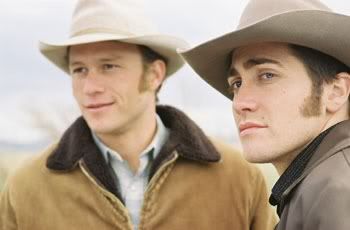 Both movies had a lot of advance press, but I think in the case of the former it did the film a disservice. It is a very, very fine effort, but I'm not sure it quite lives up to the advance reputation that was built up for it. Beautifully filmed, Brokeback Mountain the movie is as much a love affair with the landscapes and lifestyles of the American West as it is about one particular human love affair. It is a quiet, spacious film that speaks loudest when no one is talking.
A supreme challenge for any actor is to portray a character who is fundamentally unable to express himself, and Heath Ledger is astounding as the quiet, restrained Ennis del Mar, a rather volcanic man who forces his burning, conflicted and angry emotions deep down but finds himself occasionally subject to brief, uncontrollable outbursts of passion. Jake Gyllenhaal is charming as the goofier, more laid-back, more emotionally in touch character. There was a comfortable ease between the actors, but I wasn't really convinced of a deep connection. "Love is a force of nature" is the film's tagline, but it lacked the uncontrollable bound-by-fate attraction of the Tristan and Isolde legend on which this story so clearly is modeled.
In supporting roles, Michelle Williams as Ennis' long-suffering wife took up her martyrdom heroically, chewing scenery in the grand tradition. Jack's disinterested wife Lureen was handled affably by Anne Hathaway, who unfortunately appeared to look younger with each successive change of hairstyle over the decades.
I think the gay community was so delighted by the prospect of seeing gay characters on screen doing something other than comic relief that we built up an expectation of cultural watershed status for this movie, but I don't see that in the cards. The hullaballoo had me waiting expectantly for a big emotional release that just doesn't come. That's not a criticism; Brokeback is the cinematic equivalent of blue-balls, but intentionally so. It's a very good movie, and several times I couldn't help thinking that if it weren't for the man-on-man assfucking, it's the kind of thing my dad would really like.
I first read The Lion, the Witch and the Wardrobe last month, in preparation for the movie version. I'd owned the books as a child, but never touched them, for whatever reason. Recently I've been reading the theological works of C.S. Lewis, including The Screwtape Letters and Mere Christianity, so I was curious to see how his Christian ideas played out in a story aimed at children. I was also worried that the film would take simple allegorical literary devices and turn them into propagandistic cudgels.
 I have much to say on the subject of the story itself, but for now I wanted to just report that I was completely delighted with the movie. As Meghan O'Rourke pointed out in her wonderful defense in Slate, Lewis wasn't concerned so much with plot as with mood, which is captured perfectly. The movie is only heavy-handed in places where Lewis himself let his imagination be hogtied by a desire to dogmatize, or, as O'Rourke put it, "where he let his didactic, expository, Anglican self get the better of the spell-caster within."
But make no mistake, a spell is cast through much of the movie. The four child actors portraying the Pevensie siblings are all superior, most especially the adorably sweet Georgie Henley as Lucy. Tilda Swinton is fabulously malevolent as Jadis, the White Witch, the kind of villain you love to hate. The biggest conceptual error was playing the professor as a kooky old man. When the children tell him about Lucy's tale of a kingdom within the wardrobe, you chalk up his defense of Lucy to his eccentricity. In the novel, however, the effect is much more jarring to have a rational man accept the possibility.
Though aimed at children, the messages resonate clearly for adults who are open to hearing them. The film does not flinch from depicting the violence of the book, though it does spare us unnecessary gore. For kicks, I checked out the review over at the American Family Association, which warns viewers that the movie "includes brief scenes of the Witch's cleavage and of the Professor smoking a pipe as well as what sounded like one use of the Lord's name in vain."
Where Brokeback examines the complex issues of sexual attraction and adult relationships and responsibilities, Chronicles of Narnia sticks to simpler, universal truths, but is perhaps the more powerful for it.
Thursday, December 08, 2005
Words of Wisdom

I first discovered The Beatles in the late 1980s. We sublet a house in Berkeley, California for a summer while my stepfather participated in an advanced program for professional chemists at the University. It was a happy time for us; my stepfather was having a great time, and my mother, who had grown up in San Rafael, was happy to be back in the beautiful bay area. She had worked at the University for a time in the 60s, when she was first married to my dad, who was a student there.
The house was a wide, shallow multi-story cedar affair built into a steep slope way atop the Berkeley Hills, just one block below Grizzly Peak, a little to the south of Marin Avenue. I forget exactly what year it was, but I think I was about 12. At that age, I was pretty much a loner. When I wasn't out exploring the neighborhood, or surreptitiously taking the bus down to the BART station and sneaking into downtown San Francisco, I really didn't have anything to do.
The family that owned the house had a large record collection. I had heard of The Beatles, of course, but didn't know any of their music. (Despite having gone to Berkeley in the 60s, my dad was more of a Beethoven and Marty Robbins guy.) Who knows what possessed me, but I put on Sgt. Pepper's Lonely Hearts Club Band.
Little Madonna fan that I was, my first thought was that the music was corny and dated, but I kept listening. By the time the needle got to "Lucy," I was hooked. I listened to their whole collection.
I never bought any Beatles recordings for myself until many years later, when I was living in Zurich. Horribly depressed and miserably broke, I splurged on the anthology 1, which cost me more than an entire day's budget. While the tunes were all familiar, I'd never really listened to, or perhaps, connected with, the words before.
There was so much on my mind that year. I was poor, bored, lonely and angry. I felt betrayed by my circumstances there, which were so far short of what I'd hoped for that some days I contemplated just going to the airport and never looking back. My moods swung between barely contained rage and moments of such sadness that tears would spontaneously appear in my eyes. Most of the time I was just sullen. When I'd pray, I'd ask God, "Why?" over and over and over.
And then I'd listen to "Let it Be." To this day, I can't help but tear up when I hear this song, and remember the incredible comfort I took from it in desperate hours. No question, this song saved my life.
There will be an answer. Let it be, let it be.
Wednesday, December 07, 2005
Standards
Some of my friends tell me that the reason I don't date more is that I need to lower my standards. (Personally, I don't think it's about "standards" so much as the "kind" of guys I like don't really exist in New York, outside of straight bars. Actually, wait...that's a bigger problem. Sigh.)
That said, there are still some qualities that count as non-negotiable dealbreakers:
That said, there are still some qualities that count as non-negotiable dealbreakers:
- Voting for George Bush
- Liking the movie "The English Patient"
- Small dick (well, it's true)
Those are pretty much my standards. However, I have, like many credit card companies, decided to inform you that I am adopting a policy change. To the above list, I am adding one additional dealbreaker:
- Liking the song "My Humps"
I'm sorry, I can't relate to someone who enjoys a "song" that contains these lyrics:
I met a girl down at the disco.
She said hey, hey, hey yea let’s go
I could be your baby, you can be my honey
Lets spend time not money.
and mix your milk wit my cocoa puff,
Milky, milky cocoa,
Mix your milk with my cocoa puff, milky, milky riiiiiiight.
I'm never having cereal again.
Tuesday, December 06, 2005
The Parable of the Foreign-Born Heretic
 Having faith means having a conviction that your beliefs are correct. But does that necessarily mean that you must believe that other beliefs are false? Or can faith mean that you are open to finding truth and wisdom in traditions other than your own?
Everyone knows the story of the Good Samaritan. (If you don't, click here.) Unfortunately, many of us miss the real significance of the parable.
Most of us assume that the story is about the Christian virtue of helping strangers in need, which is definitely one important aspect. But the lesson is really about religious tolerance.
 Most of us think of the Samaritan as a "foreigner," but the historical Samaria was not very far at all from Jerusalem, centered around modern-day Nablus. Samaritans spoke Aramaic, the same language as Christ. So why then, is it important that a Samaritan plays the central role in this parable?
Because the mainstream Jews of Jesus' day considered Samaritans to be heretics. Samaritans believed in the Torah, but thought that the Jerusalem-based religion centered around Solomon's Temple was wrong; a rough approximation might be the difference between Mormonism and Protestantism. There was tremendous hostility between the two groups, and the Gospel of John tells us "Jews have no dealings with Samaritans."
And so not only did Jesus define the lawyer's "neighbor" as a traditional enemy, He held him up as an example of righteous behavior. The illustration could not have been more shocking had Jesus come today and told the same story to a group of American fundamentalists using a Wahhabi cleric in place of a Samaritan.
But this isn't the only Samaritan to appear in the Gospel of Luke. In Chapter 17, Jesus cures ten lepers, nine of whom go on their merry way after being healed. One of them stays behind, praising God: the Samaritan. Jesus says, pointedly, "Were not ten cleansed? Where are the nine? Was no one found to return and give praise to God except this foreigner?" And he said to him, "Rise and go your way; your faith has made you well."
There are two important lessons for modern Christians to draw here. The first, I believe, is a warning from Jesus not to assume the faith of people from other traditions is invalid because it differs from yours, and not to assume that your faith defines you as "moral" and by default makes everyone else "immoral."
The second is a lesson of context. Too many Christians insist upon the "literal" truth of the Bible, based upon their understanding of a modern translation of an ancient document without complementary historical, anthropological and linguistic contexts. In Jesus' day, the word "Samaritan" carried with it implications that by and large are lost today.
Monday, December 05, 2005
Sunday, December 04, 2005
When Best Laid Plans Go Felicitously Astray
So last night some friends and I had planned to go see Aeon Flux, since the Slate review said it "doesn't suck." It was exactly what I was in the mood for.
Unfortunately, JP and I arrived at the theater only to discover that it was sold out; worse, Mike and Derek ordered tickets in advance, so we were S.O.L. There was nothing else playing that we wanted to see. Fortunately, this being Times Square, there was another movie theater across the street. (There's a few more around the corner on Eighth Avenue, but JP and Jim and I didn't feel like seeing "Horny Teenage Sluts Take Palm Beach IV.") Because of time constraints and sold-out shows, we didn't have much choice. We settled on Walk the Line, the movie about Johnny Cash starring Joaquin Phoenix and Reese Witherspoon.
Johnny Cash is not a musician that has ever really captured my fancy, and I hadn't really intended on seeing this movie, but I am so glad we did. It was outstanding. I think Joaquin Phoenix is an underused, underrated actor, but on the other hand I'm glad he isn't over-exposed like so many.
He did a great job, but for me the real story was Witherspoon as June Carter. If that wasn't an Oscar-worthy performance, I don't know what is. She was astounding; phenomenal; charming; heartbreaking. It's one of those performances where the actor's emotions aren't merely contained within facial expressions and vocal inflections; somehow through the medium of film she leaps off the screen and grabs you and brings you along for the ride.
The Christian ethos of the film was quite striking. It would be too easy to have made June a cloying, dimwitted sap of a goody-two-shoes, contrasted against a background of wooden fundamentalist archetypes. In one scene, a perfect stranger confronts her in a store about her recent divorce and sternly lectures that "marriage is forever." Most people would probably respond by telling her off, saying it isn't any of her business and who is she to go around lecturing people when she doesn't know the first thing about them. Instead, June sadly responds, "I'm sorry I let you down." The nobility and humility of that moment was transcendant.
Later in the film, a record producer tries to discourage Cash from his plan to record an album live at Folsom Prison. "Your audience is Christian," he says. "They don't want to hear you singing songs to murderers and rapists trying to make them feel better." Cash retorts, "Then they ain't Christians."
In today's cultural climate, it was nice to see a movie that gets Christianity right. The overall theme was the recognition that humans aren't perfect, that temptation presents itself all too often and we succomb too easily, and yet no matter what we do or who we are, we never stand in a position to judge anyone else. It showed that to love someone takes work and sacrifice, and lots of forgiveness. It showed that Christianity is the embrace of the real, not a flight into denial.
Unfortunately, JP and I arrived at the theater only to discover that it was sold out; worse, Mike and Derek ordered tickets in advance, so we were S.O.L. There was nothing else playing that we wanted to see. Fortunately, this being Times Square, there was another movie theater across the street. (There's a few more around the corner on Eighth Avenue, but JP and Jim and I didn't feel like seeing "Horny Teenage Sluts Take Palm Beach IV.") Because of time constraints and sold-out shows, we didn't have much choice. We settled on Walk the Line, the movie about Johnny Cash starring Joaquin Phoenix and Reese Witherspoon.
Johnny Cash is not a musician that has ever really captured my fancy, and I hadn't really intended on seeing this movie, but I am so glad we did. It was outstanding. I think Joaquin Phoenix is an underused, underrated actor, but on the other hand I'm glad he isn't over-exposed like so many.
He did a great job, but for me the real story was Witherspoon as June Carter. If that wasn't an Oscar-worthy performance, I don't know what is. She was astounding; phenomenal; charming; heartbreaking. It's one of those performances where the actor's emotions aren't merely contained within facial expressions and vocal inflections; somehow through the medium of film she leaps off the screen and grabs you and brings you along for the ride.
The Christian ethos of the film was quite striking. It would be too easy to have made June a cloying, dimwitted sap of a goody-two-shoes, contrasted against a background of wooden fundamentalist archetypes. In one scene, a perfect stranger confronts her in a store about her recent divorce and sternly lectures that "marriage is forever." Most people would probably respond by telling her off, saying it isn't any of her business and who is she to go around lecturing people when she doesn't know the first thing about them. Instead, June sadly responds, "I'm sorry I let you down." The nobility and humility of that moment was transcendant.
Later in the film, a record producer tries to discourage Cash from his plan to record an album live at Folsom Prison. "Your audience is Christian," he says. "They don't want to hear you singing songs to murderers and rapists trying to make them feel better." Cash retorts, "Then they ain't Christians."
In today's cultural climate, it was nice to see a movie that gets Christianity right. The overall theme was the recognition that humans aren't perfect, that temptation presents itself all too often and we succomb too easily, and yet no matter what we do or who we are, we never stand in a position to judge anyone else. It showed that to love someone takes work and sacrifice, and lots of forgiveness. It showed that Christianity is the embrace of the real, not a flight into denial.
Friday, December 02, 2005
Don Wildmon and the Great Christmas Penis
 So, I'm on the American Family Association's email list.
Their latest email alert filled me with alarm: "Survey Proves Retailers Banning Christmas!"
Well, since I am a Christian, that is a cause for concern. I happen to like Christmas.
From the email they sent me:
Dear Andy,
I thought you would be interested in a survey we did. We gathered advertising inserts from 11 different companies placed in two papers on Nov. 27 (Northeast Mississippi Daily Journal and Memphis Commercial Appeal.)
Did they write this with a straight face? They looked at two minor newspapers published 100 miles apart from each other on one day and this is supposed to provide conclusive evidence of...anything? (Of course, this is the same organization that put a poll on its webpage and invited members to vote on whether they supported gay marriage or not; the page promised the results would be submitted to Congress. When the results didn't come out quite as they expected, they pulled it and declined to share the "findings" with the government.)
Okay, but let's give them the benefit of the doubt. Just because the research is, shall we say, scanty, doesn't mean it's inaccurate. If I see one raven and conclude all ravens are black, I might be lazy, but I'm still right. Maybe retailers really are banning Christmas!
Of the 11 companies, only one—McRae's/Belks—had a reference to "Christmas." They mentioned "Christmas" only two times. The other 10 companies did not mention "Christmas" a single time! While refusing to use "Christmas," they used the term "holiday" a total of 59 times in their 10 inserts.

So, I guess if you see an advertising insert decorated with twinkling stars, evergreen boughs, glass baubles, candles, stockings, candy canes, wreaths and other traditionally Christmasy trappings in a newspaper one month before Christmas but it doesn't say "Christmas" anywhere, you are looking at a concerted effort to ban Christmas. Got it. The fact that it says "holiday," even though Christmas is, in fact, a holiday, is a victory for Godlessness. And if you "only" mention Christmas twice, you just barely get a pass.
Ask these companies why they banned "Christmas" in their in-store promotions and retail advertising and they will tell you they didn't want to offend anyone. They mean, of course, anyone except Christians!
Ah, so by making the holiday season (d'oh, look, I just banned Christmas myself!) more inclusive, they're actually making it exclusive. The fact that Christmas is a "holiday" and they are wishing us "happy holidays" means that they hate us. Makes sense.
And of course even though James tells us, "Know this, my beloved brethren. Let every man be quick to hear, slow to speak, slow to anger, for the anger of man does not work the righteousness of God," it's time to get mad!
 Here's why: "According to [Chairman Don] Wildmon, supporters of his organization...are offended when retailers choose to promote the Christmas season without acknowledging it as such, choosing instead to remain 'politically correct' by marketing such things as 'holiday trees'."
Unfortunately for Don "Wildman" Wildmon, calling them "holiday trees" is actually closer to historical accuracy than political correctness (assuming there's a difference). Even the most cursory research shows that the tradition of using fir trees as decoration for winter holidays originated with pre-Christian European pagans, who venerated the trees as phallic symbols. Adopting the practice as part of the commemoration of Christ's birth is a relatively recent phenomenon; most believe it started in Germany in the 1600's.
But according to "ChristmasTree.com,"the custom spread slowly.
 The Puritans banned Christmas in New England. Even as late as 1851, a Cleveland minister nearly lost his job because he allowed a tree in his church. Schools in Boston stayed open on Christmas Day through 1870, and sometimes expelled students who stayed home. The Christmas tree market was born in 1851 when Catskill farmer Mark Carr hauled two ox sleds of evergreens into New York City and sold them all. By 1900, one in five American families had a Christmas tree, and 20 years later, the custom was nearly universal." The History Channel confirms this account.
You know, if December came and went without any commercial "holiday" music, if stores didn't bring in special decorations, and generally stayed open on the holiday itself, I might worry about an effort to "ban" Christmas. Instead what I see happening is an organization trying to pressure retailers into promoting one religion to the exclusion of others, based upon historically and theologically inaccurate arguments. To that I say, "Bah humbug!"
Wednesday, November 30, 2005
Best Date Ever
Recently I came across a book on how to be your own boyfriend. I didn't buy it, but it gave me an idea.
After work tonight I met myself for a cocktail.
I almost canceled, because by late this afternoon I started to feel that I hated my outfit, but nothing ventured is nothing gained. And you know, I'm really glad I went.
Today was payday, so I went ahead and bought the first round, and then I bought the second round, which I took as an encouraging sign.
Then I went to one of my favorite restaurants for dinner. I have really good taste in wine, which is a relief, because if I'd been a white wine drinker, that would have been a deal breaker. I paid for dinner because, well, to be honest, I was kind of hoping to guilt me into going home with me.
I have to say the dinner conversation was a bit awkward. I had to keep my voice down because I felt like people were staring at me. Why can't people just mind their own business?
After dinner I walked through Chelsea and browsed various boutiques for Christmas ornaments. I like that it didn't freak me out that I'm religious.
So then I asked if maybe...well, you know, I don't know, if I wasn't doing anything, maybe I'd like to come up to my place? As it so happened, I was going my way anyway, so I agreed.
I had a great time. I hadn't really been expecting company, but I very politely didn't mention the laundry on the floor or the sink full of dishes. As for the sex...well, a gentlman doesn't kiss and tell. But, I will say that I seemed to know exactly what I like.
I promised I'd come over tomorrow and help me with the laundry. I hope I'm not moving too fast.
After work tonight I met myself for a cocktail.
I almost canceled, because by late this afternoon I started to feel that I hated my outfit, but nothing ventured is nothing gained. And you know, I'm really glad I went.
Today was payday, so I went ahead and bought the first round, and then I bought the second round, which I took as an encouraging sign.
Then I went to one of my favorite restaurants for dinner. I have really good taste in wine, which is a relief, because if I'd been a white wine drinker, that would have been a deal breaker. I paid for dinner because, well, to be honest, I was kind of hoping to guilt me into going home with me.
I have to say the dinner conversation was a bit awkward. I had to keep my voice down because I felt like people were staring at me. Why can't people just mind their own business?
After dinner I walked through Chelsea and browsed various boutiques for Christmas ornaments. I like that it didn't freak me out that I'm religious.
So then I asked if maybe...well, you know, I don't know, if I wasn't doing anything, maybe I'd like to come up to my place? As it so happened, I was going my way anyway, so I agreed.
I had a great time. I hadn't really been expecting company, but I very politely didn't mention the laundry on the floor or the sink full of dishes. As for the sex...well, a gentlman doesn't kiss and tell. But, I will say that I seemed to know exactly what I like.
I promised I'd come over tomorrow and help me with the laundry. I hope I'm not moving too fast.
Tuesday, November 29, 2005
Disordered Objective
There is neither Jew nor Greek, there is neither slave nor free, there is neither male nor female; for you are all one in Christ Jesus.
-- Galatians 3:28
Certain literalists might look at that verse and notice that Paul did not include homosexuals; but neither did he include Chinese people, the disabled, Vikings or Republicans. Parsing this verse to see who is excluded is antithetical to the verse itself: "you are all one in Christ Jesus," without regard to ethnic or national identity, religion, social status or gender.
 Pope Benedict XVI seems to disagree, however. In 1992, as Cardinal Ratzinger, he wrote, "Sexual orientation does not constitute a quality comparable to race, ethnic background, etc., in respect to non-discrimination." (Archbishop Desmond Tutu, who knows something about racial discrimination, responded, "To make someone suffer penalties because of their sexual orientation is on the same level as making people be penalized for their gender, or race.") On this basis, the Vatican has changed its policy regarding gays in the priesthood.
Make no mistake: it is a change in policy. Conservative defenders of the Pope argue that the Church has long taught that homosexuality is "objectively disordered," but as celibacy is a requirement for priesthood, one's sexual orientation has generally been considered irrelevant. Now, however, celibacy is not enough. In the new document, Instruction Concerning the Criteria of Vocational Discernment Regarding Persons With Homosexual Tendencies, Rome argues that homosexuals "find themselves...in a situation that gravely obstructs a right way of relating with men and women."
A gay priest, writing under a pseudonym for Beliefnet, calls this statement "one of the most offensive things I have ever read in any church document about homosexuals. It says to gay men -- and by extension, celibate gay priests who have long been in the ministry -- that they are simply unable to relate to their fellow human beings. After years of dedicated service--after hearing confessions, baptizing infants, preparing people for marriage, sitting by the beds of the sick and dying, and counseling people in trouble--the gay priest is told he doesn't understand people and cannot relate to them."
In purely practical terms, banning even celibate gays from the priesthood is a risky move for Catholics, particularly here in the United States, and it's not clear that congregations understand the math. "If it's part of church doctrine, we'd be better off with 5 percent less priests," Travis Corcoran recently told The New York Times.
But it won't be 5 percent. Indeed, the number of Catholic priests in the U.S. shrank from 59,000 in 1965 to 43,000 today, even as the number of Catholics in the U.S. grew. One analysis predicts a further 45% decline over the next ten years. And by some estimates, 50% of Catholic seminarians are gay. Others predict that banning gays will reverse the trend, as heterosexuals flood back into the seminaries they had shunned.
Catholics shouldn't hold their breath.
 To defend this discriminatory purge in the name of addressing the Church's child abuse scandal is to propagate the same kinds of attitudes that brought about the abuse in the first place. Pedophiles abuse children; and, like the general population, the vast majority of people who sexually molest children are heterosexual. That most priest abuse cases involve boys has more to do with population access than sexual orientation.
The ban does not apply to priests who are already ordained and serving; if the Church perceives that homosexual priests, even celibate ones, pose such a threat to children, it does not make sense to grandfather them in. Indeed, Catholics who argue that there is such a thing as a moral absolute are at something of a loss to explain why an ordained gay priest already serving is not in violation of church doctrine but one who might be ordained tomorrow is.
"The only gay men who will enter will be either clueless, closeted, or lying," wrote the gay priest in Beliefnet. "This is a disastrous way to prepare men for healthy life as a priest, and gives rise to the very environment that everyone wanted to avoid: the repressed, fearful seminary where sexuality is a forbidden topic."
The Church's abuse scandal was not just the molestation, but the fact that complaints about priests were ignored and that they were often merely transferred to other parishes where they continued to abuse children. To stop this scandal, the Church should defrock pedophiles, not homosexuals.
 Fortunately, there is dissent within the Catholic ranks. "I have no doubt that God does call homosexuals to the priesthood, and they are among the most dedicated and impressive priests I have met,'' Father Timothy Radcliffe, former master of the Dominican order, told the Times.
"I resent the missed opportunity to welcome young men who are gay, but are put off," said an 80-year old Catholic woman in Massachusetts. "We may never know the good priests we have lost from this."
The Vatican, in a bid to uphold destructive traditions of discrimination, is relying upon centuries of secular prejudice to justify a policy, rather than the Gospel. As one gay priest asked, "Where, in the end, is the message of Jesus in this document?"
-- Galatians 3:28
Certain literalists might look at that verse and notice that Paul did not include homosexuals; but neither did he include Chinese people, the disabled, Vikings or Republicans. Parsing this verse to see who is excluded is antithetical to the verse itself: "you are all one in Christ Jesus," without regard to ethnic or national identity, religion, social status or gender.
 Pope Benedict XVI seems to disagree, however. In 1992, as Cardinal Ratzinger, he wrote, "Sexual orientation does not constitute a quality comparable to race, ethnic background, etc., in respect to non-discrimination." (Archbishop Desmond Tutu, who knows something about racial discrimination, responded, "To make someone suffer penalties because of their sexual orientation is on the same level as making people be penalized for their gender, or race.") On this basis, the Vatican has changed its policy regarding gays in the priesthood.
Make no mistake: it is a change in policy. Conservative defenders of the Pope argue that the Church has long taught that homosexuality is "objectively disordered," but as celibacy is a requirement for priesthood, one's sexual orientation has generally been considered irrelevant. Now, however, celibacy is not enough. In the new document, Instruction Concerning the Criteria of Vocational Discernment Regarding Persons With Homosexual Tendencies, Rome argues that homosexuals "find themselves...in a situation that gravely obstructs a right way of relating with men and women."
A gay priest, writing under a pseudonym for Beliefnet, calls this statement "one of the most offensive things I have ever read in any church document about homosexuals. It says to gay men -- and by extension, celibate gay priests who have long been in the ministry -- that they are simply unable to relate to their fellow human beings. After years of dedicated service--after hearing confessions, baptizing infants, preparing people for marriage, sitting by the beds of the sick and dying, and counseling people in trouble--the gay priest is told he doesn't understand people and cannot relate to them."
In purely practical terms, banning even celibate gays from the priesthood is a risky move for Catholics, particularly here in the United States, and it's not clear that congregations understand the math. "If it's part of church doctrine, we'd be better off with 5 percent less priests," Travis Corcoran recently told The New York Times.
But it won't be 5 percent. Indeed, the number of Catholic priests
 in the U.S. shrank from 59,000 in 1965 to 43,000 today, even as the number of Catholics in the U.S. grew. One analysis predicts a further 45% decline over the next ten years. And by some estimates, 50% of Catholic seminarians are gay. Others predict that banning gays will reverse the trend, as heterosexuals flood back into the seminaries they had shunned.
Catholics shouldn't hold their breath.
 To defend this discriminatory purge in the name of addressing the Church's child abuse scandal is to propagate the same kinds of attitudes that brought about the abuse in the first place. Pedophiles abuse children; and, like the general population, the vast majority of people who sexually molest children are heterosexual. That most priest abuse cases involve boys has more to do with population access than sexual orientation.
The ban does not apply to priests who are already ordained and serving; if the Church perceives that homosexual priests, even celibate ones, pose such a threat to children, it does not make sense to grandfather them in. Indeed, Catholics who argue that there is such a thing as a moral absolute are at something of a loss to explain why an ordained gay priest already serving is not in violation of church doctrine but one who might be ordained tomorrow is.
"The only gay men who will enter will be either clueless, closeted, or lying," wrote the gay priest in Beliefnet. "This is a disastrous way to prepare men for healthy life as a priest, and gives rise to the very environment that everyone wanted to avoid: the repressed, fearful seminary where sexuality is a forbidden topic."
The Church's abuse scandal was not just the molestation, but the fact that complaints about priests were ignored and that they were often merely transferred to other parishes where they continued to abuse children. To stop this scandal, the Church should defrock pedophiles, not homosexuals.
 Fortunately, there is dissent within the Catholic ranks. "I have no doubt that God does call homosexuals to the priesthood, and they are among the most dedicated and impressive priests I have met,'' Father Timothy Radcliffe, former master of the Dominican order, told the Times.
"I resent the missed opportunity to welcome young men who are gay, but are put off," said an 80-year old Catholic woman in Massachusetts. "We may never know the good priests we have lost from this."
The Vatican, in a bid to uphold destructive traditions of discrimination, is relying upon centuries of secular prejudice to justify a policy, rather than the Gospel. As one gay priest asked, "Where, in the end, is the message of Jesus in this document?"
Monday, November 28, 2005
Time Goes By...So Slowly
WOW is it quiet at work today.
I tried surfing for some new blogs to read by clicking the "next blog" button in the upper right corner, but almost everything I landed on was in Spanish, French, Portuguese, Dutch or Arabic. Either that, or it was "erotic literature," or worse, one of those conservative rant blogs with a ratio of 4 spelling errors per falsehood.
Why is it that pornographers can spell but Republicans can't?
Speaking of porn and spelling, that reminds me...
 My first summer out of high school, I had an internship with a repertory theater in Los Angeles that included both performing and crew responsibilities. I ran the follow-spot for The School for Wives, was a stagehand and an understudy for The Foreigner, and played Joe in Oklahoma (the one who buys Curly's gun in the auction).
Among the many valuable lessons I learned that summer, the one that always comes to mind first is not to spoof lines of the dialogue by changing a word or two to make it dirty. At the top of the second act, right before the bidding begins on the hampers, one farmer (or maybe it's a cowman, I can't recall) says, "I'm so hungry, I could eat a fencepost!"
The actor used to go around backstage saying, "I'm so horny I could fuck a fencepost!"
Well, one night we were out onstage and had just finished "The Farmer and the Cowman" (one man likes to ride a plow, the other likes to fuck a cow, but that's no reason why they can't be friends!) and sure enough, my fellow castmate says, "I'm so horny I could f--, uh, eat a fencepost!"
I feel that way right now.
I tried surfing for some new blogs to read by clicking the "next blog" button in the upper right corner, but almost everything I landed on was in Spanish, French, Portuguese, Dutch or Arabic. Either that, or it was "erotic literature," or worse, one of those conservative rant blogs with a ratio of 4 spelling errors per falsehood.
Why is it that pornographers can spell but Republicans can't?
Speaking of porn and spelling, that reminds me...
My first summer out of high school, I had an internship with a repertory theater in Los Angeles that included both performing and crew responsibilities. I ran the follow-spot for The School for Wives, was a stagehand and an understudy for The Foreigner, and played Joe in Oklahoma (the one who buys Curly's gun in the auction).Among the many valuable lessons I learned that summer, the one that always comes to mind first is not to spoof lines of the dialogue by changing a word or two to make it dirty. At the top of the second act, right before the bidding begins on the hampers, one farmer (or maybe it's a cowman, I can't recall) says, "I'm so hungry, I could eat a fencepost!"
The actor used to go around backstage saying, "I'm so horny I could fuck a fencepost!"
Well, one night we were out onstage and had just finished "The Farmer and the Cowman" (one man likes to ride a plow, the other likes to fuck a cow, but that's no reason why they can't be friends!) and sure enough, my fellow castmate says, "I'm so horny I could f--, uh, eat a fencepost!"
I feel that way right now.
The Problem With Lying
The problem with lying is that sometimes it is irrefutably proven that you have done so.
"I went to Congress with the same intelligence Congress saw -- the same intelligence I had, and they looked at exactly what I looked at, and they made an informed judgment based upon the information that I had."
-- George W. Bush, February 8, 2004
"The reason I keep insisting that there was a relationship between Iraq and Saddam and al Qaeda, because there was a relationship between Iraq and al Qaeda."
-- George W. Bush, June 17, 2004
"We learned more and more that there was a relationship between Iraq and al-Qaeda that stretched back through most of the decade of the ’90s, that it involved training, for example, on BW and CW, that al-Qaeda sent personnel to Baghdad to get trained on the systems that are involved. The Iraqis providing bomb-making expertise and advice to the al-Qaeda organization."
-- Dick Cheney, September 14, 2003
Oopsie.
"I went to Congress with the same intelligence Congress saw -- the same intelligence I had, and they looked at exactly what I looked at, and they made an informed judgment based upon the information that I had."
-- George W. Bush, February 8, 2004
"The reason I keep insisting that there was a relationship between Iraq and Saddam and al Qaeda, because there was a relationship between Iraq and al Qaeda."
-- George W. Bush, June 17, 2004
"We learned more and more that there was a relationship between Iraq and al-Qaeda that stretched back through most of the decade of the ’90s, that it involved training, for example, on BW and CW, that al-Qaeda sent personnel to Baghdad to get trained on the systems that are involved. The Iraqis providing bomb-making expertise and advice to the al-Qaeda organization."
-- Dick Cheney, September 14, 2003
Oopsie.
Sunday, November 27, 2005
You Know You're Gay When...
...you're stumbling back to the subway along 14th Street after partaking of the $8 Bud Lite blast at Splash listening to Carol Vaness sing "Come scoglio" on your iPod and hoping the next song will be Alfredo Kraus singing "De miei bollenti spiriti" but you're not disappointed when it turns out to be Madonna's "Bedtime Story."
*****
Me: Okay, so, if it's a flock of sheep and a school of fish, what's six homos walking down 8th Avenue?
Queer: A party.
*****
I had a wonderful Thanksgiving; of course I miss my family back in Oregon, and miss going out to the 100+ year old Victorian farmhouse in the middle of nowhere owned by family friends where we normally celebrate, but among the many, many blessings I'm thankful for this year was spending an amazing holiday with my best friends.
Most memorable moment: describing a certain guest who drove us all crazy, the host (who cooked up an absolutely delicious feast -- many, many thanks for all that work!), remarked, "His personality was excruciating."
*****
Me: Okay, so, if it's a flock of sheep and a school of fish, what's six homos walking down 8th Avenue?
Queer: A party.
*****
I had a wonderful Thanksgiving; of course I miss my family back in Oregon, and miss going out to the 100+ year old Victorian farmhouse in the middle of nowhere owned by family friends where we normally celebrate, but among the many, many blessings I'm thankful for this year was spending an amazing holiday with my best friends.
Most memorable moment: describing a certain guest who drove us all crazy, the host (who cooked up an absolutely delicious feast -- many, many thanks for all that work!), remarked, "His personality was excruciating."
Saturday, November 26, 2005
Education: We Done it to Ourselfs
There is a crisis looming in America today, one whose effects will be felt sooner than those of global warming and more broadly than terrorism. The present state of the education system in America is poised to topple our nation from the position of global leadership that we have enjoyed for the last century-plus.
The roots of the crisis are countless, and the solutions are complex and controversial. At the heart of the problem lies money. Politicians successfully campaign on reforming education; everyone agrees that something needs to be done. But once elected, they tend to drop the matter because finding the money to actually create effective change requires politicians to commit political suicide: raising taxes.
Fixing education in America is going to require many changes: we need better facilities, better equipment, and better teachers. But most of all, we need a better curriculum.
The corporate influence on American life means that everything is valued according to a result-based analysis; the problem is that we are looking at the wrong results, and we often cheat to get the results we think we want. What we really need is to value education for education's sake; what we've got is a system that emphasizes test scores. To make those test scores more palatable, we drop the bar. To achieve the results we think we want, we teach children what they need to know to pass the test. We should be teaching them how to think.
Pretty much everyone has contributed to the weakening of the national curriculum. Liberals, sensitive to the idea that children are individuals, that each one is different, that each one is special, and that none of them are robots to be held to some inflexible benchmark, have been resistant to testable standards in education. Worried about the psychological implications of a young child getting a poor grade, they've worked to eliminate grades. Now when a student is failing, we politely pretend not to notice.
Social conservatives have undermined education by putting ideology ahead of facts. The consequences cannot be underestimated; millions of Americans now believe the Founding Fathers were devout Christians who wrote the Constitution with a quill pen in one hand and the Bible in the other. They can't even fathom that the Rhode Island colony was founded by a breakaway Christian group known as "Baptists" because they believed in a separation of church and state. They're willing to sacrifice the intellectual integrity of American students by gutting science education on the altar of Biblical literalism. They confuse the meaning of "innocence" with "ignorance": they refuse to believe you can still make the moral choice not to have sex even if you know what sex is, what venereal diseases are and how to avoid them, etc., and so they prefer not to discuss it at all.
Libertarian-types have contributed by valuing education solely in terms of the dent it makes in their income, instead of seeing it as the essential lifeblood of America's future. Childless taxpayers argue they shouldn't pay for someone else's education, heedless of the fact that tomorrow's doctors, engineers and even presidents, all manner of people that they do and will rely on in their daily lives, are sitting in classrooms right now. They value only a curriculum that gives students the barest textbook-based knowledge necessary for a life as a corporate drone. Art, music, physical education and extra-curricular activities serve no apparent purpose other than inflating their tax burden.
If America wants to maintain its global leadership role, we have got to recognize and accept that we are no longer an industrial nation. Manufacturing jobs requiring a vast workforce of semi-literate, minimally skilled employees have been outsourced to cheaper countries. Instead of our hands, we're going to have to rely on our brains. Intelligence has little to do with it; an uneducated genius isn't very useful. More than any other issue facing Americans today, fixing education requires our immediate and full attention. Will we accept that challenge?
The roots of the crisis are countless, and the solutions are complex and controversial. At the heart of the problem lies money. Politicians successfully campaign on reforming education; everyone agrees that something needs to be done. But once elected, they tend to drop the matter because finding the money to actually create effective change requires politicians to commit political suicide: raising taxes.
Fixing education in America is going to require many changes: we need better facilities, better equipment, and better teachers. But most of all, we need a better curriculum.
The corporate influence on American life means that everything is valued according to a result-based analysis; the problem is that we are looking at the wrong results, and we often cheat to get the results we think we want. What we really need is to value education for education's sake; what we've got is a system that emphasizes test scores. To make those test scores more palatable, we drop the bar. To achieve the results we think we want, we teach children what they need to know to pass the test. We should be teaching them how to think.
Pretty much everyone has contributed to the weakening of the national curriculum. Liberals, sensitive to the idea that children are individuals, that each one is different, that each one is special, and that none of them are robots to be held to some inflexible benchmark, have been resistant to testable standards in education. Worried about the psychological implications of a young child getting a poor grade, they've worked to eliminate grades. Now when a student is failing, we politely pretend not to notice.
Social conservatives have undermined education by putting ideology ahead of facts. The consequences cannot be underestimated; millions of Americans now believe the Founding Fathers were devout Christians who wrote the Constitution with a quill pen in one hand and the Bible in the other. They can't even fathom that the Rhode Island colony was founded by a breakaway Christian group known as "Baptists" because they believed in a separation of church and state. They're willing to sacrifice the intellectual integrity of American students by gutting science education on the altar of Biblical literalism. They confuse the meaning of "innocence" with "ignorance": they refuse to believe you can still make the moral choice not to have sex even if you know what sex is, what venereal diseases are and how to avoid them, etc., and so they prefer not to discuss it at all.
Libertarian-types have contributed by valuing education solely in terms of the dent it makes in their income, instead of seeing it as the essential lifeblood of America's future. Childless taxpayers argue they shouldn't pay for someone else's education, heedless of the fact that tomorrow's doctors, engineers and even presidents, all manner of people that they do and will rely on in their daily lives, are sitting in classrooms right now. They value only a curriculum that gives students the barest textbook-based knowledge necessary for a life as a corporate drone. Art, music, physical education and extra-curricular activities serve no apparent purpose other than inflating their tax burden.
If America wants to maintain its global leadership role, we have got to recognize and accept that we are no longer an industrial nation. Manufacturing jobs requiring a vast workforce of semi-literate, minimally skilled employees have been outsourced to cheaper countries. Instead of our hands, we're going to have to rely on our brains. Intelligence has little to do with it; an uneducated genius isn't very useful. More than any other issue facing Americans today, fixing education requires our immediate and full attention. Will we accept that challenge?
Tuesday, November 22, 2005
TGIT
Let's hear it for paid time-off, shall we?
I am taking tomorrow off to prepare this year's contribution to Thanksgiving. I am really, really looking forward to a five day weekend.
Come on clock, tick faster.
I am taking tomorrow off to prepare this year's contribution to Thanksgiving. I am really, really looking forward to a five day weekend.
Come on clock, tick faster.
Monday, November 21, 2005
100 Channels, Nothing On
Uptown Guy, I've been living in a dial-up world...
So I had cable and high-speed internet installed over the weekend.
*sigh of contentment*
It was faster and easier than I thought; Time Warner said the guy would come between 12 and 4 on Saturday, and that I should expect installation would take about two hours. He came at 1:30 and left shortly after 2:00.
The internet is so greatly improved I can't even believe it. It's just so fast! Click, and there's the new page. No more clicking and then wandering down the hall to pee or taking out the garbage or running to the grocery store in the hope that when I return the page will have loaded.
The last time I had to update iTunes, it took 3 hours to download. On Saturday I clicked and the computer went "bing" and it was done.
 To celebrate, I went for the first time to the iTunes Music Store and downloaded a song. Big 'mo that I am, I got "Uptown Girl" by the boyband Westlife, as I have seen the video twice now in bars in New York, and it is positively adorable. No, those aren't pink triangles on their shirts, they're red underpants -- which is even gayer, if you ask me. (The hottie on the far right is out.)
It's nice to finally have television, too. I got a new TV in 2001 to replace the one my subletter dismantled, but there was just no reception at all; I even went to Radio Shack and bought a better antenna, and still got nothing. So I haven't watched TV in four years, vacations, Geek Nights, and dog-sitting gigs aside.
Last night after dinner I settled onto the couch to do some channel surfing. Honestly, there was nothing on of interest to me aside from "Predator Bay" on Animal Planet, which I'd seen twice already. I learned a lot about crocodiles this weekend. I watched the Arabic channel for a while and then went to bed.
So I had cable and high-speed internet installed over the weekend.
*sigh of contentment*
It was faster and easier than I thought; Time Warner said the guy would come between 12 and 4 on Saturday, and that I should expect installation would take about two hours. He came at 1:30 and left shortly after 2:00.
The internet is so greatly improved I can't even believe it. It's just so fast! Click, and there's the new page. No more clicking and then wandering down the hall to pee or taking out the garbage or running to the grocery store in the hope that when I return the page will have loaded.
The last time I had to update iTunes, it took 3 hours to download. On Saturday I clicked and the computer went "bing" and it was done.
 To celebrate, I went for the first time to the iTunes Music Store and downloaded a song. Big 'mo that I am, I got "Uptown Girl" by the boyband Westlife, as I have seen the video twice now in bars in New York, and it is positively adorable. No, those aren't pink triangles on their shirts, they're red underpants -- which is even gayer, if you ask me. (The hottie on the far right is out.)
It's nice to finally have television, too. I got a new TV in 2001 to replace the one my subletter dismantled, but there was just no reception at all; I even went to Radio Shack and bought a better antenna, and still got nothing. So I haven't watched TV in four years, vacations, Geek Nights, and dog-sitting gigs aside.
Last night after dinner I settled onto the couch to do some channel surfing. Honestly, there was nothing on of interest to me aside from "Predator Bay" on Animal Planet, which I'd seen twice already. I learned a lot about crocodiles this weekend. I watched the Arabic channel for a while and then went to bed.
Sunday, November 20, 2005
Penalty for Early Withdrawal
I am a liberal. When I voted for President last November, I very nearly wrote in Howard Dean's name on the ballot rather than voting for John Kerry. When I vote for Democratic candidates in local elections, I vote for them on the WFP line. In the last state gubernatorial election, I voted Green.
I protested the war on Iraq on numerous occasions and participated in letter-writing and emailing campaigns to my representatives in Congress. I wrote a letter to the editors of The Village Voice chastising a column for implying that there was unanimous support for the war within the Christian community.
I am opposed to withdrawing U.S. troops from Iraq or setting an artificial timetable to do so.
Surprised?
Congressional Democrats have once again allowed the Republicans to define the terms of this debate. Apparently there are only two options: stay the course, or cut and run.
But that is as fallacious a choice as the original decision to go to war against Iraq, where Republican hawks bellowed that our options were either full-scale invasion or sit back and do nothing, the result of which, Condi Rice assured us, would be a mushroom cloud over the U.S. Whenever anyone attempted to suggest that there might possibly be a diplomatic solution, the White House would snap, "We tried that."
No, what we tried was to get the U.N. to rubber-stamp our invasion plans based on sketchy evidence that turned out to be completely wrong. That's not diplomacy; diplomacy would have been listening to the concerns and objections of other countries.
The U.N., of course, is the the organization Republicans love to hate but have to love. As one wag put it, we ignored the U.N. in order to enforce the standard that the U.N. cannot be ignored. Without the U.N. resolutions against Iraq, we could never have gone to war.
And so today apparently we find ourselves at a fork in the Mideast Peace roadmap: declare victory and call it a day, or stay the course.
We cannot leave, not now. We made a promise to the Iraqi people. When it turned out that Saddam Hussein had no unconventional weapons and no ties to al Qaeda, let alone 9/11, Bush tried to argue that the basis for invasion had originally been humanitarian concern for the Iraqi people who suffered under the Baathist regime. But if that were the case, then Bush should have campaigned in 2000 promising a war of liberation for Iraq; after all, they were suffering before 9/11. It also didn't align with his pre-war rhetoric about the urgency of the situation, and it didn't align with the post-invasion reality, where instead of being hailed as heroes and greeted with flowers, we faced a homegrown insurgency.
We cannot declare "victory." If anything, that would be a more ignominious defeat than Vietnam. The entire world knows we have not met our objectives there. We made false allegations against a sovereign nation, toppled a government and brought the place to the brink of civil war. A country which, according to the U.S. State Department in 2001, had zero al Qaeda presence, is now a petri dish for terrorist cells.
This is not to ignore the fact that we have a fledgling government that vaguely resembles a democracy over there, and there's a lot of encouragement to be had by the significant voter participation. That for me is the reason we have to stay. This new government is the country's only hope.
Setting a timetable for withdrawal, as Senator Feingold is proposing, is also a bad choice. The insurgency will simply wait us out.
Neither, however, should we stay the course. There is no course. Frankly, if the options are abandoning the Iraqis to their fate or allowing the present White House ideologues to pursue policies based on fantasies rather than the realities on the ground, everyone might be better off if the troops just came home.
Here, then, is the way to fix this mess:
I protested the war on Iraq on numerous occasions and participated in letter-writing and emailing campaigns to my representatives in Congress. I wrote a letter to the editors of The Village Voice chastising a column for implying that there was unanimous support for the war within the Christian community.
I am opposed to withdrawing U.S. troops from Iraq or setting an artificial timetable to do so.
Surprised?
Congressional Democrats have once again allowed the Republicans to define the terms of this debate. Apparently there are only two options: stay the course, or cut and run.
But that is as fallacious a choice as the original decision to go to war against Iraq, where Republican hawks bellowed that our options were either full-scale invasion or sit back and do nothing, the result of which, Condi Rice assured us, would be a mushroom cloud over the U.S. Whenever anyone attempted to suggest that there might possibly be a diplomatic solution, the White House would snap, "We tried that."
No, what we tried was to get the U.N. to rubber-stamp our invasion plans based on sketchy evidence that turned out to be completely wrong. That's not diplomacy; diplomacy would have been listening to the concerns and objections of other countries.
The U.N., of course, is the the organization Republicans love to hate but have to love. As one wag put it, we ignored the U.N. in order to enforce the standard that the U.N. cannot be ignored. Without the U.N. resolutions against Iraq, we could never have gone to war.
And so today apparently we find ourselves at a fork in the Mideast Peace roadmap: declare victory and call it a day, or stay the course.
We cannot leave, not now. We made a promise to the Iraqi people. When it turned out that Saddam Hussein had no unconventional weapons and no ties to al Qaeda, let alone 9/11, Bush tried to argue that the basis for invasion had originally been humanitarian concern for the Iraqi people who suffered under the Baathist regime. But if that were the case, then Bush should have campaigned in 2000 promising a war of liberation for Iraq; after all, they were suffering before 9/11. It also didn't align with his pre-war rhetoric about the urgency of the situation, and it didn't align with the post-invasion reality, where instead of being hailed as heroes and greeted with flowers, we faced a homegrown insurgency.
We cannot declare "victory." If anything, that would be a more ignominious defeat than Vietnam. The entire world knows we have not met our objectives there. We made false allegations against a sovereign nation, toppled a government and brought the place to the brink of civil war. A country which, according to the U.S. State Department in 2001, had zero al Qaeda presence, is now a petri dish for terrorist cells.
This is not to ignore the fact that we have a fledgling government that vaguely resembles a democracy over there, and there's a lot of encouragement to be had by the significant voter participation. That for me is the reason we have to stay. This new government is the country's only hope.
Setting a timetable for withdrawal, as Senator Feingold is proposing, is also a bad choice. The insurgency will simply wait us out.
Neither, however, should we stay the course. There is no course. Frankly, if the options are abandoning the Iraqis to their fate or allowing the present White House ideologues to pursue policies based on fantasies rather than the realities on the ground, everyone might be better off if the troops just came home.
Here, then, is the way to fix this mess:
- Set a schedule for troop reduction based on the achievement of clearly defined goals, instead of arbitrary timetables.
- Impeach President Bush for exceeding his authority under the U.S. Constitution; only Congress can declare war, and they did not do so. Congress granted the President the power to use force to "disarm" Saddam of unconventional weapons. But there were no weapons, and therefore nothing to disarm and certainly no Constitutional justification for overthrowing a sovereign, if tyrannical, government. (The Plamegate investigation is about to swallow Cheney.)
- Move Saddam's trial out of Iraq. One of the basic principles of democracy is the right to due process; Saddam is guilty and deserves what's coming to him, but right now Iraq is not stable enough to give him a fair trial. He should be remanded to the International Court; after all, his crimes were not just against Iraqis.
- Bush should be tried in the International Court as a war criminal; I'm not saying he's guilty, but if they were to find him innocent it would lend him some much needed credibility in his retirement.
- Authority for security, reconstruction and suppression of the insurgent revolt should be taken up by the U.N. using a truly international peace-keeping force involving as much Arab participation as possible. An honest case can be made that security of the entire region is at stake, and Iraq's neighbors have a profound self-interest in a successful outcome.
- All corporate reconstruction contracts should be canceled and the bidding process should be opened up internationally. The U.N. should manage these contracts with the highest degree of transparency to demonstrate a commitment to real reform.
- Reconstruction projects should focus first on infrastructure to make the daily lives of average Iraqis better, in addition to working with the new government to establish healthcare and education systems.
- The United States should pay the majority share of reconstruction and security costs as a means of reparation. The Bush tax cuts should be repealed; corporations should be subject to a 15% flat tax on profits, there should be a 10% national gas tax, and the estate tax should be adjusted to 5% on amounts over $1 million.
Friday, November 18, 2005
Why You Need Both a Map and the "Antenna"
In a comment on yesterday's post, a regular reader warned against relying on your own intuition or conscience when it comes to moral matters. Criticizing the practice as "moral relativism," he advised sticking to Biblical absolutes.
It is true that the Bible teaches in Proverbs, "Lean not unto thine own understanding." (See this earlier post for my take on this verse.) There is great wisdom -- indeed, ultimate Truth -- contained in the Bible, and familiarity with Scripture is essential for being able to tell the difference between the two competing signals in our mind, as evil frequently succeeds by disguising itself as good. (This is how prejudice works; people justify their hatred, which is evil, by somehow coming to the conclusion that this is what God wants.)
But the Bible's explicit texts cannot be our only resource. For one thing, you can almost always find at least one verse to contradict another, depending on how you interpret them. Which, of course, leads to another problem: a lot of people argue that the Bible says what it says, end of discussion, but the reality is that different people can look at the same verse and see different meanings. And that is not to say that one is wrong, but rather to suggest that ultimate Truth is more complex than some of us would like to believe.
One must also consider the source; in the fourth chapter of the Gospel of Matthew, Satan himself quotes Scripture to tempt Jesus. Scripture, taken out of context and wongly interpreted, can be dangerous and antithetical to God's will.
We must accept, as the noted atheist-gone-theologian C.S. Lewis wrote, that the Bible is not God. This is a shocking statement for many people to read.
I was reminded of this analogy this morning while I was reading an outstanding contribution to the New York Times Op-Ed page about the relationship between science and faith, and how natural disasters tend to bring out the religious crazies. It describes "the specific brand of faith that devalues reason and confers the mantle of infallible, absolute authority upon a leader or a book."
Lewis compared the Bible to a map of the Atlantic Ocean. The map is not the ocean, but it tells us a lot about the ocean, and it was put together by people who had extensive knowledge of the subject. Also, I might add that, as scientific advances are made, the map gets more accurate.
Jesus himself suggested that there are times when it's okay to let your own judgment override the Bible's instructions. According to the Gospel of Luke, the "lawyers and Pharisees" were outraged that Jesus healed a sick man on the Sabbath, since that seemed to constitute "work" and would therefore violate the commandment to "remember the Sabbath, and to keep it holy." Jesus replied, "Which of you, having a son or an ox that has fallen into a well, will not immediately pull him out on a sabbath day?"
They could not answer.
We need the map to help us figure out how to get where we're going, but God gave us a conscience and the ability to think for a reason.
It is true that the Bible teaches in Proverbs, "Lean not unto thine own understanding." (See this earlier post for my take on this verse.) There is great wisdom -- indeed, ultimate Truth -- contained in the Bible, and familiarity with Scripture is essential for being able to tell the difference between the two competing signals in our mind, as evil frequently succeeds by disguising itself as good. (This is how prejudice works; people justify their hatred, which is evil, by somehow coming to the conclusion that this is what God wants.)
But the Bible's explicit texts cannot be our only resource. For one thing, you can almost always find at least one verse to contradict another, depending on how you interpret them. Which, of course, leads to another problem: a lot of people argue that the Bible says what it says, end of discussion, but the reality is that different people can look at the same verse and see different meanings. And that is not to say that one is wrong, but rather to suggest that ultimate Truth is more complex than some of us would like to believe.
One must also consider the source; in the fourth chapter of the Gospel of Matthew, Satan himself quotes Scripture to tempt Jesus. Scripture, taken out of context and wongly interpreted, can be dangerous and antithetical to God's will.
We must accept, as the noted atheist-gone-theologian C.S. Lewis wrote, that the Bible is not God. This is a shocking statement for many people to read.
I was reminded of this analogy this morning while I was reading an outstanding contribution to the New York Times Op-Ed page about the relationship between science and faith, and how natural disasters tend to bring out the religious crazies. It describes "the specific brand of faith that devalues reason and confers the mantle of infallible, absolute authority upon a leader or a book."
Lewis compared the Bible to a map of the Atlantic Ocean. The map is not the ocean, but it tells us a lot about the ocean, and it was put together by people who had extensive knowledge of the subject. Also, I might add that, as scientific advances are made, the map gets more accurate.
Jesus himself suggested that there are times when it's okay to let your own judgment override the Bible's instructions. According to the Gospel of Luke, the "lawyers and Pharisees" were outraged that Jesus healed a sick man on the Sabbath, since that seemed to constitute "work" and would therefore violate the commandment to "remember the Sabbath, and to keep it holy." Jesus replied, "Which of you, having a son or an ox that has fallen into a well, will not immediately pull him out on a sabbath day?"
They could not answer.
We need the map to help us figure out how to get where we're going, but God gave us a conscience and the ability to think for a reason.
Thursday, November 17, 2005
Radio God
Last night I went to a private screening of a new documentary, "Mission to Matrimony," put together by a friend and co-worker of mine. It's excellent; look for it as it starts to make the rounds at film festivals.
During the long walk back to the subway through a cold, dark, drizzly lower Manhattan, the thought occurred to me that the spiritual mind is like a radio antenna. This antenna picks up all kinds of signals, and not everyone gets the same range or detects the same frequencies. Surely you know people who can tell exactly what you're thinking at a given moment; sometimes this occurs even with total strangers. Other times, some people just don't pick up on what you're trying to avoid having to say literally. We all know people who are just permanently disconnected from society. We say they "don't get it."
Some of us have the ability to connect with animals or nature at large. All of us, however, are hooked up to the two spiritual extremes. You might think of it like basic cable: not everyone has HBO, but we've all got CNN and Fox News. (Sorry, I'm getting cable on Saturday, it's on my brain.) We all get regular broadcasts from Light and Dark.
 There are challenges, however. For example, you wouldn't tune into Darkness and hear heavy metal music followed by a DJ saying, "You're listening to Radio Satan! Coming up next, sounds of women screaming and a live broadcast of a cat being cut in half by a chainsaw, so don't touch that dial!" That would be too obvious.
Likewise, what we might call "Radio God" is not harp music alternating with Bible pleasantries and the latest from Kenny G. In fact, a lot of Radio God is telling us things we probably don't want to hear. God is not "easy listening."
If anything, Darkness would be the "easy listening" station. (Apologies to Burt Bacharach.) Goodness requires focus and dedication; Darkness is suited best to apathy.
It takes concentration and practice to keep tuned in to Radio God; different medium (but appropriate simile!), but Darkness is more like internet pop-ups, always distracting you and trying to get you to focus on something else.
The two "stations" are more alike than you might think. Just as propaganda is often disguised to look like real news, it's often difficult to distinguish between the two messages in your brain; in fact, one of Satan's most effective tools is to deceive you, by taking advantage of your arrogance, into thinking you are being moral when you are really being cruel.
The only way to tell the two apart is to submit your conscience to humility. If it's quick and easy, if you hear your mind telling you things like, "no one will notice" or "everybody does it," you need to adjust the frequency. When you hear yourself think, "This is hard, this might be unpleasant, but it's the right thing," stay tuned.
During the long walk back to the subway through a cold, dark, drizzly lower Manhattan, the thought occurred to me that the spiritual mind is like a radio antenna. This antenna picks up all kinds of signals, and not everyone gets the same range or detects the same frequencies. Surely you know people who can tell exactly what you're thinking at a given moment; sometimes this occurs even with total strangers. Other times, some people just don't pick up on what you're trying to avoid having to say literally. We all know people who are just permanently disconnected from society. We say they "don't get it."
Some of us have the ability to connect with animals or nature at large. All of us, however, are hooked up to the two spiritual extremes. You might think of it like basic cable: not everyone has HBO, but we've all got CNN and Fox News. (Sorry, I'm getting cable on Saturday, it's on my brain.) We all get regular broadcasts from Light and Dark.
 There are challenges, however. For example, you wouldn't tune into Darkness and hear heavy metal music followed by a DJ saying, "You're listening to Radio Satan! Coming up next, sounds of women screaming and a live broadcast of a cat being cut in half by a chainsaw, so don't touch that dial!" That would be too obvious.
Likewise, what we might call "Radio God" is not harp music alternating with Bible pleasantries and the latest from Kenny G. In fact, a lot of Radio God is telling us things we probably don't want to hear. God is not "easy listening."
If anything, Darkness would be the "easy listening" station. (Apologies to Burt Bacharach.) Goodness requires focus and dedication; Darkness is suited best to apathy.

It takes concentration and practice to keep tuned in to Radio God; different medium (but appropriate simile!), but Darkness is more like internet pop-ups, always distracting you and trying to get you to focus on something else.
The two "stations" are more alike than you might think. Just as propaganda is often disguised to look like real news, it's often difficult to distinguish between the two messages in your brain; in fact, one of Satan's most effective tools is to deceive you, by taking advantage of your arrogance, into thinking you are being moral when you are really being cruel.
The only way to tell the two apart is to submit your conscience to humility. If it's quick and easy, if you hear your mind telling you things like, "no one will notice" or "everybody does it," you need to adjust the frequency. When you hear yourself think, "This is hard, this might be unpleasant, but it's the right thing," stay tuned.
Tuesday, November 15, 2005
When Christians Attack
Back in the late '90s, FOX television began pioneering "reality tv." During ratings season, clip shows thrown together from amateur and news videos were ubiquitous. Even I succombed to "World's Scariest Police Chases IV" and "When Good Pets Go Bad." (Look for the upcoming "When Homosexuals Queen Out," featuring me with this guy performing the duet "A Boy Like That" on the C train.)
Though most of these shows today have a tenuous relationship to "reality," and despite the fact that we marvel and despair at people's willingness to exploit their frailties and air their dirty laundry for a shot at fame and some cash, they are exceedingly popular. Their influence is such that even fictional shows, such as Battlestar Galactica, are filmed as quasi-documentaries.
Currently zooming its way around the internet is a clip from a recent episode of Fox's Trading Spouses. (Hat tip.)
I have to say this is truly one of the most terrifying things I have ever seen.
I'm sure a lot of people find it hysterical, but honestly for me it's profoundly disturbing. For one thing, the poor woman featured in the clip is clearly insane; skeptics of religion (in particular evangelical Christianity) probably assume that either insanity made her susceptible to the influence of religion, or vice versa, and they probably don't care which because it comforts them to think that religion and insanity are related.
 Partly I found myself mad at this woman. She is monstrous; preposterous, overblown and offensive. She practically begs us to mock her pathological sincerity. But in the end, I can only pity her, and hope that she finds the help she so clearly needs.
The larger issue is that this clip now adds a newer, more terrifying dimension to the public perception of Christianity shaped by lunatics like Pat Robertson and George W. Bush, who claimed God told him to invade Iraq. I wonder if God forgot to tell Bush that Iraq no longer had WMD's, or if God was also duped by the CIA.
What's even sadder, though, is not what nonbelievers think Christianity means, but what some Christians apparently think it means. There is nothing in Margaret Perrin's rant that suggests even a passing familiarity with the Gospel. Prefacing your insults with, "In the name of the Lord" doesn't excuse or justify them. One might as well shout, "Go fuck yourself, in Jesus' name!" She seems inordinately terrified of "books on witchcraft" and astrology. Astrology? If I'm not mistaken, the three wise men were led to Bethelehem by reading signs in the heavens; literally, they followed a star.
Margaret's faith is fear-based. She perceives "darkness" everywhere. She's not wrong, of course, but she seems to have zero real comprehension of God's power. As mighty as Darkness is, anyone who really knows and believes in the Lord knows that they have nothing to fear from a book, no matter what's in it. "Yea, though I walk through the Valley of the Shadow of Death, I will fear no evil." I am always amazed that the most publicly zealous believers tend to display no real confidence in their faith.
This pervasive perversion of Christianity, which ignores the Gospels in favor of a literal but out-of-context reading of Genesis, Exodus, Leviticus and Revelation, and promotes the idea of an angry, easily-insulted God waiting to smite you the moment you step out of line, must be denounced as the heresy that it is. This is not Christian doctrine. The damage such beliefs cause can easily be witnessed by watching the Perrin children flinch in terror from their mother.
That's reality.
Though most of these shows today have a tenuous relationship to "reality," and despite the fact that we marvel and despair at people's willingness to exploit their frailties and air their dirty laundry for a shot at fame and some cash, they are exceedingly popular. Their influence is such that even fictional shows, such as Battlestar Galactica, are filmed as quasi-documentaries.
Currently zooming its way around the internet is a clip from a recent episode of Fox's Trading Spouses. (Hat tip.)
I have to say this is truly one of the most terrifying things I have ever seen.
I'm sure a lot of people find it hysterical, but honestly for me it's profoundly disturbing. For one thing, the poor woman featured in the clip is clearly insane; skeptics of religion (in particular evangelical Christianity) probably assume that either insanity made her susceptible to the influence of religion, or vice versa, and they probably don't care which because it comforts them to think that religion and insanity are related.
 Partly I found myself mad at this woman. She is monstrous; preposterous, overblown and offensive. She practically begs us to mock her pathological sincerity. But in the end, I can only pity her, and hope that she finds the help she so clearly needs.
The larger issue is that this clip now adds a newer, more terrifying dimension to the public perception of Christianity shaped by lunatics like Pat Robertson and George W. Bush, who claimed God told him to invade Iraq. I wonder if God forgot to tell Bush that Iraq no longer had WMD's, or if God was also duped by the CIA.
What's even sadder, though, is not what nonbelievers think Christianity means, but what some Christians apparently think it means. There is nothing in Margaret Perrin's rant that suggests even a passing familiarity with the Gospel. Prefacing your insults with, "In the name of the Lord" doesn't excuse or justify them. One might as well shout, "Go fuck yourself, in Jesus' name!" She seems inordinately terrified of "books on witchcraft" and astrology. Astrology? If I'm not mistaken, the three wise men were led to Bethelehem by reading signs in the heavens; literally, they followed a star.
Margaret's faith is fear-based. She perceives "darkness" everywhere. She's not wrong, of course, but she seems to have zero real comprehension of God's power. As mighty as Darkness is, anyone who really knows and believes in the Lord knows that they have nothing to fear from a book, no matter what's in it. "Yea, though I walk through the Valley of the Shadow of Death, I will fear no evil." I am always amazed that the most publicly zealous believers tend to display no real confidence in their faith.
This pervasive perversion of Christianity, which ignores the Gospels in favor of a literal but out-of-context reading of Genesis, Exodus, Leviticus and Revelation, and promotes the idea of an angry, easily-insulted God waiting to smite you the moment you step out of line, must be denounced as the heresy that it is. This is not Christian doctrine. The damage such beliefs cause can easily be witnessed by watching the Perrin children flinch in terror from their mother.
That's reality.
Monday, November 14, 2005
Let There Be Cable
It is done.
After months of hemming and hawing, I finally called up TimeWarner and placed the order. My cable/RoadRunner package will be installed this Saturday.
I am very indecisive and lazy about a lot of things. At work I'm focused, organized and efficient. At home, I'm a disaster. Seriously. I just couldn't get my butt in gear. Plus, among other phobias, I'm mildly afraid of commitment and I don't like having strangers in my apartment. (And I wonder why I'm single? Oh yeah, I'm also fat.)
So what motivated me? This email from AOL:
WARNING: THE USE OF SOME OF THE FOLLOWING TELEPHONE NUMBERS MAY RESULT IN LONG DISTANCE CHARGES. IN SELECTING YOUR ACCESS NUMBER(S), PLEASE NOTE THAT ALTHOUGH AN ACCESS NUMBER MAY BE IN YOUR AREA CODE OR LOCATED IN YOUR GENERAL GEOGRAPHIC REGION, IT MAY NOT NECESSARILY BE A LOCAL NUMBER FOR YOU. YOU MAY INCUR SUBSTANTIAL TELEPHONE CHARGES IF YOU CHOOSE ACCESS NUMBERS THAT ARE NOT COVERED BY YOUR LOCAL CALLING PLAN.
Nice, right?
Anyway, I'm all excited. Now I get Jeff Corwin, Jon Stewart and Anderson Cooper all in the privacy of my home.
After months of hemming and hawing, I finally called up TimeWarner and placed the order. My cable/RoadRunner package will be installed this Saturday.
I am very indecisive and lazy about a lot of things. At work I'm focused, organized and efficient. At home, I'm a disaster. Seriously. I just couldn't get my butt in gear. Plus, among other phobias, I'm mildly afraid of commitment and I don't like having strangers in my apartment. (And I wonder why I'm single? Oh yeah, I'm also fat.)
So what motivated me? This email from AOL:
WARNING: THE USE OF SOME OF THE FOLLOWING TELEPHONE NUMBERS MAY RESULT IN LONG DISTANCE CHARGES. IN SELECTING YOUR ACCESS NUMBER(S), PLEASE NOTE THAT ALTHOUGH AN ACCESS NUMBER MAY BE IN YOUR AREA CODE OR LOCATED IN YOUR GENERAL GEOGRAPHIC REGION, IT MAY NOT NECESSARILY BE A LOCAL NUMBER FOR YOU. YOU MAY INCUR SUBSTANTIAL TELEPHONE CHARGES IF YOU CHOOSE ACCESS NUMBERS THAT ARE NOT COVERED BY YOUR LOCAL CALLING PLAN.
Nice, right?
Anyway, I'm all excited. Now I get Jeff Corwin, Jon Stewart and Anderson Cooper all in the privacy of my home.
192
Oh, dear God.
I happened to weigh myself on the scale in a friend's bathroom over the weekend. (No, I don't own one. That's going to change.)
Yeah, I could use a little more physical activity. I've been slacking on my yoga. But the real problem is my diet. I don't really like to cook, and when I get home I want something fast and easy. I eat frozen pizza way too often. Then I wash it down with beer and ice cream. For breakfast, I usually get a croissant or a muffin from my hot cart guy on Wall and Pearl. On bad-mood days, I augment it with a chocolate donut. That needs to end.
For lunch I often get a turkey sandwich, which isn't so bad, but it's usually accompanied by a small bag of chips. And maybe a cookie. On Fridays I get panini dripping with melted cheese and bacon.
Another huge problem is alcohol. I drink almost every single day. I'm not an alcoholic; at least, I don't think I am. I don't get "drunk" very often. But I have mild-to-irritating anxieties, mostly stemming from my crowd phobia. (And when you live in Manhattan, a crowd phobia is inconvenient.) When I get home from work, I find that having one drink really improves my mood; and if I'm in a social situation, I'm a lot more relaxed and friendly once I've had a drink.
I can do it; I give up alcohol for Lent every year. And I think if I restrict myself to just having a drink or two on Friday nights when I'm with my friends, that should help. But a major behavior shift is in order.
Sorry if this post is horribly boring and self-centered, but I needed to make this commitment to myself public to keep on track. My goal is to lose about 20 pounds. (I'm 6'1, for the record.) I can't propose a timetable right now because the holidays are coming up, and we all know how that goes.
I happened to weigh myself on the scale in a friend's bathroom over the weekend. (No, I don't own one. That's going to change.)
Yeah, I could use a little more physical activity. I've been slacking on my yoga. But the real problem is my diet. I don't really like to cook, and when I get home I want something fast and easy. I eat frozen pizza way too often. Then I wash it down with beer and ice cream. For breakfast, I usually get a croissant or a muffin from my hot cart guy on Wall and Pearl. On bad-mood days, I augment it with a chocolate donut. That needs to end.
For lunch I often get a turkey sandwich, which isn't so bad, but it's usually accompanied by a small bag of chips. And maybe a cookie. On Fridays I get panini dripping with melted cheese and bacon.
Another huge problem is alcohol. I drink almost every single day. I'm not an alcoholic; at least, I don't think I am. I don't get "drunk" very often. But I have mild-to-irritating anxieties, mostly stemming from my crowd phobia. (And when you live in Manhattan, a crowd phobia is inconvenient.) When I get home from work, I find that having one drink really improves my mood; and if I'm in a social situation, I'm a lot more relaxed and friendly once I've had a drink.
I can do it; I give up alcohol for Lent every year. And I think if I restrict myself to just having a drink or two on Friday nights when I'm with my friends, that should help. But a major behavior shift is in order.
Sorry if this post is horribly boring and self-centered, but I needed to make this commitment to myself public to keep on track. My goal is to lose about 20 pounds. (I'm 6'1, for the record.) I can't propose a timetable right now because the holidays are coming up, and we all know how that goes.
Sunday, November 13, 2005
Sunday Photo Blogging
Hi. I'm still here. This past week at work was exhausting. There was so much to do and I really didn't have a spare moment. I've been coming home and collapsing, and my brain has had nothing it wanted to contribute to the blogosphere. It still doesn't. Here for your viewing pleasure are some pictures I've taken.

Lionfish, Musée National des Arts d’Afrique et d’Océanie, Paris

Historical marker in Tingen, Germany
Rialto Bridge, Venice

New Mexico desert, outside Taos
Golden Gate Bridge, San Francisco

Columbia River Gorge, Oregon

Takeoff from LaGuardia Airport.
Wednesday, November 09, 2005
The Meaning of Privacy
In the comments section of my last post, I lashed out at a reader in a manner that many of you recognized as uncharacteristic of the general tone of my blog. Not only did I depart from my usual respect for all points of view, my response was, to put it bluntly, vulgar.
I've been thinking about this over the past couple of days. I stand by what I said, and the way I said it. Here's why.
Does the Constitution explicitly enshrine and define a "right to privacy"? No. But many top legal thinkers throughout American history have perceived limits on governmental power to regulate our personal lives, to the extent that a general "right to privacy" is a well-established presumption of law. Such right to privacy ranges from the prohibition against reading mail not addressed to you, restricted access to personnel and medical records, client-attorney privileges and recent acts like anti-spam legislation and the National Do Not Call Registry.
In 2003, the United States Supreme Court ruled in Lawrence v. Texas that sexual activity between consenting adults, regardless of gender, cannot be criminalized on the basis of traditional prejudice. The case arose after police in Texas responded to a false report of a domestic disturbance and entered a private residence whereupon they discovered two men engaging in a sexual act that was prohibited by law. The men were arrested.
Much of the national debate on this case centered around the idea that the sexual activity was taking place in the "privacy" of their own home, and seemingly liberal pundits talked about "getting the government out of bedrooms" and respecting "what goes on behind closed doors."
The problem is, I am not gay only when I'm having sex in my bedroom. I am still gay when I'm not having sex. I am gay when I get up and go to work in the morning, I was gay when I went to vote last night, I'm gay when I pay taxes every April, and I'm still gay when I'm sitting through mass in church. But on the basis of sexual activity, I am discriminated against by law.
In the Lawrence ruling, Justice Kennedy wrote, "The petitioners are entitled to respect for their private lives." I think everyone would agree that our private lives extend outside of the bedroom. I am open about my sexuality, but it's still a private matter. Private does not mean "secret," it means no one else has authority over it.
And so yes, I get angry when people whose civil rights are not and will never be under any threat from this kind of legislation glibly assert that there is "no right to privacy." How lovely it must be, by virtue of genetic coincidence, to have been born into the majority and to live comfortably knowing that you will never have to worry about being a victim of discrimination.
I've been thinking about this over the past couple of days. I stand by what I said, and the way I said it. Here's why.
Does the Constitution explicitly enshrine and define a "right to privacy"? No. But many top legal thinkers throughout American history have perceived limits on governmental power to regulate our personal lives, to the extent that a general "right to privacy" is a well-established presumption of law. Such right to privacy ranges from the prohibition against reading mail not addressed to you, restricted access to personnel and medical records, client-attorney privileges and recent acts like anti-spam legislation and the National Do Not Call Registry.
In 2003, the United States Supreme Court ruled in Lawrence v. Texas that sexual activity between consenting adults, regardless of gender, cannot be criminalized on the basis of traditional prejudice. The case arose after police in Texas responded to a false report of a domestic disturbance and entered a private residence whereupon they discovered two men engaging in a sexual act that was prohibited by law. The men were arrested.
Much of the national debate on this case centered around the idea that the sexual activity was taking place in the "privacy" of their own home, and seemingly liberal pundits talked about "getting the government out of bedrooms" and respecting "what goes on behind closed doors."
The problem is, I am not gay only when I'm having sex in my bedroom. I am still gay when I'm not having sex. I am gay when I get up and go to work in the morning, I was gay when I went to vote last night, I'm gay when I pay taxes every April, and I'm still gay when I'm sitting through mass in church. But on the basis of sexual activity, I am discriminated against by law.
In the Lawrence ruling, Justice Kennedy wrote, "The petitioners are entitled to respect for their private lives." I think everyone would agree that our private lives extend outside of the bedroom. I am open about my sexuality, but it's still a private matter. Private does not mean "secret," it means no one else has authority over it.
And so yes, I get angry when people whose civil rights are not and will never be under any threat from this kind of legislation glibly assert that there is "no right to privacy." How lovely it must be, by virtue of genetic coincidence, to have been born into the majority and to live comfortably knowing that you will never have to worry about being a victim of discrimination.
Monday, November 07, 2005

Saturday, November 05, 2005
Why Roe Matters to Gays
In a high school health class, my teacher asked us to write a researched opinion paper on abortion. I hadn't really given the subject much thought, but eventually I decided that while I thought abortion was most definitely a bad thing, there seemed to be good reasons for keeping it legal.
I failed the assignment. The teacher told me explicitly, "You can't sit on the fence on this issue!" I took the paper to the administration, and they ordered the teacher to give me a passing grade. At 17, however, I already knew I was gay, and I felt awkward discussing the subject of abortion because I knew it wasn't something that was going to be relevant to my life.
Over the years my understanding of the debate has become more nuanced, but my position really hasn't changed, and until recently, I still wondered what business gay people had having an opinion on the subject.
Even though I recognize that a conservative person who opposes abortion is statistically likely to also oppose gay rights, I distanced myself from people and groups who made a habit of assuming that someone opposed to abortion was also anti-gay. After all, I know gay people who are opposed to abortion; furthermore, opposition to abortion is a legitimate ethical stance, whereas opposition to homosexuality is merely prejudice.
However, the Supreme Court nomination process has helped me to understand why this is such a crucial issue for the gay community. Roe v. Wade is not really about abortion; it is about a right to privacy.
Jon Davidson, legal director at Lambda Legal, recently explained it this way to the Gay City News: “Roe is the foundation for Lawrence [v. Texas, the 2003 Supreme Court ruling which overturned all sodomy laws in the U.S.]. The privacy right of what you do with your body that was the foundation of Roe is inextricably linked to Lawrence. If Roe falls, Lawrence could be in jeopardy.”
Roe, in turn, draws on 1965's Griswold v. Connecticut; you might recall that early in the doomed confirmation process of Harriet Miers, Senator Arlen Specter (R-PA) initially told the press that Ms. Miers had expressed her support for Griswold and believed in a Constitutional right to privacy. Shortly thereafter, however, Specter had to issue a correction that Ms. Miers had expressed no such support and he must have misunderstood.
This is why these rulings matter; the issue of abortion is a red herring. Conservative activists want these rulings overturned not so much because they care about unborn children (though I am not accusing them of insincerity, just ulterior motives), but because they stand in the way of the right wing's plans to legislate their morality for all of us.
I failed the assignment. The teacher told me explicitly, "You can't sit on the fence on this issue!" I took the paper to the administration, and they ordered the teacher to give me a passing grade. At 17, however, I already knew I was gay, and I felt awkward discussing the subject of abortion because I knew it wasn't something that was going to be relevant to my life.
Over the years my understanding of the debate has become more nuanced, but my position really hasn't changed, and until recently, I still wondered what business gay people had having an opinion on the subject.
Even though I recognize that a conservative person who opposes abortion is statistically likely to also oppose gay rights, I distanced myself from people and groups who made a habit of assuming that someone opposed to abortion was also anti-gay. After all, I know gay people who are opposed to abortion; furthermore, opposition to abortion is a legitimate ethical stance, whereas opposition to homosexuality is merely prejudice.
However, the Supreme Court nomination process has helped me to understand why this is such a crucial issue for the gay community. Roe v. Wade is not really about abortion; it is about a right to privacy.
Jon Davidson, legal director at Lambda Legal, recently explained it this way to the Gay City News: “Roe is the foundation for Lawrence [v. Texas, the 2003 Supreme Court ruling which overturned all sodomy laws in the U.S.]. The privacy right of what you do with your body that was the foundation of Roe is inextricably linked to Lawrence. If Roe falls, Lawrence could be in jeopardy.”
Roe, in turn, draws on 1965's Griswold v. Connecticut; you might recall that early in the doomed confirmation process of Harriet Miers, Senator Arlen Specter (R-PA) initially told the press that Ms. Miers had expressed her support for Griswold and believed in a Constitutional right to privacy. Shortly thereafter, however, Specter had to issue a correction that Ms. Miers had expressed no such support and he must have misunderstood.
This is why these rulings matter; the issue of abortion is a red herring. Conservative activists want these rulings overturned not so much because they care about unborn children (though I am not accusing them of insincerity, just ulterior motives), but because they stand in the way of the right wing's plans to legislate their morality for all of us.
Wednesday, November 02, 2005
Das Wandern
 O Wandern, wandern, meine Lust,
O Wandern!
Herr Meister und Frau Meisterin
Lasst mich in Frieden weiterziehn,
Und wandern!
Perhaps the only thing I really truly loved about living in Switzerland was that I could quite literally step out my door and walk into the wilderness. Zürich is small and centralized enough that you don't have to go far at all to find yourself in the middle of nowhere. As I was deeply unhappy and exceptionally poor, wandering through the forests of the Alpine foothills was relaxing, interesting and affordable.
I have a good sense of direction and there are many paths or Wanderwege leading out of Zürich, so I rarely made any plans and seldom relied on a map. I would just see where my feet would take me and then, when I was tired, I would find my way home.
 I recall one occasion where I did unfortunately get turned around, and instead of heading for home, I was unknowingly going further away. It was a cold, dim, overcast day (as per usual) and I couldn't rely on the sun for direction until it was too late and the sunset turned the clouds a gentle shade of lavender. I came upon an enormous, unfamiliar lake, and decided it was time to pull out the map, which I consulted in the alpenglow.
I realized I had reached the Greifensee; after hiking for three hours and then thinking I'd turned around and headed an hour toward Zürich, I despaired to realize I was now four hours by foot from home. It was getting dark. Based on the map, I decided to head for the town of Uster on the other side of the lake and then take a train back. It took me another two hours to reach the station. I was exhausted when I finally got home, but it was a great adventure.
It's a pleasure I find difficult to replicate in Manhattan, having traded alpine forests for the urban jungle. New York is one of the best places for walking, sure; but for indulging in a bit of escapism and isolating yourself from distractions to be alone with your thoughts, Sixth Avenue and Houston isn't really ideal. The closest you could come would be Central Park, but even there you're hard pressed to be truly "alone" anywhere for more than a few minutes. I love getting lost, but you can't do that in a city built on a numbered grid; even deep in The Rambles, the soaring skyscrapers permanently orient you.
 The Wanderlust, as the Germans would call it, has been nagging at me again. For the last two mornings I've awakened and left earlier than necessary for work, getting off a few stops ahead and walking. Monday I got off at Canal Street and walked east toward the Bowery, then down Water to Wall Street. Today I left even earlier, got off the A train at West 4th, and zigzagged through the West Village, SoHo, Chinatown and the financial district. (For a little perspective, a forty-minute subway ride from my apartment got me to a location that is one hour by foot from my office.)
No, there are no quiet, gurgling streams to come across, and I'm not likely to catch a sudden glimpse of a deer or a heron through the trees, much less crest a hill and find myself gazing at a panoramic mountain view, but New York has an infinite and inspirational beauty all its own.

Ach, Bächlein, liebes Bachlein, du meinst es so gut;
Ach, Bächlein, aber weisst du wie Liebe tut?
Ach unten, da unten, die kühle Ruh!
Ach, Bächlein, liebes Bächlein, so singe nur zu.
*All photos by the author.
Tuesday, November 01, 2005
Noted
If you're gay and bored and looking for casual conversation or...???..., don't go to your neighborhood bar on "Ladies' Night."
The Trouble with Casey
There are good reasons for liberals to be concerned about the nomination of Samuel Alito to replace O'Connor on the Supreme Court; I recommend Dahlia Lithwick for a crash course on Alito's significant decisions, but this New York Times Op-Ed is an exceptionally objective supplement.
As always, the nominee's position on abortion is going to play a central role in the confirmation process. However, it would be irresponsible -- for both liberals and conservatives -- to conclude that Alito will vote to overturn Roe v. Wade based on his dissent in 1991's Planned Parenthood v. Casey.
"Casey challenged a Pennsylvania law that required a woman to receive extensive information about the fetus and the abortion procedure, to wait 24 hours, to sign a statement of informed consent, and—most controversially—to tell her husband about her intention to have an abortion. A panel of three appeals judges on the Third Circuit upheld all the regulations except for the spousal notification. Alito, who was on the panel, dissented from the part of the ruling that struck down the requirement that women tell their husbands before obtaining an abortion," summarized Emily Bazelon in Slate.
Bazelon claims "Alito's opinion in that case would have limited the right to abortion more severely than Sandra Day O'Connor, whom he will replace if confirmed, has ever been willing to do." That is a categorically incorrect conclusion.
The requirement would not restrict abortion in the slightest. It is essential to note that the husband's consent was not required, merely a notification. (Additionally, there was no requirement for proof of notification aside from the woman's statement that she had complied. If you're asking yourself, "Then what's the point?" you have already discovered the toothlessness of both the law and the dissent.) I disagree with the Supreme Court's eventual ruling that this somehow meets O'Connor's standard of an "undue burden." (There should be a judicial bypass option, however.)
Furthermore, I would argue that the law does not go far enough, restricted as it is to married women. Since a woman must endure the hardship of pregnancy, the final decision ought to be hers. However, does the father have no right whatsoever to know that his partner is carrying his unborn child? Does he have no right to an opportunity to discuss the situation with the mother and attempt to dissuade her if he wishes?
If a father has no right to know that he has impregnated a woman and that she has decided to terminate the pregnancy, then I would also suggest that a father has no responsibility, financial or otherwise, if the woman should unilaterally decide to carry to term a child that the father does not want.
Abortion rights should not include the option to leave fathers out of the discussion. That's not feminism, that's monstrous.
As always, the nominee's position on abortion is going to play a central role in the confirmation process. However, it would be irresponsible -- for both liberals and conservatives -- to conclude that Alito will vote to overturn Roe v. Wade based on his dissent in 1991's Planned Parenthood v. Casey.
"Casey challenged a Pennsylvania law that required a woman to receive extensive information about the fetus and the abortion procedure, to wait 24 hours, to sign a statement of informed consent, and—most controversially—to tell her husband about her intention to have an abortion. A panel of three appeals judges on the Third Circuit upheld all the regulations except for the spousal notification. Alito, who was on the panel, dissented from the part of the ruling that struck down the requirement that women tell their husbands before obtaining an abortion," summarized Emily Bazelon in Slate.
Bazelon claims "Alito's opinion in that case would have limited the right to abortion more severely than Sandra Day O'Connor, whom he will replace if confirmed, has ever been willing to do." That is a categorically incorrect conclusion.
The requirement would not restrict abortion in the slightest. It is essential to note that the husband's consent was not required, merely a notification. (Additionally, there was no requirement for proof of notification aside from the woman's statement that she had complied. If you're asking yourself, "Then what's the point?" you have already discovered the toothlessness of both the law and the dissent.) I disagree with the Supreme Court's eventual ruling that this somehow meets O'Connor's standard of an "undue burden." (There should be a judicial bypass option, however.)
Furthermore, I would argue that the law does not go far enough, restricted as it is to married women. Since a woman must endure the hardship of pregnancy, the final decision ought to be hers. However, does the father have no right whatsoever to know that his partner is carrying his unborn child? Does he have no right to an opportunity to discuss the situation with the mother and attempt to dissuade her if he wishes?
If a father has no right to know that he has impregnated a woman and that she has decided to terminate the pregnancy, then I would also suggest that a father has no responsibility, financial or otherwise, if the woman should unilaterally decide to carry to term a child that the father does not want.
Abortion rights should not include the option to leave fathers out of the discussion. That's not feminism, that's monstrous.
Subscribe to:
Posts (Atom)