I thought this would be easier - maybe just logging on for even ten minutes every couple of days and jotting something down. I am still pretty disciplined in my prayer life, but especially after a full work day trying to fit in some exercise, 30-45 minutes (or an hour, sometimes...) for keeping the Office, not to mention running errands, doing chores, keeping up with my volunteer commitments and also attempting to have something resembling a life, it is hard to fit in time to sit and be intentional in this way.
Maybe I should try harder, though. I am feeling very confused right now. Argh.
Thursday, September 22, 2011


Saturday, July 23, 2011
Proper 11, Saturday, Year 1
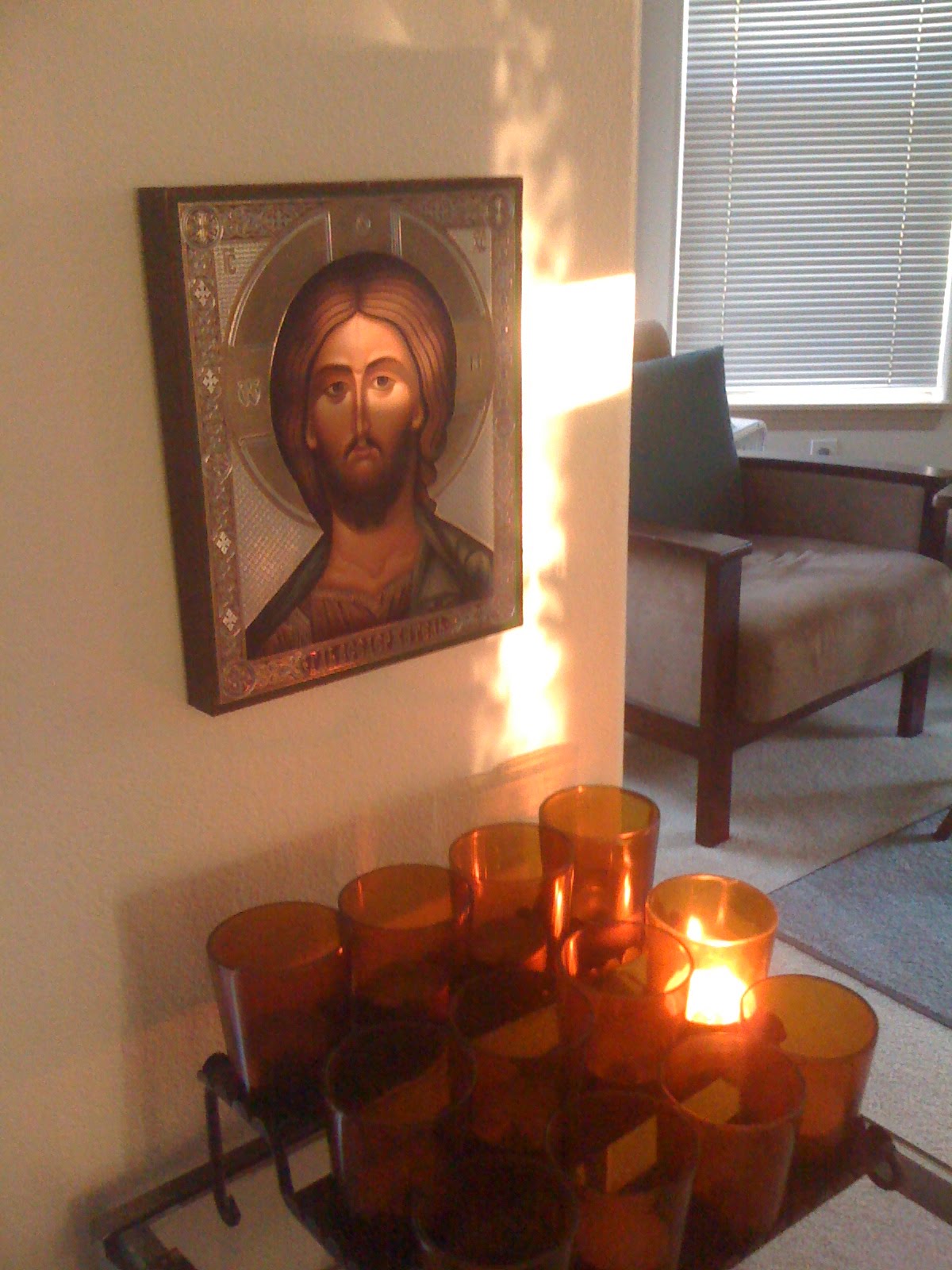
The image above was taken tonight with my iPhone as the brilliant mid-summer sunset light streamed through the blinds in the kitchen and struck this icon in this rather unique way...what comes to mind is the Phos hilaron, one of the most ancient hymns of the church, traditionally sung/recited at the beginning of vespers or evening prayer:
O gracious Light,
pure brightness of the everliving Father in heaven,
O Jesus Christ, holy and blessed!
Now as we come to the setting of the sun,
and our eyes behold the vesper light,
we sing your praises, O God: Father, Son, and Holy Spirit.
You are worthy at all times to be praised by happy voices,
O Son of God, O Giver of life,
and to be glorified through all the worlds.
Today was interesting. I am the chair of the board of directors of the Oregon chapter of the Episcopal Church's outreach ministry to GLBT people, and today we had a much needed, long overdue board retreat. It wasn't a full-on retreat in the best sense of the word, but we spent a good six hours sequestered away in the basement of a suburban parish working out together what we think our mission is going to be in the coming year and some concrete strategies for doing that. It was a very inspiring afternoon. It's a really incredible, interesting, diverse group of people that God has brought together for this special ministry in this time and place. O God, you manifest in your servants the signs of your presence, says the BCP in one of the collects for mission at evening prayer.
The lectionary for today was interesting, as well.
The Saul-David-Solomon saga is only read during the season after Pentecost in Year 1, so once every other year. Yesterday's lesson, the last chapter of 1 Samuel, told of the deaths of Saul and his sons. Today, with the beginning of 2 Samuel, David is given the tragic news, and tomorrow he will sing "The Song of the Bow," his epic lament, in which he proclaims that his love for Jonathan surpassed his love for women. I find that a hard verse for the fundies to explain away; try as they might to dismiss it as poetic hyperbole, don't you agree that it's a very strange choice of words, of all the possible ways he might find to describe his friendship with Jonathan? "I love you more than I love women...no homo!" just doesn't seem to be credible...
Sigh...there's more I could say, but it was a long day with full on mental investment, and I'm fried. So I'll just leave it there. : )
Thursday, July 21, 2011
Proper 11, Thursday, Year 1
Mark 5:1-20
I have vague memories from Sunday school at the Lutheran Church where I was brought up of a video of the story of the demons that were cast into the herd of swine; I remember the image of pigs tumbling down an embankment into water, and I remember thinking that was pretty hilarious and strange.
Today, however, I find this story one of the most beautiful, moving, compassionate and terrifying segments in all of the Gospels.
So, last we talked about Jesus, he and the disciples were crossing the Sea of Galilee when a terrible storm arose and threatened to sink the boat and drown the passengers. Jesus calmed the winds and the waves, and the disciples were terrified.
Now they come at last to the far shore, and immediately they encounter a naked lunatic. This has to be one of the scariest images in the Bible, especially in the New Testament (outside of the Revelation): a naked man who lives in the hills among the tombs, howling incoherently, so violent and strong that he cannot even be chained down, for he rips the fetters apart, and he cuts himself with stones.
Do you believe in demonic possession?
For my part...yes, at least I think so. But there is also the reality of mental illness, and I think it's entirely possible that conditions which are diagnosable today would have been inscrutable in the first century and, not unreasonably, attributed to demons. Today I think maybe the opposite is true, that possession is often considered merely mental illness. I do not think they are the same thing, but they probably share many external characteristics.
My heart breaks reading about this man. For some reason, the image I have is of a young, strong adult who, if he weren't filthy and deranged, would be considered exceedingly attractive. He's bright, he's sensitive, and he's deeply troubled. He cuts himself with stones! And people are frightened by him.
I certainly get that. Having lived in Manhattan for many years, and now back in Portland which has a famously large street population, I've certainly beheld many people suffering from mental illness, and it can be very scary; it's that level of unpredictability and the knowledge/fear that you can't necessarily reason with them.
For me, the most terrifying part is when Jesus asks "the unclean spirit" what his name is, and the response comes, "My name is Legion; for we are many." It's the stuff of cheap horror movies, and yet I just...I can't quite articulate it. I really believe it. It raises the hair on my neck.
There is also a very deliberate political subversion happening here. A "legion," of course, was the basic unit of the Roman military; Rome was the violent occupier of Palestine and the empire that murdered the Christ. Scholars tend to think that the author of "Mark," whatever his (her?) name really was, was a follower of Peter (also murdered by Romans, in Rome), and the Gospel may even have been written in Rome. This is loaded and rich language, associating the demonic possession of a human with political and military occupation.
So, the demons negotiate a deal with Jesus to be cast into the swine, the herd of pigs leap into the sea and drown, and the man becomes his old self again.
Then what happens? Then people came to see what it was that had happened....and saw the demoniac sitting there, clothed and in his right mind, the very man who had had the legion; and they were afraid.
Once again, we are shown how people witness the healing and saving power of God in spectacular fashion, and their response is not joy or comfort, but fear.
Wednesday, July 20, 2011
Proper 11, Wednesday, Year 1 - Elizabeth Cady Stanton, Amelia Bloomer, Sojourner Truth & Harriet Ross Tubman
Mark 4:35-41
Alas, I don't have much to say about the amazing women who are remembered in the calendar today, other than just how proud I am to be part of a church that recognizes their contributions to our modern world and honors them with a regular religious observance.
Instead, I have another reflection on the value of reading multiple translations of the Bible. Today's Gospel passage is the familiar story, found in all three synoptic Gospels, of Jesus and the disciples crossing the Sea of Galilee in a boat, only to have a terrible storm arise, threatening to swamp the boat and drown them. Jesus is asleep in the back of the boat, and the apostles wake him in terror and cry, "Do you not care that we are perishing?"
Jesus "rebukes" the wind and says to the sea, "Peace, be still." The wind dies down and the sea becomes calm, and Jesus says, "Why are you afraid? Have you still no faith?"
The reader, of course, has the benefit of knowing who it is in the boat with them and, also, of not being in a small, fragile craft in the middle of a tempest. It's easy for us to scoff and think, "Pfft, they were with Jesus, really...what did they think could happen?"
But from their perspective, they were on the verge of imminent and unpleasant death, and their leader was not only not concerned or trying to help, he was asleep. It's not so strange that they were panicking.
The lesson for us is that Jesus asks us to trust that even now, right now, Jesus is in that boat with us. And yet, do we live our lives like that? How many of us have confidence to weather the storms, as the metaphor goes, without anxiety? That's hard, because to us it often does seem that perhaps Jesus is asleep or not paying attention; we need help, we want assurance of safety, and we want it right now. The Bible asks us to believe that we do have it, right now and always. "Have you still no faith?"
Note, however, the disciples' collective response to this miracle.
The King James Version has Jesus ask, "Why are ye so fearful? how is it that ye have no faith?"
And they feared exceedingly, and said one to another, What manner of man is this, that even the wind and the sea obey him?
Beautiful. Why are ye so fearful?....And they feared exceedingly. So typical, right? It doesn't seem to matter how often God comes to our rescue in life, or how spectacularly obvious the intervention is, we cling to our fear. In this case, the miracle not only didn't inspire faith and confidence in the disciples, they became more afraid.
The language here matters, and this seems to be yet another occasion when the KJV, for all its shortcomings, strikes closer to the original Greek, which can be translated, "And they feared a great fear." "Fear" is the important word, we are to note that "fear" is the response to "why are you afraid"?
The NRSV, however, phrases it, "And they were filled with great awe." No!
I understand the editors' desire in many places to use "awe" instead of "fear" because this common phrase "fear of the Lord" doesn't make much sense in the context of God's repeated invitation, "Fear not." Awe, not fear, is the appropriate response in the presence of the Divine.
But the disciples do not respond appropriately; they are not filled with holy awe at the miracle they have just seen, they are filled with fear. That matters for the meaning of the story.
Tuesday, July 19, 2011
Proper 11, Tuesday, Year 1 - St Macrina
1 Samuel 25:1-22
I have mentioned before that for this two-year lectionary cycle I am studying with the King James Version. This evening I was reading along, following a typically awful Old Testament-style story of betrayal and bloodshed in 1 Samuel (the chapter which begins, by the way, with the death of Samuel...even though there are five more chapters to go, plus 2nd Samuel) but was taken aback when I got to the last verse of the lesson where David is praying to God for assistance in avenging an insult by slaughtering a bunch of innocent people, vowing by morning to have killed "any that pisseth against the wall."
Come again? LOL.
Curious, I turned to the other translations on my shelf (the NRSV, the NIV and the NKJV), all of which instead simply (and preferably...) refer to "men" or "males."
I Googled the phrase, and while admitting it's not like I spent hours of research on this, it does appear that in fact the King James has the more literal rendering of a Hebrew idiom for "men." (The phrase "that pisseth against the wall" appears in the KJV a second time in 1 Samuel 25, and in four verses of 1 & 2 Kings.)
But what really blew my mind was a video that came up of a Baptist pastor citing these verses to insist that God wants men to pee standing up. I won't link to it, you can find it yourself, if you're of a mind.
He relates a story about visiting Germany and seeing signs over toilets asking men not to pee standing up, and, explaining that his wife is German, he asked her, "Is this a joke?" and she apparently said, "No man in Germany pees standing up." "That's where we're headed in this country," says Pastor Steven L. Anderson.
Where to start?
I lived in Switzerland for a year and have visited Germany a couple of times. I lived in a university dorm in Zurich and, yes, there were signs over the toilets in the restrooms saying that peeing standing up was verboten. Now, this isn't because Switzerland has been taken over by anti-Christian feminist zealots, it's because, well, some men have really terrible aim, and no one likes to have to wipe someone else's pee off a toilet seat before using it. Duh. It's called etiquette.
But the idea that there is some sort of Teutonic cultural prohibition against urinating in a vertical position on principle is ridiculous. Any public restroom -- especially in train stations, etc -- will have urinals. In fact, in Switzerland, where the German dialects are sprinkled with French words, the common name for a men's restroom is a pissoir, where there's not a toilet in sight, and not even individual urinals, but just one long porcelain wall (!!!) with a drain at the bottom.
Moreover, "Sitzpinkler" -- which literally means "one who sits to pee" -- is a very common German derogatory word for a less-than-manly man, specifically one who can't stand up for himself.
Anyway, this has nothing to do with poor St Macrina, whose feast unhappily coincides this year with this particular lesson, and who deserves a better post.
Pastor Anderson goes on to caution his listeners against judging him for using bad language by arguing that this word "pisseth" comes directly from the mouth of God, via the Bible. He rails against other translations, including the New King James, for rendering the euphemism as "males" instead of keeping the word-for-word idiom, and cites this as evidence of the extent to which anti-Christian feminizing political correctness has infested even the church itself, in what basically amounts to a xenophobic, sexist, homophobic rant where a holy concept of "masculinity" can be so narrowly defined as to require certain orthodox, patriotic postures for peeing.
I lament that this is the sort of sermon that gets regularly posted to YouTube, and this is what has the potential to go viral. When I think of the hundreds or even thousands of thoughtful sermons that must be given in all kinds of churches every Sunday, to think this is the sort of pathetic nonsense that will form or reaffirm some people's ideas about Christianity and the Bible, I am filled with anger and despair.
Sunday, July 17, 2011
Ezekiel Goes to a Funeral
So that post on Psalm 51 I've been kicking around in my head never got written. Another time, maybe.
The Gospel lesson appointed for the Office today (Matthew 25:14-30, Proper 11, Year 1) is the Parable of the Talents, where the guy goes off and leaves three of his servants with various amounts of money, each according to their abilities, and when he comes back he is full of praise for the two who invested the money and made interest, and furious with the one who buried it in the dirt and returned the original amount. That's another passage I just don't really get. Something really troubles me about the third servant, who accuses the lord of being 'harsh' and reaping what he hadn't sown and gathering what he had not planted, and the vitriolic response of the master -- "You wicked and lazy slave" -- seems to indicate that maybe he was on to something. I Googled the parable and looked for commentaries to help, but it seems the consensus really is that the traveling master is understood to represent Christ and that the third servant is duly punished for not doing something with the gift he was given. It still doesn't sit right with me, though, and I am unsatisfied. So that's all I can say about that.
This afternoon I went to the funeral of a beloved teacher from high school, who had also been a good friend and colleague of my parents. The funeral was at a Foursquare church, where apparently he was very active, and within the confines of my own ignorance and prejudice and snobbishness I am still trying to reconcile the memories I have of this very free-thinking, well-educated, objective, progressive person (who gave no hint that I ever picked up on that he was remotely spiritual) with the discovery that he was active in a Pentecostal community.
I confess to some ambivalence about going, not really sure what the worship experience would be like there, and wondering what kind of strange ideas, cheap theology and corny music I might hear. I thought fondly of Ouiser in Steel Magnolias, who declines to visit Annelle's church because "they'd probably make me eat a live chicken," to which Annelle responds, "Not on your first visit." But my mother needed to go, and I was more than willing, out of respect for this great man.
Well, it definitely wasn't an Anglican rite. But as the pastor got up to speak about the importance of community and God's healing power even and especially in times of great pain and bewilderment, I just had this sense that we really were talking about the same God. And then, suddenly, I heard that "still, small voice," and what came into my mind was a phrase from Ezekiel: "I will remove from your body the heart of stone and give you a heart of flesh," and I cried through the rest of the service.
Friday, July 08, 2011
St Elizabeth of Portugal
OK, so here's another observance not in the Episcopalians' calendar.
However, unlike Thomas More, I had never before heard of St Elizabeth. How did she make it on to my blog?
This evening I felt a real desire to have evening prayer; whereas I have been feeling fairly disinterested and passionless, even sometimes thinking of the office as a chore, tonight I really felt called to enter into intentional meditation. We are right in the middle of a two-week period nearly unbroken by the observance of any special feast, with the exception of St Benedict of Nursia coming up on Monday. My own made-up discipline calls for music and incense only on feast days, and I was missing that particular vehicle for creating a sense of the immanence of the divine. So I decided to look to the list of proposed new feasts for the calendar (to be approved next year), but nothing for today.
Then I turned to my copy of the 1962 Roman Missal (one of my favorite resources), and saw that the appointed feast in the Catholic tradition is St Elizabeth. "Well, that's odd," I thought, since I was pretty sure that St Elizabeth is in our calendar, too. I turned to Lesser Feasts & Fasts and saw that, yes, St Elizabeth of Hungary is venerated on November 21. So I went back to the Missal for a closer look: ah, this is Elizabeth of Portugal, who was named for her great aunt, Elizabeth of Hungary. "Neat," I thought. As I read further, I saw that, after she was widowed, the queen took the veil and entered the order of the Poor Clares, the Franciscan order for women founded by St Clare of Assisi. That would be the same St Clare of Assisi whose prayer book I am using this week. Whoa.
After all this, I decided I didn't really want to bother with music and incense, so I just settled in and began. The texts were wonderful; I'll touch on them below. But the really weird thing? The "prayer of the saints" in the St Clare Prayer Book for Friday evening was written by...Elizabeth of Hungary. (Cue Twilight Zone music.) Chills.
I have had similar experiences before, when saints just sort of randomly decided to reach out of the ether and catch my attention. I will spend some more time this evening meditating on why I think this happened tonight. It is interesting; before I began evening prayer I remember thinking, I'm so tired of my prayer discipline becoming so rote, I need one of those rare spiritual experiences that keep me coming back. And, voila.
So let's talk about those texts. One of the interesting things about this St Clare Prayer Book is that each section of morning and evening prayer for a seven-day week opens with a form of confession using a portion of Psalm 51, the first half of the psalm for the morning, and the first verse followed by the second half in the evening. I had thought maybe this would be the focus for tonight's meditation, but then the whole double-Elizabeth thing came up and so I've put that off, maybe for tomorrow.
Each section also opens with a brief Gospel sentence, to help us focus our intentions on the given theme for the day. This morning's Gospel sentence ("No one can be the slave of two masters; he will either hate the first and love the second, or be attached to the first and despise the second," Matthew 6:24) was actually taken from the selected Gospel passage for tonight (Matthew 6:22-27), which I don't think happens anywhere else in the book.
The Franciscans, of course, were devoted to holy vocational poverty; that is, they chose it. They rejected the idea of possessions (Francis himself is said to have asked to be allowed to die naked so that he could leave this world possessing absolutely nothing at all, but the brothers persuaded him instead, for modesty's sake, to borrow a brother's habit, and St Clare's rules for her order were initially rejected by the pope for being too severe), and so this theme of the corrupting power of wealth and materialism is naturally recurring in this prayer book.
The idea is not so much to suffer poverty for God's sake, but to embrace poverty in an exercise of trust that God will provide all you really need. In the context of tonight's Gospel reading, that opening sentence from this morning is immediately followed by, "Therefore I tell you, do not worry about your life, what you will eat or what you will drink, or about your body, what you will wear. Is not life more than food, and the body more than clothing?" This is a core principle of Franciscan life.
Of course, Christians throughout history have found this a difficult, even impossible challenge to accept. Fear and doubt keep us worrying about all kinds of things, and hold us hostage. One of the most salient critiques of the biblical literalists is that hardly any of them even acknowledge, let alone obey, Christ's requirement that to follow him we must sell everything we own and give the money to the poor. I freely acknowledge my own fears on this point, which is why I feel it is important for me to come back frequently to St Francis, and confess my failures.
Where I have come in this process is a belief that truthfully I possess nothing. Everything belongs to God, but some things have been entrusted to me, for my benefit and use. However, I should always be mindful that nothing is mine and I should always be willing to part with anything I have for the sake of someone else who needs it. It's not quite living fully into the Gospel life, but it's as far as my fears allow me to go right now.
And so, back to Elizabeth of Portugal. She had an illustrious pedigree, great-great-granddaughter of the Holy Roman Emperor Frederick I (also known as Red-Beard or "Barbarossa"), and became Queen of Portugal at the tender age of 12. Widowed at 54, she left the royal life and entered a convent, where she lived in voluntary poverty for eleven years, until her death.
This really speaks to me. I am always thinking about money, how my life might be easier or better or more interesting if I had more money. I think God asks us to accept that this is an illusion. A while back I was told I was being promoted and given a significant raise, but then one thing led to another and it all fell through the cracks. For many months I was just angry thinking about the money I should have been making. Eventually it worked itself out and I got my raise and, well, truthfully, I am no happier or less fearful than I was before the raise.
Thursday, July 07, 2011
Maybe Less Discipline is Good Discipline
Oh, dear, I have really fallen off the disciplinary wagon.
I attempted to write something last week for the Feast of Saints Peter & Paul, one of my favorites, but it was rambling and obvious, so it has been condemned to the purgatory of "drafts" and will no doubt remain there.
I might have had something to say yesterday commemorating the death of Thomas More, who was executed by Henry VIII for exercising his conscience and refusing to support the political separation of the Church of England from Rome. He is venerated as a martyr by the Roman church on June 22 (unclear why) and by the Church of England on July 6, the anniversary of his execution. Though the Episcopal Church in the United States is busily adding to the calendar what seems to be hundreds of people small and great who in some noteworthy way or other played a role in church history, Sir Thomas has yet to be nominated, an omission I find very strange in the context of new additions such as John Calvin. So although there is no official Episcopalian observance for Thomas More, I write him into the calendar myself and keep the day by watching the classic film A Man for All Seasons. (One week earlier I kept Saints Peter & Paul by watching the extraordinary Quo Vadis, which is campy and overwrought but magnificent). (For the record, I also write in my own observances for Gandhi and the Buddha, whom I am certain were saints who in fact preached the Gospel, even if not in the name of Christ.)
In general, my "daily office" discipline has been pretty weak. I think it's less about the health of my faith life than it is a symptom or symbol of my general state lately: I'm tired. I've worked incredibly hard the last few months both professionally and on volunteer projects, and I am needing a break from responsibility and commitments, more flexibility, more fun and more me-centered time.
For these two weeks in July, I have even set aside the BCP completely as there are no feasts in the calendar to observe. Instead, I have two Franciscan prayer books, one focusing on St Clare and another on Francis himself, which each contain a week's worth of morning and evening prayer liturgies. They are shorter and simpler than what I normally do, but I think that's a good boundary to stretch, as well. I use the readings provided therein, which are chosen for thematic relevance, rather than keeping the lectionary.
Even though the simplified liturgy means I can get through the office in 10 or 15 minutes, rather then 30-45, I'm still finding the structure burdensome, though I trust it is beneficial. My mind seems permanently elsewhere. I am reading, but not comprehending, looking, but not seeing.
This isn't to say that I'm not thinking about God these days. I am, and quite frequently. I am feeling rather unsettled -- or, perhaps, too settled -- and it reminds me of how I was feeling about five years ago back in New York when I had this great sense that what I was doing wasn't working and that a big change was needed. That change ended up being leaving everything behind in New York and starting over from scratch with a new life, new friends, new job and new community in Portland.
In hindsight, the change was absolutely the right one, for many reasons. I do truly feel that I had opened myself up to discernment, to listening to that 'still, small voice,' and was called back to Portland at an important time. Now I feel restless. I don't know whether this is leading me on to yet another city and another life, or whether it's change on a less dramatic scale. I think frequently about moving to another part of town, but the pro/con analysis always keeps me where I am. (For now.)
The other thing that is going on seems to be that I am possibly emerging from many years of emotional and romantic isolation. The Christian ethos I have been raised with trains me to seek one partner with which to make a committed relationship and to be abstinent otherwise, and so, in the absence of a partner all these long years, I have been...lonely, shall we say. But in my meditations in recent months (especially in Lent) I have had a great deal of focus on sex and sensuality and relationship, and as I enter tentatively back into the "dating world," part of me remains unclear whether I even want a relationship. I am sensing that the church's historic sexophobia is wrong and damaging, and yet also feel certain that there is a higher standard to which Christians are called for their intimate behavior.
The Bible doesn't anywhere condemn sex, or sexual pleasure, or sex for the sake of pleasure. That thinking is a product of the middle ages, a legacy of St Augustine's over-compensation for his own admitted debauchery and a mistaken assumption that "original sin" has something to do with sex. This got codified in Aquinas' ideas about natural law, and got us to the persisting religious argument that sex is for procreation, and only within the bonds of male/female Christian marriage; any sex that is not procreative in intent or capacity is sinful, and even procreative sex is understood to be sinful if the participants enjoy themselves. This cannot be what God intended.
Obviously this is the subject for a post of its own...many posts, probably. I concede the Bible repeatedly condemns fornication and adultery, but I think those are specific abuses of sexual behavior, not sex in general that is being condemned. Somehow I was raised with a very traditional, sex-negative religious outlook, and I think that has kept me emotionally and spiritually retarded in many ways. I have a sense that God is calling me to a healthier physical life. We'll have to see.
Monday, June 13, 2011
Late Pentecost
Man, I just don't have as much free time as I used to. I guess that's good, in most ways.
Anyway. Lots I could say about Pentecost, which was yesterday, but no time and no energy. I'll just say that the Spirit came through in a couple of huge ways today and I am embarrassed that I didn't have more faith in a positive outcome.
"Lord, I believe; help my unbelief!" That's from somewhere in Mark. I'm too tired to look it up. But it's one of my favorite verses and it's totally applicable right now.
Peace.
Saturday, June 11, 2011
St Barnabas
Ecclesiasticus (Sirach) 3:31-11; Acts 4:32-27
I suddenly dig St Barnabas. If you'd asked me yesterday who St Barnabas was, I couldn't have given you a very good answer. It's not that I've never kept his feast before, it just never stuck. I wish I had looked him up before I visited a parish of St Barnabas last week.
Reading the lessons appointed for morning prayer on this feast, one wonders just which Bible, exactly, a lot of Americans are reading. (Okay, fair enough: they are in fact probably reading one that does not contain Ecclesiasticus, found in the apocrypha.)
It's hard for me to resist the temptation of pointing out what I think other people should take away from these readings, instead of concentrating solely on what they say to me, but I just get so angry at the way our faith is misrepresented, distorted, even, yea, perverted by those who have appointed themselves its greatest advocates and true believers. Today's reading from Sirach is exemplary, but not unique. How is it, exactly, that so much of America's Christian culture aligns itself with a political system that serves Mammon? I get equally despondent over many liberals, the self-appointed guardians of objectivity and education, who are satisfied that all they need to know about the Bible or Christianity they have heard on television from crackpots, and dismiss Christians as ideological zealous bigots, or, at best, sad, deluded people clinging to some bizarre ancient myth to bring rays of hope into their pathetic little lives, and think of the Bible as an archaic manifesto for every kind of small-mindedness and oppression known to history.
The rich person toils to amass a fortune,
and when he rests he fills himself with his dainties.
The poor person toils to make a meagre living,
and if ever he rests he becomes needy.
Bam! That's about as succinct a summation of the progressive view of the shortcomings of capitalism as you could find. We hear a lot, especially from the "libertarian" crowd, about how the rich are the products of their own success and hard work and, ergo, the poor must be so because they chose not to work as hard. Assuredly, there probably are some underachievers out there who ought to take more responsibility and show some initiative, but a general philosophy that the poor don't work as hard as the rich when more often than not it's the poor who end up working the physically exhausting or the dangerous or the smelly or unpleasant or unrespected tasks is delusion. Some wealthy people definitely work very hard, but usually in a comfortable and safe way, and they are able to rest from time to time in comfort, if and when they choose. And, of course, some rich people don't work at all. We live in a celebrity culture, where some people are famous for being famous.
One who loves gold will not be justified;
one who pursues money will be led astray by it.
Many have come to ruin because of gold,
and their destruction has met them face to face.
Okay, enough shooting fish in a barrel. I certainly am no saint in this regard; perhaps I sin even more egregiously, because I read things like this, and I feel their truth, and while I desire to live a comparatively simple and modest life, the plain truth of the matter is that I am stinking, filthy rich. I don't think most Americans would agree with that assessment -- I drive a Honda, I live in a suburban apartment, I don't have a butler or a maid or take fancy vacations; in fact, I think a lot of Americans would say my life is kind of lame. I don't even have cable. And yet, given my income, I am in the top 1% of earners worldwide. More than 99% of humanity has less money than I do, so I don't know how I could define myself as anything other than loaded.
Sure, I work pretty hard (by "middle class" standards). But I'm not pursuing any particular passion; it's just a job. I want to have my modest but comfortable life, pay off my student loans, and put some money away for retirement. In our culture, that's not bad. It's considered normal and responsible. But there's the serious disconnect between a real Christian life and a generic American life. The stories of the saints are filled with people who walked away from comfort for the sake of the Gospel; in America, we tend to think that following the Gospel entitles us to comfort.
St Barnabas is one of these heroes. He was a landowner who sold his property and gave the money to the church. Now, maybe that doesn't sound so extraordinary to us. Wealthy folk - even the non-religious - commit acts of generosity and philanthropy all the time. But this information about Barnabas comes to us immediately following the controversial section of Acts that appears to claim that the early Christians were essentially socialists. "No one claimed private ownership of any possession, but everything they owned was held in common....There was not a needy person among them, for as many as owned lands or houses sold them and brought the proceeds of what was sold...and it was distributed to each as any had need." Barnabas didn't donate a fortune in exchange for getting the new wing of the hospital named after him. He simply gave away everything he had so that those who had nothing might have something, trusting that the community would be there to meet his needs, too. He didn't decide there was a certain fraction of his income he could do without; he laid his money at the apostles' feet.
Note how at odds this is with the political wing of our country that most loudly claims to be the paragons of Christian virtue. They abhor the notion of living like this, and rail against anything that might benefit the poor at the inconvenience of the wealthy. Of course, they defend this by noting that all this charity was voluntary, not compelled by the government. But we have a totally different system; we are not run by hereditary monarchs (hereditary oligarchs, maybe...), or puppet princes in the service of a foreign empire. We govern ourselves; it's not like Caesar taxing the poor to pay for his own excesses. Instead, we, like the apostles, are supposed to be sitting down together, adding up our resources, and using them to address our needs and problems.
I still have such trouble with the hypocrisy of these "conservatives" who claim the authority of Scripture, but only when it's not inconvenient or at odds with their personal political views. Somehow we end up with "Christians" who want to cut off unemployment assistance in a time when there are vastly more people looking for work than there are jobs to be filled, arguing that unemployment insurance just encourages people to be lazy. We get "Christians" who deny global climate change, even as poor communities in coastal areas around the world continue to be inundated by rising seas, as icecaps and glaciers disappear and deserts expand, because making a meaningful effort to combat these problems would necessarily mean making major changes in the comforts and conveniences to which Americans (especially, but not exclusively) have grown accustomed. We get "Christians" who argue that there is no "right" to health care, as though our capacity to prevent and cure disease and eliminate or ameliorate suffering is a special privilege of the wealthy, rather than a moral obligation.
Blessed is the rich person who is found blameless,
and who does not go after gold.
Who is he, that we may praise him?
Good question.
Friday, June 10, 2011
Friday in Week 7 of Easter, Year 1 - Ephrem of Edessa
Luke 10:38-42
The video here doesn't really have anything specifically to do with today's lectionary, but it's a good example of the stuff I love to listen to.
I've always been very uncomfortable with Luke's story of Jesus' visit to the home of Mary and Martha; as a perfectionist and control freak myself, I relate to Martha. I can only imagine the emotional state I'd be in if freakin' Jesus were coming to my house. I would be frantically trying to make sure that everything was absolutely perfect, and I, too, would be very annoyed if someone I thought should be helping abandoned me altogether and went to the party, as it were.
Maybe it seems a little juvenile of Martha to go to Jesus and say, "Can you tell her to help me, please?" instead of talking to Mary directly and saying, "I really need your help for a little bit."
Perhaps there's a lesson in that, too: how often when difficulties in our various relationships arise, do we turn to God in prayer and ask, "Can you please tell her to help me?" or "Can you please help him understand what I'm going through right now?" If you are conflict-averse, like me, that's probably your preferred strategy, rather than confronting the person.
Now, Martha's request frankly doesn't seem all that extraordinary. Really, why should Martha do all the work by herself while Mary's off having a grand time? So I'm always really bothered by Jesus' response: "Mary has chosen the better part, which will not be taken away from her."
What's that about? Mary called dibs on hanging out with Jesus so Martha has to suck it up and do all the work by herself?
Well, let's back up, here. So Martha complains, but first Jesus says to her, "Martha, Martha, you are worried and distracted by many things." This is a very comforting statement; there is compassion here. Imagine Jesus saying this to you: "You are worried and distracted by many things." How would you respond? I would probably say, "Totally." And Jesus continues, "There is need of only one thing."
This is one of those "lilies of the field" moments, a speech that Jesus is working toward in chapter 12 of the same Gospel; "Can any of you by worrying add a single hour to your span of life?" Oh...busted.
I think what has troubled me is the language of the NRSV, "Mary has chosen the better part." I'm no Greek scholar (understatement...) so for all I know, Luke's original text is best translated "better." But again, this year I am reading the KJV, which instead renders it, "But one thing is needful: and Mary hath chosen that good part, which shall not be taken away from her."
Maybe what Jesus is really saying here is not so much, "Sorry, Martha" but rather, "Stop putzing around in the kitchen and trying to do too many things and come sit by me and listen for a while." Stop being resentful of Mary and realize that she has chosen well: to not worry so much about this that and the other thing and just go and sit quietly at the foot of the Lord. I like this wording, "that good part," because it implies that Martha (and the rest of us) can choose it, too, that those of us who are busy working hard behind the scenes to make sure everything is right and perfect need to trust more that a) that is not the most important thing and b) that our needs will be met, and scurrying around trying to make perfect what God has already made perfect is wasted energy.
I don't know. Maybe that's not the point of this passage, at all. But it's always been one of my least favorite readings, as I had this notion that Jesus was condescending and dismissive of Martha. Now I have an avenue toward understanding it differently.
Thursday, June 09, 2011
Thursday in Week 7 of Easter, Year 1 - St Columba
Ezekiel 18:1-4, 19-32
I was first exposed to Celtic spirituality about four years ago, and I was deeply and immediately attracted to a way of relating to the goodness of God by seeing it reflected in all of creation, even and especially in simple things, and in discovering "thin" places, those locations or moments when, for whatever reason, the immanence of the divine is palpable. Many Christians give a lot of lip service to how good God is, but focus more on the darkness of the world and the human heart.
The darkness is real; but light shines in the darkness, and the darkness does not overcome it. It is perhaps good for us now and again to spend some time in the darkness, to be reminded of the healing and comforting powers of the Holy Spirit, and to help us empathize with those whose lives are very dark, indeed.
Earlier this week I was very much in that darkness; not only did I not blog, I wasn't even interested in intentional prayer, at all. I was overcome by negative thoughts and emotions, and instead of engaging with them, discerning their source and praying for wisdom, guidance and hope, I gave in to them. Last night I began to emerge from my funk, realizing that part of my problem was tremendous anxiety about all the many things I need to do in the next week or so, and deciding that the best way to combat that was to, you know, actually get some of that stuff done, and was up late crossing things off the list. By the time I woke up this morning and realized it was St Columba's day, it was too late for me to have morning prayer and still make it to work at a respectable time. However I am very glad I set aside time tonight for prayer; I feel very different now than I did an hour or so ago.
A lot of the fears and frustrations from earlier in the week are still with me. There was great temptation not to pray tonight, either, and go out and have fun instead (or at least look for it). But somehow I knew this restlessness I felt would be best addressed by some time of focused stillness; there's time this weekend for fun and certainly many opportunities in the coming week. It took some mental and spiritual effort to calm myself and enter into prayer, but the result is undeniable. With Celtic spirituality's emphasis on nature I took advantage of this warm, light and quiet evening and threw the windows wide open and listened to the birds and felt a gentle breeze as I settled in.
Today's lesson from the Hebrew scriptures is from the prophet Ezekiel. "But when the righteous turn away from their righteousness and commit iniquity and do the same abominable things that the wicked do, shall they live? None of the righteous deeds that they have done shall be remembered; for the treachery of which they are guilty and the sin they have committed, they shall die." [18:24]
Oh, yeah...that's where I am. Okay, I'm not saying I want to run out and commit "abominable" actions; although I suppose the normal social life of any single gay man qualifies as "abominable" in some circles. But I have been feeling the occasional desire to give the church stuff a rest, and go be a normal gay guy and date and maybe find a boyfriend and go to parties and events and wear nicer clothes, instead of always being so freaking responsible and cautious. I found myself tonight praying for help finding a balance between a healthy faith life and a healthy social life, when suddenly I realized that the seeking of a balance is the problem, because it implies that faith and social life are separate, competing needs that need to be figured out. So I stopped in mid-thought and decided instead to ask for help in integrating them.
Somewhere along the way I picked up an unhealthy dose of Calvinist fundamentalism, this notion that fun = iniquity = death. This is where the important lessons of Celtic thinking can help; there is beauty in life, there are good, divine things to be found in laughter and the company of others, alcohol (used responsibly) is a wonderful gift, dancing is one of humanity's most ancient expressions of joy (and clearly approved of by the psalmists), and there are good, healthy, divine gifts in our sexuality. That's not a carte-blanche license for debauchery, but it is an invitation to think outside of the Augustinian box, as it were.
The chapters of the book I use for my reflections on the great Celtic saints (Holy Companions) always include a short snippet of actual quotes (or at least attributions) of the saint in question; tonight I was struck by Columba's own words, "Let me study sacred books to calm my soul....let me say my daily prayers, sometimes chanting, sometimes quiet, always thanking God," and how closely that articulation resembles my own practice.
I always say this prayer in the evening: "Most holy God, the source of all good desires, all right judgments, and all just works: give to us your servants that peace which the world cannot give, so that our minds may be fixed on the doing of your will, and that we being delivered from the fear of all enemies, may live in peace and quietness, through the mercies of Jesus Christ our Lord." Tonight I really felt that peace.
Monday, June 06, 2011
Monday in Week 7 of Easter, Year 1
Luke 9:51-62
Today's Gospel passage contains a fascinating episode highlighting the importance of understanding what you're reading by knowing something about historical and cultural contexts and the history of biblical texts themselves.
The lesson opens with the beautiful phrase, "When the days drew near for [Jesus] to be taken up, he set his face to go to Jerusalem," a unique Semitic idiom expressing resolve. Jesus spent the majority of his ministry in rural areas around the Sea of Galilee, and so from this point the story proceeds both geographically and spiritually toward his destiny in Jerusalem, marking a significant shift in the narrative.
In order to reach Jerusalem from Galilee one had to pass through Samaria; Samaritans revered a version of the Torah and considered themselves the true descendants of the ancient Israelites, objecting to the temple worship in Jerusalem as a fabrication invented after the Babylonian exile. Naturally, tremendous tension existed between Jews and Samaritans (a recurring theme in the gospels), and the Samaritans were not inclined to be hospitable to Jews traveling to Jerusalem.
That, then, is the important background for understanding why Jesus was not "received" by the Samaritans. The brothers James and John - the Gospel of Mark tells us Jesus referred to them as boanerges, or "sons of thunder" in Aramaic - react to this affront by asking if they should "command fire to come down from heaven and consume them," referencing one of the tales of Elijah told in 2 Kings. In the New Revised Standard Version (NRSV), the preferred text of the Episcopal Church, Jesus "turned and rebuked them."
However, for this lectionary cycle I am reading from the Authorized, or "King James" version (KJV), in honor of the 400th anniversary of its publication. Whatever its scholarly or linguistic shortcomings compared to modern translations, it remains one of the greatest achievements in the English language and, for better or worse, is the source of the Biblical texts that most people recognize or can quote.
This is one of those occasions for which it is instructive to read multiple translations. Whereas Jesus "rebuked them," full stop, in the NRSV, the KJV says Jesus "turned, and rebuked them, and said, Ye know not what manner of spirit ye are of. For the Son of man is not come to destroy men's lives, but to save them." (The NRSV puts this language in a footnote, "Other ancient authorities read...".) I would be interested to know why the editors feel the shorter text is the more authentic; presumably it has to do with the preponderance of manuscripts deemed more reliable.
We could wade deep into the weeds beating our heads against the proverbial wall at the idiotic intransigence of the folk who insist the Bible is the inerrant "Word of God," period, when the simple truth is that we have none of the original texts and the surviving manuscripts - case in point - do not always agree. Alas, it's a tired and unoriginal complaint, and one not remotely compelling or successful with the "inerrant" crowd. Criticizing fundamentalists for their lack of academic rigor is truly shooting fish in a barrel. Hooray for us contemplative eggheads who are interested in these sorts of complexities.
What caught my attention here is that the KJV is oft betimes the preferred translation of the fundamentalists, kind of in the same way that for centuries the Vulgate was the only permissible version of the Bible, even though not a single word of the original texts was in Latin. The NRSV indicates that Jesus rejected James and John's suggestion, but does not provide any further explanation. The KJV, on the other hand, has Jesus dismissing the invocation of divine violence against sinners and saying, "Ye know not what manner of spirit ye are of," implying that what James and John think is righteous is actually demonic. This is, sadly, one of the things that is least understood about the Devil; we are not enticed to do "evil" things, we just become confused. Little wonder that the serpent tempted us with the fruit of the tree of Knowledge of Good and Evil, that we might become like God. One of the Enemy's most successful strategies - sadly illustrated by centuries of church history - is suggesting to us and thereby convincing us that acts of dire evil are actually God's will. And this power of darkness is not merely aimed at those who are weak in faith or poor in theology; this is James and John, for goodness' sake. That should be a warning to us all.
What makes the story even more interesting is that this is not some random idea the brothers came up with; they are inspired by the story of Elijah, who in fact did successfully call down fire from heaven against a hostile army. There is, so to speak, biblical precedent for their suggestion.
Jesus then goes on to say that he did not come to destroy men's lives, but to save them.
Do you ever get the feeling that folks like Pat Robertson would just love to call down divine fire on people who believe different things than he does? Bible, Bible, Bible...that's all a lot of these "Christian" extremists can talk about, and yet their referencing of it is so selective as to be comical, if it weren't so painfully serious. You can, like James and John, find plenty of Biblical support for praying for violence against sinners or enemies; the psalms are full of imprecations. But here's Jesus saying bluntly, "That's not what I'm about." And still we get "Christians" referencing Psalm 109 - "Let his days be few; and let another take his office. Let his children be fatherless and his wife a widow" - on anti-Obama t-shirts and bumper stickers. In fact, much of the Evangelical culture is built around this heretical and unbiblical notion that Jesus is coming back precisely in order to rain fire down upon the unorthodox and the unbelievers.
The only way to arrive at such a sick notion is to rip various verses from the Bible free of their important contexts, and string them together in a way in which they were not intended to be associated, and you have to completely ignore or deny a bunch of other passages.
As the saying goes, you can take the Bible literally, or you can take it seriously. You can't do both.
Sunday, June 05, 2011
The Seventh Sunday of Easter - Sunday after the Ascension

I'm not a particular fan of Salvador Dali, but I do love this vision of the Ascension. There are certain paradoxical qualities about it; Christ's arms are outstretched in a gesture of triumph, like Pavarotti after a climactic high note, and yet of course we are to notice that he is ascending in cruciform, that wonderful juxtaposition of triumph and tragedy at the intersection of the cross. Note how his body appears healthy, whole and strong, but the hands are tensed and the fingers are curled, as if in agony. And we mostly see the bottom of his feet, just what the "men of Galilee" who stood there gaping slack-jawed would have seen, but they do not bear the wounds of his execution. The world he leaves behind is a landscape of death; dark and dry. No trees, no lush green spaces, just a few brown buildings in a dark grey world under gathering black clouds. It's just an astonishing painting.
This morning I visited St Barnabas parish in McMinnville, a good hour from home -- but a very pleasant drive through the most lush and green pastoral landscape imaginable, dotted with beautiful farm houses, fields and orchards -- because a close friend of mine, an aspirant for holy orders, was preaching. He had the unenviable task of not only addressing the Ascension but also the mission and ministry of Integrity, the Episcopal Church's gay, lesbian, bisexual and transgender outreach and advocacy organization, in a rural congregation (which it appears was very well received).
He had an interesting metaphor for the Ascension, comparing it to being a child and learning to ride a bicycle with training wheels. One day the father decides that it's time for the training wheels to come off. The child may not be ready; indeed, it may be very frightening, but the father knows this push has to be made. The father also does not turn his back and leave the child to chance, but walks or runs alongside, there to tip us back to center or pick us up if we fall over all together, until we are really ready to ride off on our own. Ascension Day is the training wheels coming off. We're still a little wobbly, but the time has come. Jesus taught us what we need to know, it's our job now to develop the skills and the confidence to ride out into the world. But we haven't been abandoned; the Holy Spirit is right there, running alongside us, encouraging us, teaching us, and ready if we fall.
I enjoyed the visit to St Barnabas very much. It was very different than my home parish in some ways, and I thought maybe I ought to make more of an effort to visit other churches. Not because I am unhappy where I am, but because I think for my own prayer disciplines it's good to expose myself to different ways of approaching worship. I am grateful that the Episcopal Church accommodates so many styles.
Recently I've been in one of those places where keeping the Daily Office has seemed more of a chore than a joy, and while I'm supposed to be focusing on my devotion, my mind wanders off to all manner of things. Last night's study of St Kevin, however, sparked my imagination and I have continued to ponder him today. I am drawn to his passion for and friendship with all kinds of animals, and his frequent desire to retire in solitude to the wilderness to pray. I wish I could find a nice place in the woods somewhere where I could go on regular, affordable retreats.
I am a big fan of the Portland-based women's vocal ensemble In Mulieribus, who specialize in medieval and renaissance polyphony. Tonight they gave a concert at St Stephen's RC church in SE Portland called Legenda Aurea, based on the medieval book of that name about the lives and legends of the saints. I almost didn't make it; I woke up from my nap late and hadn't eaten, but I managed to cook dinner, shower and get dressed all in about 45 minutes and flew out the door, arriving with about five minutes to spare at the concert. I am glad I made the effort. The music was so transcendant, I could not wait to come home and have my own private evening devotions with recordings of sacred music. I had originally planned to stop at a bar on the way home and see what was going on, but decided to go straight back, light some candles and incense and pray.
For the evening hymn, I just put my playlist on shuffle until I landed on something that was appropriate, which rather ironically/coincidentally turned out to be Hildegard von Bingen's "Cum vox sanguinis," from her body of work meant for the Feast of St Ursula, which had been on tonight's program.
Saturday, June 04, 2011
Saturday in Week 6 of Easter, Year 1
I have been too busy to do much about this discipline this week. Yesterday in the calendar of the Episcopal Church we celebrated the Feast of the Martyrs of Uganda, an observation that has added import given the ongoing anti-gay insanity in that country, which recently resulted in the new martyrdom of civil rights advocate David Kato.
June 3 is also the traditional date of the Feast of St Kevin, one of the great Celtic saints, who has been proposed for inclusion in the Episcopal calendar; I decided to "transfer" his feast to this evening, and am glad I did. I am exhausted and can't say much beyond the fact that I just felt a powerful resonance with his story. I hope I find the time, opportunity and energy to learn more.
June 3 is also the traditional date of the Feast of St Kevin, one of the great Celtic saints, who has been proposed for inclusion in the Episcopal calendar; I decided to "transfer" his feast to this evening, and am glad I did. I am exhausted and can't say much beyond the fact that I just felt a powerful resonance with his story. I hope I find the time, opportunity and energy to learn more.
Monday, May 30, 2011
Memorial Day
O Judge of the nations, we remember before you with grateful hearts the men and women of our country who in the day of decision ventured much for the liberties we now enjoy. Grant that we may not rest until all the people of this land share the benefits of true freedom and gladly accept its disciplines. This we ask in the name of Jesus Christ our Lord. Amen.
The Sixth Sunday of Easter, Year 1
Sirach (Ecclesiasticus) 43:1-12, 27-32; Matthew 13:24-34
I love the 'wisdom' books, especially Ecclesiasticus and the Wisdom of Solomon from the apocrypha. When people have shallow arguments over whether the Bible is "true," they usually reduce it to banal carping over whether the Earth was created in six days or pointing out or defending chronological inconsistencies in the gospels. Rarely does anyone seem to ask, or care, whether the Bible contains truth. That there can be truth in something that is not necessarily true from a historical or scientific standpoint is lost on a lot of people.
I really need to read Rob Bell's new book Love Wins. The gist of it, as I understand it, is that none of us goes to hell. I think I can understand theologically and scripturally how one gets there, but I'm not sure you can do it without disregarding a lot of other important passages that seem to make it very clear that some will be shut out of the Kingdom, especially from the Gospel of Matthew.
Today's lesson is an interesting one with a series of three parables; the last one is so brief, it's only one sentence, but it is notable that Jesus says "the kingdom of heaven is like a woman." The second parable is a famous favorite trope for the "is the Bible true" crowd, because it refers to a mustard seed as "the smallest of all seeds," which scientifically we know today is not correct. Again, we miss the forest for the trees, or the mustard shrubs, as it were. Why ignore the wisdom of the saying over a technical irrelevance?
It's the first and longest of the three stories for today that is best known and what I wish to ponder.
The parable of the tares is one of many apocalyptic passages in Matthew that seem to refer to Judgment Day, when the good will be separated from the bad, which in this tale are bound into bundles and burned.
But a closer reading does not support the notion that the meaning of this parable is that some people will be separated out. The kingdom of heaven is compared to "someone who sowed good seed in his field." Then an enemy comes overnight and sows weeds in among the wheat. This is interesting; it's not good wheat and bad wheat, it's two different kinds of plants. One kind came from the farmer, the other kind came from an enemy. Maybe it doesn't refer at all to "good" people and "bad" people and judgment, but rather God's wisdom in letting us grow, even with bad things in and among us, content in the knowledge that at the harvest time everything will work out the way it was meant to, and the enemy's efforts were in vain.
***
Sorry this post is late, I was working later than anticipated last night and then when I went back and re-read what I had written, I hated it and deleted it and started over.
We could say more but could never say enough;
let the final word be: ‘He is the all.’
let the final word be: ‘He is the all.’
I love the 'wisdom' books, especially Ecclesiasticus and the Wisdom of Solomon from the apocrypha. When people have shallow arguments over whether the Bible is "true," they usually reduce it to banal carping over whether the Earth was created in six days or pointing out or defending chronological inconsistencies in the gospels. Rarely does anyone seem to ask, or care, whether the Bible contains truth. That there can be truth in something that is not necessarily true from a historical or scientific standpoint is lost on a lot of people.
* * * * *
I really need to read Rob Bell's new book Love Wins. The gist of it, as I understand it, is that none of us goes to hell. I think I can understand theologically and scripturally how one gets there, but I'm not sure you can do it without disregarding a lot of other important passages that seem to make it very clear that some will be shut out of the Kingdom, especially from the Gospel of Matthew.
Today's lesson is an interesting one with a series of three parables; the last one is so brief, it's only one sentence, but it is notable that Jesus says "the kingdom of heaven is like a woman." The second parable is a famous favorite trope for the "is the Bible true" crowd, because it refers to a mustard seed as "the smallest of all seeds," which scientifically we know today is not correct. Again, we miss the forest for the trees, or the mustard shrubs, as it were. Why ignore the wisdom of the saying over a technical irrelevance?
It's the first and longest of the three stories for today that is best known and what I wish to ponder.
The parable of the tares is one of many apocalyptic passages in Matthew that seem to refer to Judgment Day, when the good will be separated from the bad, which in this tale are bound into bundles and burned.
But a closer reading does not support the notion that the meaning of this parable is that some people will be separated out. The kingdom of heaven is compared to "someone who sowed good seed in his field." Then an enemy comes overnight and sows weeds in among the wheat. This is interesting; it's not good wheat and bad wheat, it's two different kinds of plants. One kind came from the farmer, the other kind came from an enemy. Maybe it doesn't refer at all to "good" people and "bad" people and judgment, but rather God's wisdom in letting us grow, even with bad things in and among us, content in the knowledge that at the harvest time everything will work out the way it was meant to, and the enemy's efforts were in vain.
***
Sorry this post is late, I was working later than anticipated last night and then when I went back and re-read what I had written, I hated it and deleted it and started over.
Saturday, May 28, 2011
Saturday in Week 5 of Easter, Year 1
Psalm 27; Luke 9:1-17
The calendar notes that the General Convention of The Episcopal Church in 2009 proposed that this day be set aside for the regular liturgical commemoration of John Calvin, which suggestion will be presented for ratification in 2012. I have to say: I don't get it. Admittedly any student of theology and Christian history ought to know who he is and generally what he was about, but I find this a very odd celebration for Episcopalians. His focus on predestination and the quasi-Augustinian notion of the complete and total depravity of humankind is somewhat alien to the usual Episcopalian view of things.
* * * * *
I had originally written a much longer introduction here, and decided to file that under "TMI."
CliffsNotes version: I am the diocesan organizer in Oregon for Integrity, the national advocacy and outreach organization for gay, lesbian, bisexual and transgender Episcopalians. Three weeks from tomorrow is the Portland Pride Parade, and for the first time in history, our diocesan bishop will be marching with us. We have also (I think...) successfully coordinated the participation of all the gay-friendly parishes in the metro area so that we march as one group.
By themselves, these should be sufficient cause for jubilation. But that's not how my mind works.
For one thing, though the bishop will be just a few blocks away, celebrating the mass at Trinity Cathedral in NW Portland (Pride is on Trinity Sunday this year), the parade starts at noon. We strategically registered late, hoping for a spot toward the back to give the bishop reasonable travel time after the Eucharist, but it's still going to be a close call. I'm already hyperventilating about that.
Second, last year's turnout (I blame the weather) was not inspirational. But this year we have the bishop. (Assuming he gets there.)
Third, we don't have a booth at the waterfront festival this time, and that's my fault. I assumed the registration deadline was a lot later than it was. Oooops. We're on the waiting list, but I think it's too late. Even if a spot opened up, how would we coordinate two days' worth of volunteer shifts on such short notice?
Fourth, I'm struggling to feel like our work is generating much if any interest beyond a tiny dedicated core, and even that has recently fractured somewhat, with the sudden resignation of one of our board members. Given that and various other scheduling conflicts that have arisen, only one other board member can attend our June meeting. Arrrghghgh.
Ooooookay. Breathe in. Breathe out. Repeat.
Recently - I forget exactly where, alas - I read that when you reach a point where you can't do anything else, you should rejoice, because that means God has taken the matter out of your hands. There's a part of me that believes that, part of me that wants to trust that, and another part that wants to dismiss it as cheap Hallmarky quasi-religious schlock for the hopelessly naive.
So then we come to tonight's readings for the office. Maybe they haven't anything really to say about the underlying issues of sexuality and inclusion and equality and all that, but they do speak to the question of anxiety.
Psalm 27 is all about anxiety.
There's tons to say here about the various forms of cheap grace, as Dietrich Bonhoeffer termed it, that people ascribe to the Bible and Christianity, about the ways in which faith protects us. But this can be very dangerous thinking, leading to arrogance if our lives are presently comfortable and blessed, thinking we have earned it; leading to contempt, if we similarly look on the unfortunate and imagine if they only had our faith and our virtues they wouldn't be in that mess; or leading to guilt in thinking we have deserved our adversity. The Bible doesn't teach or promise that nothing bad will ever happen to you if you just believe the right things; the right thing to believe is that you needn't fear the bad things that may happen to you. All shall be well.
The psalmist here spends a lot of time thinking about unpleasant possibilities. Maybe evildoers will assemble against me and devour my flesh. False witnesses arise and "breathe out" violence. None of that sounds good. But in the end he advises, "Wait for the Lord; be strong, and let your heart take courage; wait for the Lord!"
Well, easier said than done. But faith is an active thing. Being strong is not about never being afraid. Being faithful is not about never doubting. From fear and doubt come strength and faith. And what's this about waiting? I want my resolution now! I want to know that everything is going to work out!
Well, it is going to work out. Maybe not in the way you'd imagined or hoped; and that's not to say there will never be pain or heartbreak. But so, so many times I look back on worries that I had or fears that I nurtured and see that they were wasted time and energy. Of course, in the moment, it's difficult. Faith isn't about being dismissive of negative possibilities, it's about hanging in there when the outcome appears bleakest. Think of the Israelites backed up against the Red Sea with Pharaoh's host charging them; all the signs and miracles that they had already witnessed didn't even come to mind, they just thought they were going to die, and this pattern repeats itself throughout the story of the Exodus. No matter how many times and how spectacularly God comes to our rescue, the next time we worry.
The Gospel passage for today is relatively long and tells two stories; one about Jesus sending the apostles out on a mission of healing (with a kind of odd interjection about King Herod), and concluding with one of the great miracle stories, the feeding of the five thousand.
I once heard in a sermon the interesting idea that the miracle Luke is talking about here isn't that two fish and five loaves of bread were somehow enough to feed five thousand with leftovers. One way of looking at the story is seeing it as a parable of anxiety: there isn't enough. Imagine everyone there has a fish, or two fish, and a loaf of bread or two. But they look around and they see all these hungry people, and they think to themselves that, as much as they might wish to help, they can't, because then there won't be enough to meet their own needs, let alone those of their 4,999 neighbors. But as soon as someone has the courage to share something from their meager lot, it inspires similar acts of confidence and generosity. And before you know it, not only was there enough, it turned out to have been this tremendous feast, and there wasn't any reason for anyone to have worried in the first place. It's a miracle of trust, not of multiplication.
Breathe in, breathe out. Repeat.
So now I look back on my worries about the parade challenges. I will wait, and I will trust in the Lord. I will not think about the time and the money and the things and the people and the resources I wish I had, I will trust that not only do I already have them, I have more than I need.
Amen.
Starting Again?
It's been over two years since I wrote anything for this blog; it's kind of amazing I even remembered the password!
So, why am I here? What brings me back?
I have gotten into a fairly regular discipline of keeping the "Daily Office," the practice of setting aside regular times for prayer and contemplation, using the liturgies and lectionary (a two-year cycle of daily Bible readings) of The Book of Common Prayer (BCP) of The Episcopal Church. It's a tradition that has its origins in the monastic life of the ancient church, also known as the "liturgy of the hours."
Of course, the monks said prayers about every three hours, beginning at midnight with matins, then at 3 a.m. with lauds, 6 a.m. for prime, 9 a.m. for terce, noon for sext, 3 p.m. for none, 6 p.m. for vespers and concluding at 9 p.m. for compline. Obviously this is not really practical in the context of a modern, secular life, but the BCP simplifies and consolidates it into Morning Prayer, Noontime Prayer (which is very brief), Evening Prayer and Compline.
Often, given the realities of daily life, I only manage to fit in one session, usually Evening Prayer, because that seems to be the time of day I feel at my most contemplative, and as I grow older I'm less and less of a "morning person." It is a rare day when I don't get around to it at all, and I make it a point to keep Morning and Evening Prayer and Compline (right before bedtime) during Advent and Lent.
Why do I do this?
There are many reasons, actually, and it's kind of hard to articulate some of them. For one thing, I have just fallen in love with liturgy; it appeals to my passion for structure, and I feel a deep resonance with the wisdom of the ancient church. I love that I open to the lectionary pages at the back and see, "Okay, here are the psalms appointed for this morning, and here are the lessons." I like that the lectionary forces me to read parts of the Bible I might otherwise ignore, and I like the way it is organized thematically by the seasons of the church year. I like that there's even a recommended schedule for canticles ("songs" or poems from scripture, especially Isaiah, Revelation and Luke) that are said or sung or chanted after the lessons. Thursday evening? Okay, the canticle after Old Testament lesson is the Surge illuminare. (And yeah, I like that canticles and psalms are still often identified by their Latin titles.) Sunday morning? The Benedictus Dominus...unless it's Lent, in which case it's the Kyrie Pantokrator, or Easter, when it's the Cantemus domino. I like these "rules" -- I like in such and such a season, you "must" do or say this, or in such and such a season, you "must" not.
I put "must" in quotes because I'm not under any illusion that God gives a flying one if we say "alleluia" during Lent. Still, I believe that the Holy Spirit has spoken powerfully to the church over the centuries, inspiring the development of these practices, and that following them carefully teaches us many important things that God wants us to know.
I've even created my own rules to complicate things further; at certain times I light candles and burn incense; at other times, I do not. Some days I use recordings I have collected of the psalms, canticles and ancient chants of the church; some days I do not. Most of the time I just read the Office, but sometimes I chant the whole thing, and sometimes I read it silently. Sometimes it's hard to concentrate (especially on those "silent" days), sometimes I don't feel like chanting, sometimes my mind wanders somewhere very far afield while listening to a hymn...and sometimes the experience is completely transcendent. The lectionary has this effect on me, too: some passages I read and think, "Oh, that's nice," and sometimes my honest reaction is, "What the fuck?" (You have to be honest with God, and frankly, putting the Bible down in exasperation and saying in a loud voice, "WHAT???!?!?" is a good discipline.) And still other times, I am amazed that the given passage for the day seems to speak directly to present matters; sometimes I am reassured and comforted, sometimes I am inspired, and sometimes severely chastised. This is what keeps me coming back, those hoped for but often unanticipated moments of wonder and illumination. In a way I am glad they only happen occasionally, because otherwise they might not be so special. One has to keep that in mind on the days when keeping the Office feels like a chore.
OK. So...why go back to the blog?
Well, the Office should be the means to an end (prayer), not the end itself. It should help you get started in this conversation with God. There are many beautiful prayers in the BCP: thumb through the collects or the list in the back and be reminded of all the many things we can and should be praying for, articulated in language that is more eloquent than most of us could hope to come up with. And yet, too often, I let the BCP speak for me. Too often I search the pages for a prayer that seems to encapsulate what I'm trying to say. Now, that's not all bad; in fact, that's what it's for. But at the same time, I feel a need to work harder to discern what I need to say to God and, thereby, open myself to what God has to say back.
I also want to go deeper into my contemplation of scripture. I want to force myself to address those "wtf" passages and see if I can't find something there; I want to explore the things that leap off the page and excite me.
What I am not here to do is "preach." This isn't a sermon blog, though perhaps it will sometimes read that way. My goal here is not to tell you what you should be praying for, or what a passage of scripture should mean for you. It won't help me much to be reading the Bible in the light of what I imagine you need to hear.
So why blog? Why not just keep a private journal?
Well, again: discipline. Writing for an "audience" will force me to be as concise and accurate in my meditations as possible, and will discourage intellectual laziness (I hope). I want to be open, also, to the opportunity for various readers, such as may exist, to share their own insights or offer suggestions for alternative understandings. And maybe I can form a sort of online "monastic community," where a few of us can share our meditations together, and pray for each other.
This will be a different way of blogging for me. I won't be posting much about things going on in my life, except from a spiritual perspective. I think Facebook takes care of that particular need now. I also will not be focusing on politics; I think our political culture today is positively toxic, and it is physically unhealthy for me to spend much energy there. However, I may be unable to resist the temptation to address certain political events or questions as they arise in the context of spiritual contemplation, especially in the case of political figures who play the Bible card to advance an un-Biblical argument.
I used to have a nice core of regular readers; I imagine they are all gone now. I've probably been deleted from their blogrolls and RSS feeds due to my inactivity, and that's okay. If any of you happen to still be around, say "Hi." : )
Monday, March 30, 2009
In Which I Take Hillary Clinton's Side
Okay, so lately, I confess I have been on a personal journey learning more about the saints and exploring Christian mysticism and having some remarkable experiences of my own...but on the other hand, let's get real.
"The image of Our Lady of Guadalupe was miraculously imprinted by Mary on the tilma, or cloak, of St. Juan Diego in 1531."
And the pope is infallible and condoms spread HIV.
"The image of Our Lady of Guadalupe was miraculously imprinted by Mary on the tilma, or cloak, of St. Juan Diego in 1531."
And the pope is infallible and condoms spread HIV.
Subscribe to:
Posts (Atom)