William Saletan, a Slate Magazine columnist, is one of my favorite writers. He objectively tackles the field of bioethics, particularly in areas such as genetic research, cloning and stem cells, weighing potential benefits against potential harms and stacking them up against moral concerns. His recommendation for Democrats on the issue of abortion – that they’ll never get anywhere with the American heartland until they can admit that “abortion's legality doesn't make it right, or that some women take it too lightly, or that every abortion is tragic” – is spot on. He’s insightful, empathetic, intelligent and opinionated without being ideological.
That’s why I was so disappointed with the piece that appeared today, “Solemnize Me.” He is correct that a major conservative objection to same-sex marriage is the idea that gays will treat matrimony lightly, that marriage will become a casual thing.
Saletan’s prescription for the gay community is to embrace “Covenant Marriage,” a conservative Christian practice that includes pre-marital counseling, written and oral affirmations of lifelong intent, and barriers to divorce. It’s not especially popular: fewer than 1% of heterosexual couples choose this option in states that promote it, about 7,000 couples in total since the practice began in 1997. Compare that with Massachusetts, where more than 7,000 same-sex couples have married just since 2003. Saletan argues that if gays could convince conservatives that they intend to take marriage seriously, they could gain some ground.
He’s right, but he gives the wrong prescription. What’s needed is for conservatives to get a grip on reality. Gay people already take marriage at least as seriously as heterosexuals.
“Supporters of gay equality think they can demand marriage like any other right,” he says. “You cannot assume or demand it,” he chides, “you have to earn it.” What did straight people do to earn their right to marriage? The Declaration talks about inalienable rights with which we have been naturally endowed. If the right to recognition of your committed relationship doesn’t fall under “life, liberty and the pursuit of happiness,” then I don’t know what does.
Saletan cites some poll numbers showing that the growing acceptance of homosexuality in America draws a line at same-sex marriage: “solid majorities oppose offering gay couples ‘the same rights as traditional marriages.’” That’s not entirely true: in New Jersey, the most recent data suggests 56% in favor of legalizing same sex marriage. That’s not a static number; even a cursory glance at changing attitudes toward homosexuality will show an accelerating trend toward acceptance. Gay marriage is an unstoppable juggernaut; it’s a social inevitability. Even if it weren’t, his argument stumbles fatally on the core definition of a civil right: the majority doesn’t get to decide whether the minority is equal under the Constitution.
Then he reverts to the old canard about definition: marriage is “usually about kids, and it’s always about commitment.” What gay marriage isn’t about commitment? As for children, “A new survey finds that two-thirds of lesbians and a third of gay men in the US plan to add children to their families in the near future.”
“If covenant marriage were opened to gays, many on the left would spurn it,” he predicts. Yet he reports that fewer than 1% of heterosexuals are interested. For what reason should gays be held to a higher standard?
Citing John O’Sullivan, he ponders, “Just how many gay couples would sign up for a marriage that was really lifelong?” Doesn’t everyone who gets married have the intention, at least on the day of their wedding, to make it last forever? Yet the most recent data shows that 38% of marriages go bust. No one proposes denying marriage to heterosexuals on account of their lousy track record, yet some feel perfectly justified in denying it to same-sex couples based on assumptions and double-standards. Gay people shouldn’t get married because they might get divorced?
Saletan is not arguing that gays shouldn’t be able to get married, but he does unfairly blame the gay community for the obstacles in their path. The problems with marriage in America – divorce, infidelity, etc., -- are not unique to one sexual orientation or another. Those that are willing to make a legal commitment and a serious attempt at a lifelong partnership should not have that opportunity denied by a hypocritical majority.
Saturday, April 29, 2006


Friday, April 28, 2006
Our National Soul
The President came out today against singing our national anthem in any language other than English.
"One of the things that's very important is, when we debate this issue, that we not lose our national soul," he said.
Because our soul, apparently, only speaks English. Because our soul, apparently, comes from the English heritage of the colonists and Founding Fathers. Can't sing the national anthem in German, or Russian, or Vietnamese, or Spanish, or Mohican, even though all of the cultures those languages represent are strands in our national fabric, because our "soul" is English.
As a former opera singer, I have a bunch of thoughts on singing music in translation. The biggest argument against it, in my mind, is that it relegates the work of the poet to distant second-class status, as if his (or her) contribution were insignificant, as if an opera without words still has the same effect. In the best operas, the words and music are inseparable; indeed, the words themselves are musical. Perhaps the best example is the alliteration of Siegmund's Act I aria from Die Walküre, "Winterstürme wichen dem Wonnemond, in mildem Lichte leuchtet der Lenz; auf linden Lüften leicht und lieblich, Wunder webend er sich wiegt," etc. To discard this poetry on the argument that the audience doesn't understand German is to not understand what opera is.
The Star Spangled Banner, however, is not opera. It's a nationalistic jingle. It's not an aria describing the events at Fort McHenry, it's a metaphor for the endurance of American ideals. It should be sung with pride. One of the things we have taken pride in, at least since the 20th century, is our cultural diversity. I think the idea that the national anthem should be sung in a variety of different languages is a good one. At the very least, it should not be dismissed with the prejudiced assertion that our national character would be tainted or, indeed, lost, by singing this song in a different language.
No, Mr. President. This country lost its soul when you deceived its citizens and led us into a war against innocent people under false pretenses.
Thursday, April 27, 2006
Chagrin & Tonic
Dating is like baseball: it takes balls. Unlike baseball, you can also strike out in one swing.
On Tuesday I looked too adorable for words, and, not wanting to waste that opportunity, I met my friend after work for happy hour at a friendly Chelsea bar.
I made eye contact with a very good looking guy, who smiled. I smiled back.
After that happened a couple of times, emboldened by a glass or two of liquid courage, I decided I would break out of the mould and actually go say hello. I left my friend under the pretext of getting another round; the guy was over by the bar with some friends. Once there I introduced myself and claimed my friend was talking to a cute guy (completely plausible!) and I wanted to give them a moment.
We chatted politely for a few minutes. After a moment, The Guy excused himself to use the restroom. I said to his friends, "He seems nice. Is he seeing anyone?"
"Yeah, me," said one, raising his hand.
"Oooooohhhh....kayyyy, errmmmm, uh...well, this isn't awkward or anything...I guess my friend's through talking to that guy now. Nice meeting you!"
Wednesday, April 26, 2006
After School Special: Sex Clubs!
Parents, it’s 4:00 p.m. Do you know where your children are?
That seems to be the main theme of a recent article in WorldNetDaily, “How Homosexual School Clubs Offer Sex to Students,” by Linda Harvey. (Ms. Harvey is president of an organization that “monitors homosexual activism, the occult and New Age influence on American youth,” although it doesn’t appear she “monitors” these disparate topics so much as rails against them.) Despite the juicy headline, she doesn’t have any evidence, anecdotal or otherwise, that school-based GSA clubs or youth-oriented LGBTQ community centers “offer sex” to anyone.
Today, April 26, is the “Day of Silence,” an annual event sponsored by GLSEN in schools and colleges where students protest discriminatory treatment against people who are gay or perceived to be gay or people who do not conform to traditional gender roles by maintaining silence. Ms. Harvey advocates instead for April 27, “Day of Truth,” sponsored by the conservative legal group Alliance Defense Fund.
Her main concern is that youth, especially very young children, are being indoctrinated by these clubs and community centers into a lifestyle of sexual irresponsibility and near-certain HIV infection. Her particular outrage focuses on the idea that explicit discussion of sexual behavior is made available to underage youth, and that participation in these groups requires no parental consent, notification, or participation. As evidence that such organizations “target” young children, she writes that many centers “are located conveniently on bus lines to accommodate kids under driving age.” Oh, those cunning homosexuals!
Ms. Harvey also clearly believes in sexual preference, not orientation, a distinction she makes by always using quotation marks around words like gay or acronyms such as LGBTQ. One imagines her speaking a la Dr. Evil, using “quotation fingers” every time she finds herself needing to say “lesbian.” Because of this misunderstanding, she assumes a principal function of such groups is recruitment.
She can’t be faulted for being concerned about spreading HIV, but she should be roundly condemned for her association of HIV with homosexuality. One of the reasons that the rates of transmission are highest among heterosexuals is the belief that AIDS is a gay disease. She also has fallen prey to the bizarre notion that people who are well informed about the risks of sexual behavior and actions they can take to avoid or minimize those risks are more likely to engage in risky behavior than those who remain uneducated. She doesn’t realize that an educated teen (or adult) can still make a moral choice for abstinence.
Look at the programs she criticizes: a youth group in Boston describes a seminar by saying they provide “sexy new ways to use condoms and barriers,” with “honest, judgment-free conversations about…how to keep it safe and advocate for yourself.” Yes, the language includes mention of behaviors such as group sex, mixing sex and drugs and unprotected sex. But that’s not promotion of these behaviors: it’s educating young people about the risks involved and ways to avoid them. It empowers youths to make informed decisions about sexual behavior. Similarly, she warns about an Ohio program called K.I.S.S., which stands for “Keep It Smart and Safe.”
She’s living in La-La-Land if she thinks heterosexual teenagers aren’t also having unprotected, risky sex. This is not a gay phenomenon. It wasn’t gay students having oral sex in the backseats of the weekend ski bus in my junior high.
My senior year in high school I attended a few meetings of the Gay-Straight Alliance. I don’t recall that we ever talked about sex, nor were we “encouraged” to participate in sexual behaviors. There certainly wasn’t any sex going on during the meetings, as Harvey seems to allege is commonplace. We talked about issues relating to safety and self esteem, and mostly it was just a fantastic relief to show up and find out that I wasn’t alone at my school. It was comforting to know that other people I’d known for years were struggling with the same issues – including the bully who’d kicked my ass in the locker room in eighth grade. (The day he showed up I nearly fell out of my chair.)
She is inordinately worried that these kinds of meetings do not typically involve parents.
“Parents are, by and large, not a problem for kids, but the primary people in the world who care most about a kid’s welfare,” writes Harvey. Well, duh. But these programs aren’t necessarily for kids with great parents who are involved in their children’s lives and emotionally available for these kinds of intimate discussions. One only needs to open the local paper to read stories about parents who abuse their children physically, emotionally and sexually. Some kids can’t talk to their parents about issues of sexual orientation, because they risk abuse or being thrown out on the street. That’s not the fault of the gay community, that’s the fault of people like Ms. Harvey who continue to advocate for ignorance, and against what she terms “the beasts of tolerance and acceptance.”
Sunday, April 23, 2006
Sunday Photo Blogging: It is Finished

The new office before any work.

I am sooooo tired. Here's what I've spent the last few weeks working on: the new office space at work. We didn't do anything too dramatic, we just painted, shampooed the carpet to within an inch of its life, built a wall to subdivide one office, move old furniture in and have some new furniture delivered and installed. It wasn't a complete makeover of the space like this guy did. Still, it was lots of hard work, and I am glad it's over.
This weekend marks the first anniversary of the day I accepted their job offer, so to have this major project finished exactly a year later is a good feeling. Now I'm going to take my good feeling and go back to bed and sleep some more.


Saturday, April 22, 2006
He Auditioned for This

Yesterday on my way to work I spied a guy (well, I guess it could have been a gal) in a chicken suit hawking (nice pun, right?) Texas rotisserie chicken. And I thought, yes, that is definitely worse than training your whole life for an opera career, only to end up onstage next to your idol with nothing to sing. Though I'm sure he's getting paid.
I began to wonder about people like this. How do you find these jobs? Are there ads in The Times? "Wanted: Chicken Impersonator." Is there an audition? "Hello, my name is Julio Suarez, and I'd like to do a scene from Chicken Run."
Maybe it's just an interview. "So, Mr. Braszlawski, do you have any experience playing a chicken?" "No, but once I was a sheep in the church nativity pageant when I was nine."
Perhaps one needs an agent for this sort of work. "Jimmy, it's your manager. Hey, look, I haven't heard back from the Law & Order folks, but I've found a job for you on Broadway." "Broadway, really?" "Yes, Broadway and Wall. You're going to be wearing a chicken suit handing out menus."
The Literal Media
Ah, the New York tabloid press. Here are my favorite headlines from yesterday about President Hu Jintao's visit to the White House.
BOO HU
WOK THIS WAY
DUBYA HEARS A HU
Where Time and Space are One
Last night I was at a party, and someone mentioned that someone we knew was setting up someone else we knew with yet a third person we knew.
"I wonder how long that will last," said one.
"About three inches and thirty seconds," said another.
And the rest of us knew exactly what he meant.
Wednesday, April 19, 2006
What I Did for Love...and Fifty Bucks
 From September 2000 to July 2001, I sang with the Zurich Opera as a member of the Internationales Opernstudio.
Things got off to a good start: the day I landed and walked jet-lagged and culture-shocked into the opera house for the first time, they said, “Oh, hello, we have a role for you in Salome” – a new production conducted by Valery Gergiev. Things were looking up!
Turns out I was overly optimistic.
After Salome closed, I didn’t have anything else coming up in the house, which was mighty depressing. Then suddenly one day the director casually said, “Oh, we’ve found a part for you in Fedora.”
Fedora…starring tenor Jose Cura and my great idol Mirella Freni. I was so excited I could barely contain myself. I thought, “I don’t care how small the part is, oh my God, I get to sing with Freni!”
Well…you know how they say to be careful what you wish for? They’re not kidding.
They wanted me for a non-singing extra, the police commissioner’s secretary. Ouch.
But, at least I would have the rare opportunity of being onstage with the great diva in the twilight of her career, and I knew that would be special. Also, I needed the money, and there was still more than half a season left, so I didn’t dare turn it down.
Madame Freni was extraordinary. She was 65 at the time, but looked marvelous and sang like the devil. It was just amazing. She was also so gracious and friendly and unpretentious. She made a small mistake in Act I of the dress rehearsal, then turned upstage to where I was standing and crossed her eyes and made a funny face as if to say, “D’oh!”
 While she was delightful, I was the one who unfortunately had to be a diva. They wanted to glue a beard and mustache on me. Now, I am VIOLENTLY allergic to spirit gum: it causes my skin to turn lobster red and break out in lymph-covered blisters. It stays that way for about a week. I asked if they had hypoallergenic adhesive, and the makeup lady told me they did. She lied. The day after the dress rehearsal I marched into the theater with my red, crusty, swollen face, found her making someone up for La Traviata, pointed at myself and said, “Thank you very much. No more beard.” She looked appropriately horrified. For some reason, they wouldn’t let us do our own make up. As you can see from the photo, she painted me like I was doing a drag show in the Astrodome, not a bit part in a 900 seat theater. (The fact that you can’t see my blisters is a testament to the quarter-inch of grease paint I’m wearing, which didn’t help the rash. Love the eyebrows.)
My contract specified a fee of 100 Swiss Franks per night (after taxes about $50) over and above my monthly salary. Every night before a show, the management would place a receipt in our dressing room, which could be redeemed from the cashier anytime after the first act was over. Often I saved up my receipts and collected all my fees at once, but on opening night I was desperately in need of some cash. They hadn’t left me a receipt, so at intermission I went to the cashier to inquire.
“Which role are you?” the unfriendly Swiss woman behind the glass asked. When I explained, she said, “Oh, you are nonsinging, of course we don’t pay you for this.”
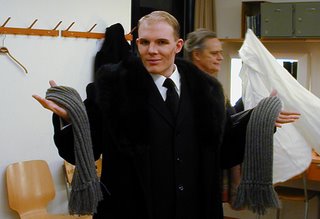
Early the next morning my scabby face appeared in the director’s office. “Look pal,” I said, “I did not spend 6 years in conservatory, earn a master’s degree and fly to Switzerland at my own expense to do walk-on roles for free. I did the rehearsals, I’m giving up six evenings for performances, and I will be paid what you said I would be paid for stage performances or I will not do them. I did not leave my apartment in the hands of a subletter to come to Europe for a year to volunteer to not sing. I auditioned for this.”
I got my fee.
Tuesday, April 18, 2006
Monday, April 17, 2006
Nuclear Threats
I’ve been trying to catch up on last week’s news, most of which I missed because I didn’t have time to do any reading during the office move.
Far and away, what horrified me the most is the development that the Bush Administration is considering – or, “won’t rule out,” or, “all options are on the table,” in their parlance – using “tactical” nuclear weapons on Iran.
Where to begin? As if we needed further proof that the White House is run by people who are insane, they’ve now handed us this definitive evidence that they are mad. Absolutely, unapologetically, unquestionably cuckoo.
As Condoleezza Rice recently helpfully pointed out in an interview with the British press, “Iran is not Iraq.”
Iran is “slightly larger than the combined area of the contiguous states of California, Arizona, Nevada, Oregon, Washington, and Idaho.” Iran is modern, it is wealthy, and even though experts declare that Iran’s claims of nuclear capability are exaggerated, there is no question about their ambitions.
Oh yes, Iran is not Iraq. Don’t let the people who tried to tell you that Iraq could be converted to democracy within six months at a cost of $1.7 billion plan out our strategy for dealing with Iran.
It’s time to have an open and honest debate about the doctrine of pre-emption: what it means, and what its limits should be, and what the standards for implementation ought to be. Clinton used it semi-successfully: the 1998 missile strikes on Iraq shut down what was left of Saddam’s WMD programs; he also blew up an aspirin factory in Sudan. Israel successfully bombed a nuclear reactor in Baghdad in 1981. Had Bush not rejected an option to bomb Zarqawi’s training camp in northern Iraq prior to the invasion, the occupation might have turned out very differently.
The world should not allow Iran to have nuclear weapons capability. Actually, no one should have it: nuclear weapons should be banned outright, and present weapons should be deactivated, their warheads used in power plants instead.
The United States, however, continues to maintain an enormous arsenal, by which it appears to claim authority to determine which other countries may have nuclear weapons: Israel, but not Iraq; India, but not Pakistan. The international community should strongly condemn this notion and actively seek to thwart it.
A mere sixty years into the history of a nuclear world, it is the height of arrogance to assume we know all the potential ramifications of using weapons with radioactive half-lives lasting decades or centuries, depending on size and ingredients. Nuclear weapons are immoral not because of their immediate and devastating explosive power, but because they poison the atmosphere, the water and the soil. They make a place literally unlivable. Those who are not killed instantly succomb to or suffer from radiation sickness. They may develop rare cancers or other diseases; children born years after the attack can be severely deformed.
During the Cold War, the concept of “mutually assured destruction” kept us at relative peace. Both sides knew that in the event of nuclear war, there would be no winner. Everyone would be annihilated. That would not be the case in a strike on Iran: the U.S., taking unfair advantage of superior weaponry, would unleash environmental hell. The Bushies see no apparent disconnect in the argument that they have the authority to use nuclear weapons to stop a country from doing the same.
Instead of a nuke, there’s something else we might try: friendship.
Sunday, April 16, 2006
Sunday Photo Blogging: Spring!

Pictures from Ft. Tryon Park in upper Manhattan, taken on a beautiful Easter morning. Enjoy!


Saturday, April 15, 2006
The Sounds of Summer
I think we can safely say that winter is over.
It was 78 and sunny in New York today. Birds are singing, tulips and daffodils are blooming, and my windows are open. I am sighing a big sigh of joyful contentedness. Personally, I'm in favor of global warming. Winter is evil. (Okay, I'm not really being serious about global warming, but I do regularly fantasize about living somewhere like San Diego where a blustry winter day is 60.)
I love summer so much. Even in New York. The streets look better when the trees have leaves. The people look better when they're not bundled up under eight layers and a hat. Fire Island! Hurray for warm weather!
Of course summer in New York does have its drawbacks. Humidity. The smells of rotting garbage. The smells of stale urine in the subway stations. The smells of subways, period. But the worst, absolutely the worst, is the fucking Mr. Softee truck.
Why, why, Mr. Softee, must you park right outside my window every year? For hours? Playing that godforsaken horrible crucible of a jingle? Out of tinny, rusty speakers? The same eight bars of "melody," over and over and over and over and over. This is, I'm sure, what the mood music in hell sounds like (except there's no ice cream truck).
Digital technology being what it is -- if I hit "shuffle" on my iPod it would play continuously without repeating a single song for 12 days, 8 hours, 49 minutes and 19 seconds -- I can't comprehend why you're stuck on these same eight bars. Are you afraid the Liebestod won't sell ice cream?
Well, I guess this is the price I pay for decent weather. It could be worse...I suppose Mr. Softee could switch to "My Humps."
Friday, April 14, 2006
Rescuing Kundry
When we first meet Parsifal, midway through the first act, he is a bumbling ball of ignorance, all id and no superego. When Kundry tells him that his mother has died, he attacks her and tries to choke her. Gurnemanz and the knights pull him off her, and then she brings him a drink of water. “Well done, according to the Grail’s mercy,” declares Gurnemanz. “For evil is ended when it is repaid with goodness.”
Kundry is a wildly misunderstood character. At the top of the second act, the evil sorcerer Klingsor wakes her with an invocation: “Herodias you were, and what else? Gundryggia there, Kundry here!” This is a reference to her many incarnations, one of the strongest Buddhist aspects of the work: karma has condemned her to successive lives in which she must atone for some great sin.
Misinterpretations of Parsifal often begin with this line. Kundry’s original identity was Herodias, wife of King Herod of Judaea, mother of Salome. Alone with Parsifal in Klingsor’s garden, she will confess: “I saw Him…Him! And…I laughed.” That is to say, she observed Christ carrying his cross on the road to Calvary on the day we now call "Good Friday"; she beheld ultimate suffering, and she mocked it. This has unfortunately given rise to the idea that Parsifal is an anti-Semitic work.
The truth is that the historical Herodias was neither religiously nor ethnically Jewish. That is not a recent discovery, and Wagner was almost certainly aware of it. Furthermore, Kundry’s other named incarnation, Gundryggia, is a figure from Nordic legend: an Aryan. Kundry’s sin is not Jewishness, as so many people have assumed Wagner intended. It was her fundamental lack of compassion.
Moreover, Kundry is portrayed by Wagner as a victim of discrimination. The stage directions describe her as a woman with dark eyes, black hair, and a deep red-brown complexion. In act one, the young squires of the Grail deride her behavior, saying she acts like a “wild beast,” and they accuse her of being a heathen sorceress who hates them.
“What harm has she done you?” asks the wise old Gurnemanz. “She has nothing in common with you, yet when help is wanted in danger, her zeal speeds her through the air, and she never looks to you for thanks.”
The Grail Temple is hidden in a magical forest, "where time and space are one," protected by a spell that keeps all who are unworthy from ever finding it. That is how Gurnemanz initially recognizes Parsifal’s potential: only those whom the Grail summons may approach. Significantly, Kundry can come and go from the forest as she pleases. I have never seen anyone else comment on this: it seems the Grail welcomes Kundry, but it is the knights who never extend to her the invitation to visit the temple itself. She is strange, mysterious, unfamiliar, and therefore they are suspicious.
Kundry needs to be loved, to have her humanity valued, and, above all, to be forgiven. It is Parsifal who is eventually able to offer her pardon. Compassion and forgiveness seem like such simple things, but Wagner realized that in fact they are immensely difficult for people. What couldn’t be achieved in this world if we were only willing to forgive each other all transgressions as Christ commands? In this way, when Parsifal calls her “Friend” in the third act, his compassion is more heroic, brave and triumphant than any mortal sacrifice in any other Wagner opera.
On a beautiful Good Friday, when the world is filled with signs of renewal, it is Parsifal who then leads Kundry to the temple for the first time, where she is released from her curse of immortality and sinks lifeless, but transcended and redeemed, to the ground. Parsifal is not an opera about racial or gender exclusion; on the contrary, it is a hymn to inclusion, a command to look beyond people’s superficial traits and embrace their inner human worth.
A vindictive opera? An assassination of basic ethics? Hardly.
Subscribe to:
Posts (Atom)