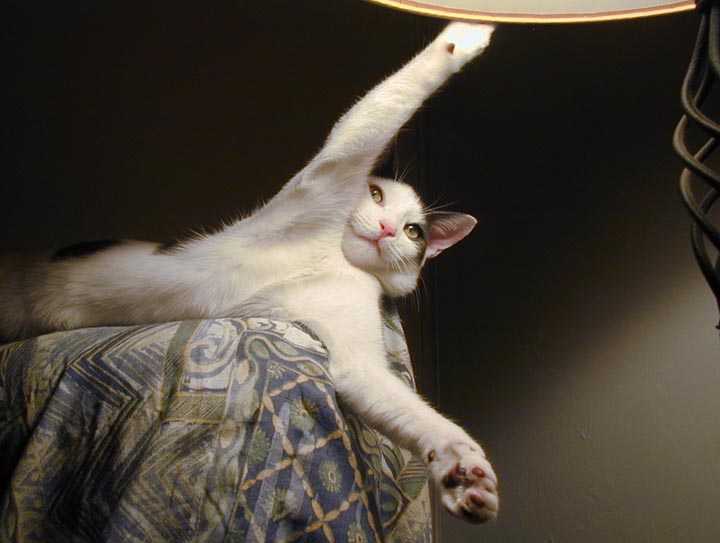
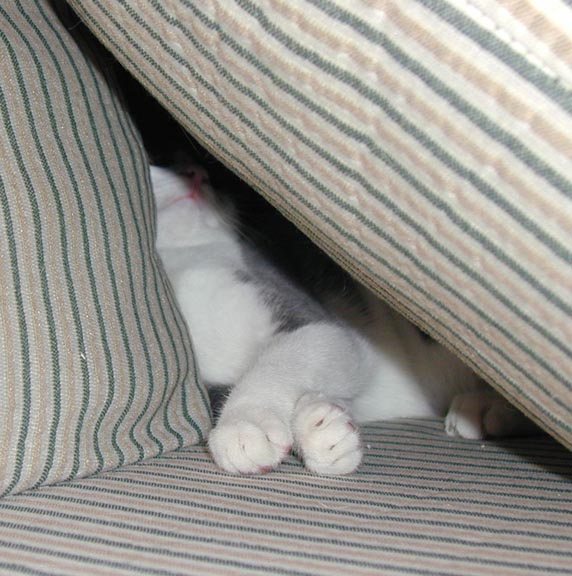
Rocky has developed this odd habit of sitting on the back of the recliner and resting one paw on the lampshade. He finds that very comfortable, apparently.

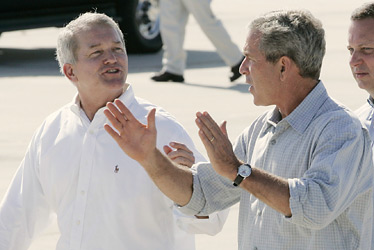 L-R: ex-Congressman Mark Foley, President George W. Bush, ex-FEMA director Mike "Heckuva Job" Brown.
 Conventional wisdom says that opera is a dying art form, that the audiences are aging and shrinking. But that’s not borne out by the facts: over the past half-century, opera in America has grown exponentially in popularity, from two opera houses in 1952 to 114 professional companies in 43 states, which give nearly 3,000 annual performances attended by 6.6 million people. American opera audiences grew 8.2% from 1992 to 2002, the largest audience increase of all performing arts disciplines.
 Those who are interested in seeing opera kept alive must be realistic: opera isn’t for everyone, anymore than baseball or bungi-jumping or blogging or any other pastime. We also should not be concerned about the median age of the opera audience: opera tends to be something people come to appreciate later in life; go back and look at historical photos of the audience at the Old Met in its heyday: everyone’s old.
 So how do we keep opera alive? Bishop is correct when he writes, “Music is the art form that comes closest to expressing that which is inexpressible.” That’s a strength that needs to be emphasized. But he also astutely notices “the athletic requirements of classical singing.” Opera needs to be compared not just with other forms of theatrical entertainment, but with sports. Opera fans reminisce about Corelli and Tebaldi the way sports fans talk about DiMaggio and Mays. Semiramide might not be relevant, but “Bel raggio lusinghier” is certainly athletic, and if Tristan is a marathon, Violetta is something of a triathlon.


Last month, Patricia Todd won the Democratic primary in Alabama’s district 54; since there is no Republican candidate, she will run unopposed in the general election for the state legislature, making her the first openly-gay elected official in Alabama history.
The primary victory was not without its hiccups, however. Ms. Todd is white, and district 54 is predominately black. She emerged the winner after a runoff election by 59 votes over a black challenger, but was then accused of breaking a law requiring that financial disclosure forms be filed five days before an election. (Todd filed the day before.)
It turned out, however, that this law had never once been enforced since its establishment in 1988, and that not only did the Democratic candidates for governor and lieutenant governor also fail to comply, the challenger herself did not submit the report on time. A Democratic Party subcommittee then voted to disqualify both candidates. A full committee overturned that decision, based on a state supreme court ruling that late filing is not grounds for disqualification.
The kerfluffle is the result of interference from a Democratic Party bigwig, Joe Reed, who told The New York Times, “This is not about lifestyles; this is not about race. This is about whether she complied with the party rules.”*
Yet he told The Birmingham News, “I don’t apologize in regard to trying to preserve a black seat,” and wrote a letter to county leaders urging them to vote for “blacks in majority black districts” and to “pull out all the stops to help elect” Todd’s challenger. (Imagine if someone claimed we should preserve a "white" seat.) Flyers were circulated during the runoff calling Todd a “confessed lesbian.”
Essentially what happened is that a Dem boss disagreed with the voters over who should represent them, and he tried to rig an election on a technicality.
Joe Murray, writing for the American Family Association, on the other hand, has a different take on the situation: “For almost half a century, blacks in the South enjoyed a hegemonic reign -- that is, until the arrival of the homosexuals," which was apparently in July.
“The homosexual hoedown between blacks and gays had begun,” he writes. “The Todd story shows that there is a power shift occurring in the Democratic Party. Homosexual activists are marching out of strongholds such as San Francisco, South Beach, and Provincetown, and they have their eyes set on other places, such as the Land of Cotton."** (Todd, for the record, is a native of that left-wing fringe state Kentucky and has lived in Birmingham for over 20 years.)
Murray sees Todd’s victory as a result of the machinations of the Democratic Party, in an attempt to liberalize the South by installing people like Patricia Todd – “the homosexual lobby’s lesbian lieutenant,” Murray calls her – in state legislatures. “Todd was a trophy candidate; a candidate funded by the gay lobby, and her victory signals the Democratic wind is blowing in a new direction. Gays in, blacks out.”
“The homosexual lobby is on a quest to raise its rainbow flag over every state house in the Union,” says Murray. Exactly how an unpopular minority group that makes up somewhere from 2-10% of the American population is going to take over the government by winning elections in the Bible Belt is unclear.
The flaw with Murray’s analysis -- leaving aside the fact that he’s capable of writing sentences like, “District 54 will become a Michael Jackson district (i.e., once black and now white)” – is that it was actually Democratic Party bosses who intervened to try to overturn Todd’s election.
What he really doesn’t want to admit is that Patricia Todd didn’t win on some technicality organized by Howard Dean pulling strings a thousand miles away in Washington, D.C.; Patricia Todd got more votes than anyone else. If there's a power struggle going on between blacks and gays (these are mutually exclusive subsets?), somebody ought to tell the black folks in Alabama not to vote for white lesbians.
Oh. They did. And it didn't work.
* The challenger he supported broke the same law.
** We are also after the Lands of Linen, Wool, and Leather, but if you are concerned about The Homosexual Agenda, you might want to consider emigrating to the Lands of Polyester, Rayon and Pleather.