Sigh. Some atheists are every bit as smugly self-righteous, arrogant and prejudiced as the religious extremists they decry.
Because "news" in America must have entertainment value, the public faces of religion in this country are loons willing to compress complex ideas into rhetorical soundbytes. I will grant that eloquent voices of moderation are hard to find in this world of infotainment.
I am the last person to claim religion is harmless. I frequently like to quote Bishop Gene Robinson: "Religion is the source of our oppression."
But it is an intellectually dishonest position to say that all religious ideas and all religious people are deluded and harmful. That idea isn't any more enlightened than creationism, or any more supportable by empirical study.
If atheists want to take pride in "reason" and "intellectualism," then perhaps they should take more of an interest in getting their facts straight.
Tuesday, November 07, 2006


Gender and Genitalia
What defines male and female?
The New York Times reports today that New York City is likely to adopt a proposal to allow transgender people to change the gender on their birth certificate even if they have not had reassignment surgery.
First, a primer on what is meant by “transgender.” Let us make a clear distinction – even as we acknowledge that these are blurry boundaries – between drag performers, or gender illusionists, who take on an alternate persona for the purpose of entertainment, transvestites or crossdressers, who enjoy dressing up as the opposite gender as a form of recreation, and people who suffer from gender identity disorder. One is an act, one is a hobby and the last is a psychological condition where a person’s self-perception of their gender does not match their genitalia.
This is a new and shocking social frontier for many of us, and let me be the first to admit I don’t fully understand it, myself – and to that end, I apologize in advance to any transfolks who might read this and infer insensitivity where really there is only ignorance.
Are men and women really only defined by their genitalia? Of course not. If that were the case, we wouldn’t have books like Men are from Mars, Women are from Venus trying to explain what the differences are, we’d have books called Men Have Penises and Women Have Vaginas, and it would be a very short book. A pamphlet, even. We wouldn’t have academic studies about why boys and girls tend to perform differently in school and we wouldn’t have had a big to-do when Larry Summers tried to explain why there aren’t as many women scientists. He could have said, “Because they have vaginas,” and, if that were truly what determined gender, he might have been right and that would have been the end of it.
In this year’s New York Court of Appeals ruling on same-sex marriage, Judge R.S. Smith argued that marriage should be limited to opposite-sex couples because “a child benefits from having before his or her eyes, every day, living models of what both a man and a woman are like.” I don’t think he meant that children need to be shown a penis and a vagina every day to avoid confusion.
We can debate whether gender stereotyping is right or wrong, but however we feel about it we must admit it exists, and it starts at birth: babies with vaginas are dressed in pink, and babies with penises in blue. Some children get Barbies as presents, and some get fire trucks, and what they have between their legs determines how we talk to them, how we encourage them to behave, and what we expect of them. Yet when we say to children, “You need to behave like a big boy now” or “Act like a man,” that doesn’t really have anything to do with their penis. We usually perceive who is a man and who is a woman without needing to check below the belt. Quite simply put, one’s gender identity consists of a lot more than a reproductive organ.
[On a side note, we should really examine our ambivalence about our sexual organs, and why it is that we call people dicks, pussies and cunts.]
Gender is defined by more than genital status, and since hormone therapy and reassignment surgery are not covered by insurance (not to mention this country has 45 million uninsured people anyway), many transgender people cannot afford medical treatment. Also, given our larger social gender prejudices, it’s often difficult for transfolks to find meaningful work, because they are perceived to be mentally ill, or at a minimum, very weird, and somewhat threatening. Some transgender people do not feel a need for therapy or surgery. The new policy would allow birth certificates to be changed with recommendations from a doctor and a therapist and evidence that the applicant has lived with their current gender expression for two years.
Kudos to New York City for having the courage to confront this controversial issue and to come up with positive recommendations.
The New York Times reports today that New York City is likely to adopt a proposal to allow transgender people to change the gender on their birth certificate even if they have not had reassignment surgery.
First, a primer on what is meant by “transgender.” Let us make a clear distinction – even as we acknowledge that these are blurry boundaries – between drag performers, or gender illusionists, who take on an alternate persona for the purpose of entertainment, transvestites or crossdressers, who enjoy dressing up as the opposite gender as a form of recreation, and people who suffer from gender identity disorder. One is an act, one is a hobby and the last is a psychological condition where a person’s self-perception of their gender does not match their genitalia.
This is a new and shocking social frontier for many of us, and let me be the first to admit I don’t fully understand it, myself – and to that end, I apologize in advance to any transfolks who might read this and infer insensitivity where really there is only ignorance.
Are men and women really only defined by their genitalia? Of course not. If that were the case, we wouldn’t have books like Men are from Mars, Women are from Venus trying to explain what the differences are, we’d have books called Men Have Penises and Women Have Vaginas, and it would be a very short book. A pamphlet, even. We wouldn’t have academic studies about why boys and girls tend to perform differently in school and we wouldn’t have had a big to-do when Larry Summers tried to explain why there aren’t as many women scientists. He could have said, “Because they have vaginas,” and, if that were truly what determined gender, he might have been right and that would have been the end of it.
In this year’s New York Court of Appeals ruling on same-sex marriage, Judge R.S. Smith argued that marriage should be limited to opposite-sex couples because “a child benefits from having before his or her eyes, every day, living models of what both a man and a woman are like.” I don’t think he meant that children need to be shown a penis and a vagina every day to avoid confusion.
We can debate whether gender stereotyping is right or wrong, but however we feel about it we must admit it exists, and it starts at birth: babies with vaginas are dressed in pink, and babies with penises in blue. Some children get Barbies as presents, and some get fire trucks, and what they have between their legs determines how we talk to them, how we encourage them to behave, and what we expect of them. Yet when we say to children, “You need to behave like a big boy now” or “Act like a man,” that doesn’t really have anything to do with their penis. We usually perceive who is a man and who is a woman without needing to check below the belt. Quite simply put, one’s gender identity consists of a lot more than a reproductive organ.
[On a side note, we should really examine our ambivalence about our sexual organs, and why it is that we call people dicks, pussies and cunts.]
Gender is defined by more than genital status, and since hormone therapy and reassignment surgery are not covered by insurance (not to mention this country has 45 million uninsured people anyway), many transgender people cannot afford medical treatment. Also, given our larger social gender prejudices, it’s often difficult for transfolks to find meaningful work, because they are perceived to be mentally ill, or at a minimum, very weird, and somewhat threatening. Some transgender people do not feel a need for therapy or surgery. The new policy would allow birth certificates to be changed with recommendations from a doctor and a therapist and evidence that the applicant has lived with their current gender expression for two years.
Kudos to New York City for having the courage to confront this controversial issue and to come up with positive recommendations.
Monday, November 06, 2006
Saturday, November 04, 2006
Against the Use of Nature
We still don’t know the full story of what happened between megapastor Ted Haggard and the Denver-based male escort, so it’s premature to draw conclusions about this specific incident. Yet, like any parable, we can start to examine the lessons, even if we don’t know all the details.
That Haggard admits he purchased methamphetamines is, I think, the most significant part of the story right now. Sex and drugs tend to go together, but there are many, many drugs out there, like pot, cocaine and painkillers, that aren’t necessarily used in sexual situations. You can do a bump of coke in the bathroom at a club for a boost of energy, or you can stay at home on a rainy night, dim the lights, put on Coltrane and light up. You can pop a vicodin in your office before the board meeting. But meth is a sex drug, and while there are certainly straight people who use it, crystal, or “tina,” is ubiquitous on the gay party circuit.
It gives the user – so I’m told – an overwhelming sense of immortality and invincibility, as well as a raging, uninhibited sex drive. An acquaintance of mine who has used it said it makes you feel “amazing” and turns you into the Energizer Bunny in bed, except that the ad slogan would be “it keeps on coming” instead. The idea that someone would use methamphetamines without intending to use it to enhance sexual performance and experience would be akin to someone randomly taking a hit of Cialis without intending to get laid.
So while it may remain in the realm of possibility that Pastor Ted innocently arranged for a massage with a man he did not know was a prostitute, it defies credibility that innocuous conversation with a masseur would casually and naturally turn to discussions about how to obtain a gay sex drug.
Haggard’s evangelical colleague James Dobson was quoted by The New York Times today saying, “The situation has grave implications for the cause of Christ and we ask for the Lord’s guidance and blessings in the days ahead.” For once I agree with him.
In Paul’s letter to the Romans, there is a passage on sexual immorality that is at the heart of the ongoing discussion about homosexuality and Christianity. In the time and culture in which Paul was writing, as with today, many people believed that only heterosexual orientation is natural, and that gay people are folk who “exchange natural intercourse for unnatural” motivated by “the lusts in their hearts.”
But increasingly today we come to the awareness that sexual orientation is less about lust than something innate, with evidence that it is genetic in origin. This turns Paul’s sentence on its head, or at least opens it up to a new, more expansive reading: the sin is in the exchange of one’s natural sexual identity for one that is false.
We don’t know yet precisely what Mr. Haggard’s situation is, but the anecdotal evidence about what happens when a gay person suppresses their natural identity in exchange for an outwardly heterosexual lifestyle, including marriage and children, is vast, and it’s not pretty.
The problems arise not only because of sexual urges that are difficult to restrain, but because sexual orientation is an essential part of identity and self-awareness, quite apart from sexual activity. Sexual attraction and activity is merely a manifestation, an expression of who you are. Pretending to be heterosexual is not about refraining from gay sex, it’s about denying a huge part of what makes you you.
“The cause of Christ,” as Dobson puts it, is love. May we all come to understand that we do not serve Christ faithfully by only pretending to love someone. We do not serve Christ by loving someone only on the condition that they conform to ancient prejudices about sexual orientation. We will serve Christ best by loving honestly and sincerely, which can only be done when we honestly and sincerely love our own true natures.
As progressive Christians, we must resist the temptation to indulge in schadenfreude over an Evangelical’s hypocritical downfall. Mr. Haggard remains our brother in Christ. May he find healing through the peace of God, which surpasses all understanding.
That Haggard admits he purchased methamphetamines is, I think, the most significant part of the story right now. Sex and drugs tend to go together, but there are many, many drugs out there, like pot, cocaine and painkillers, that aren’t necessarily used in sexual situations. You can do a bump of coke in the bathroom at a club for a boost of energy, or you can stay at home on a rainy night, dim the lights, put on Coltrane and light up. You can pop a vicodin in your office before the board meeting. But meth is a sex drug, and while there are certainly straight people who use it, crystal, or “tina,” is ubiquitous on the gay party circuit.
It gives the user – so I’m told – an overwhelming sense of immortality and invincibility, as well as a raging, uninhibited sex drive. An acquaintance of mine who has used it said it makes you feel “amazing” and turns you into the Energizer Bunny in bed, except that the ad slogan would be “it keeps on coming” instead. The idea that someone would use methamphetamines without intending to use it to enhance sexual performance and experience would be akin to someone randomly taking a hit of Cialis without intending to get laid.
So while it may remain in the realm of possibility that Pastor Ted innocently arranged for a massage with a man he did not know was a prostitute, it defies credibility that innocuous conversation with a masseur would casually and naturally turn to discussions about how to obtain a gay sex drug.
Haggard’s evangelical colleague James Dobson was quoted by The New York Times today saying, “The situation has grave implications for the cause of Christ and we ask for the Lord’s guidance and blessings in the days ahead.” For once I agree with him.
In Paul’s letter to the Romans, there is a passage on sexual immorality that is at the heart of the ongoing discussion about homosexuality and Christianity. In the time and culture in which Paul was writing, as with today, many people believed that only heterosexual orientation is natural, and that gay people are folk who “exchange natural intercourse for unnatural” motivated by “the lusts in their hearts.”
But increasingly today we come to the awareness that sexual orientation is less about lust than something innate, with evidence that it is genetic in origin. This turns Paul’s sentence on its head, or at least opens it up to a new, more expansive reading: the sin is in the exchange of one’s natural sexual identity for one that is false.
We don’t know yet precisely what Mr. Haggard’s situation is, but the anecdotal evidence about what happens when a gay person suppresses their natural identity in exchange for an outwardly heterosexual lifestyle, including marriage and children, is vast, and it’s not pretty.
The problems arise not only because of sexual urges that are difficult to restrain, but because sexual orientation is an essential part of identity and self-awareness, quite apart from sexual activity. Sexual attraction and activity is merely a manifestation, an expression of who you are. Pretending to be heterosexual is not about refraining from gay sex, it’s about denying a huge part of what makes you you.
“The cause of Christ,” as Dobson puts it, is love. May we all come to understand that we do not serve Christ faithfully by only pretending to love someone. We do not serve Christ by loving someone only on the condition that they conform to ancient prejudices about sexual orientation. We will serve Christ best by loving honestly and sincerely, which can only be done when we honestly and sincerely love our own true natures.
As progressive Christians, we must resist the temptation to indulge in schadenfreude over an Evangelical’s hypocritical downfall. Mr. Haggard remains our brother in Christ. May he find healing through the peace of God, which surpasses all understanding.
Friday, November 03, 2006
Fundy Fodder
What irks me most about the allegations surrounding Ted Haggard is that they reinforce the prejudices of the fundamentalists.
Religious fundamentalists will claim this is further proof that gay people are secretive, promiscuous drug users.
Secular fundamentalists will claim this is further proof that Christians are hypocrites.
Religious fundamentalists will claim this is further proof that gay people are secretive, promiscuous drug users.
Secular fundamentalists will claim this is further proof that Christians are hypocrites.
Thursday, November 02, 2006
I Want an Apology
Let's establish a new rule for politicians, shall we?
From now on, no one can demand an apology from anyone except the person who was actually the target of the alleged offensive comment.
*****
If I had known how today was going to turn out, I'd have stayed in bed with the covers over my head and the curtains drawn.
From now on, no one can demand an apology from anyone except the person who was actually the target of the alleged offensive comment.
*****
If I had known how today was going to turn out, I'd have stayed in bed with the covers over my head and the curtains drawn.
Tuesday, October 31, 2006
Monday, October 30, 2006
Two Questions
1. Which movie adaptation of a book was your biggest disappointment?
For me, the easy answer is The Black Stallion Returns. That was a phenomenal book, on which the movie was VERY loosely based. A huge disappointment. The book was romantic, exotic, surprising, and highly evocative of time and place.
*****
2. Has anyone ever actually gotten a job simply from having posted a resume on a website like Monster.com?
For me, the easy answer is The Black Stallion Returns. That was a phenomenal book, on which the movie was VERY loosely based. A huge disappointment. The book was romantic, exotic, surprising, and highly evocative of time and place.
*****
2. Has anyone ever actually gotten a job simply from having posted a resume on a website like Monster.com?
Friday, October 27, 2006
And You Thought My Taste in Music Sucked
On the A train home tonight there was a man listening to a cutting board.
Thursday, October 26, 2006
NJ Marriage Decision: Initial Thoughts
Woot!
I know you have all been waiting impatiently for me to post on this, hungry as you are for the kind of insightful legal analysis that can only be provided by a human resources assistant with a master's degree in classical voice.
Yesterday was something of a nailbiter, having to wait until 3:00 (after having waited over eight months) to finally get the decision in Lewis v. Harris, the New Jersey Supreme Court case weighing whether same-sex couples were permitted to marry under the state constitution.
After a string of disappointments this year in New York, Washington, California, Nebraska and Georgia, I wondered if there was any cause for optimism. I also worried about potential ramifications of the decision this close to elections, whichever way it came down.
When the decision was finally posted, it was not immediately clear what it said. The first language that caught my eye, in the syllabus by the court clerk, was that the decision of the appellate court had been modified but affirmed, which -- since we lost at the appellate level -- to my mind meant that the court had reached the same conclusion by different reasoning, but we had still lost.
Furthermore, I saw that there was a split 4-3 decision, and Chief Justice Poritz, who I personally had assumed to be in favor of marriage equality based on watching her during the oral arguments, had voted with the dissent. That looked like trouble.
But in fact, it was one huge ginormous victory.
There was no "dissent" in the normal sense, where one part of the court reaches an opposite conclusion of the majority. All seven justices found that the present situation in New Jersey unfairly disadvantages same-sex couples and violates the liberty and equal protection guarantees of the state constitution. In short, the court ruled unanimously in our favor, which I think was both unexpected and unprecedented.*
The split occurred because the majority found that under their understanding of the term "fundamental right," there was no fundamental right to same-sex marriage (even though they explicitly state that marriage is a state and federally-recognized fundamental right) because it is not deeply rooted in history, tradition and collective conscience. So while they have instructed the state legislature to make available to same-sex couples all rights, privileges, protections and responsibilities of married opposite-sex couples, they chose to defer to the legislature on whether to call that "marriage" or instead set up an identical system (presumably civil unions) for same-sex couples.
The three dissenting judges, led by Chief Justice Deborah Poritz on the occasion of her mandatory retirement, disagreed with the majority conclusion. If the issue of same-sex marriage is one of equal protection, then a separate classification, no matter how closely it mirrors opposite-sex marriage, is by definition a violation of that principle. Judge Poritz also found that, based on Loving v. Virginia, it is not necessary that a practice (interracial marriage or same-sex marriage) be rooted in tradition or collective conscience in order for it to be qualified as a fundamental right. The dissent found that same-sex couples should be allowed to marry, and call it marriage.
The New Jersey Legislature must act within 180 days. While of course I believe they should apply the term marriage to civil partnerships of both same- and opposite-sex couples, even should they choose "civil unions" or other terminology, it will be a huge step forward toward equality.
*****
As far as the elections go: in my deepest heart of hearts, I believe most Americans really do not give a flying one about gay marriage. I think people are concerned about national security, about the war in Iraq, about the economy, about fiscal responsibility, and about government transparency. The New Jersey decision may rejuvenate some of the disenchanted far right, but Democrats should not allow this silly wedge issue to overshadow the pressing questions of the day which affect us all. As Red Leader says in Star Wars, "Stay on target."
*****
* See comments for correction.
I know you have all been waiting impatiently for me to post on this, hungry as you are for the kind of insightful legal analysis that can only be provided by a human resources assistant with a master's degree in classical voice.
Yesterday was something of a nailbiter, having to wait until 3:00 (after having waited over eight months) to finally get the decision in Lewis v. Harris, the New Jersey Supreme Court case weighing whether same-sex couples were permitted to marry under the state constitution.
After a string of disappointments this year in New York, Washington, California, Nebraska and Georgia, I wondered if there was any cause for optimism. I also worried about potential ramifications of the decision this close to elections, whichever way it came down.
When the decision was finally posted, it was not immediately clear what it said. The first language that caught my eye, in the syllabus by the court clerk, was that the decision of the appellate court had been modified but affirmed, which -- since we lost at the appellate level -- to my mind meant that the court had reached the same conclusion by different reasoning, but we had still lost.
Furthermore, I saw that there was a split 4-3 decision, and Chief Justice Poritz, who I personally had assumed to be in favor of marriage equality based on watching her during the oral arguments, had voted with the dissent. That looked like trouble.
But in fact, it was one huge ginormous victory.
There was no "dissent" in the normal sense, where one part of the court reaches an opposite conclusion of the majority. All seven justices found that the present situation in New Jersey unfairly disadvantages same-sex couples and violates the liberty and equal protection guarantees of the state constitution. In short, the court ruled unanimously in our favor, which I think was both unexpected and unprecedented.*
The split occurred because the majority found that under their understanding of the term "fundamental right," there was no fundamental right to same-sex marriage (even though they explicitly state that marriage is a state and federally-recognized fundamental right) because it is not deeply rooted in history, tradition and collective conscience. So while they have instructed the state legislature to make available to same-sex couples all rights, privileges, protections and responsibilities of married opposite-sex couples, they chose to defer to the legislature on whether to call that "marriage" or instead set up an identical system (presumably civil unions) for same-sex couples.
The three dissenting judges, led by Chief Justice Deborah Poritz on the occasion of her mandatory retirement, disagreed with the majority conclusion. If the issue of same-sex marriage is one of equal protection, then a separate classification, no matter how closely it mirrors opposite-sex marriage, is by definition a violation of that principle. Judge Poritz also found that, based on Loving v. Virginia, it is not necessary that a practice (interracial marriage or same-sex marriage) be rooted in tradition or collective conscience in order for it to be qualified as a fundamental right. The dissent found that same-sex couples should be allowed to marry, and call it marriage.
The New Jersey Legislature must act within 180 days. While of course I believe they should apply the term marriage to civil partnerships of both same- and opposite-sex couples, even should they choose "civil unions" or other terminology, it will be a huge step forward toward equality.
*****
As far as the elections go: in my deepest heart of hearts, I believe most Americans really do not give a flying one about gay marriage. I think people are concerned about national security, about the war in Iraq, about the economy, about fiscal responsibility, and about government transparency. The New Jersey decision may rejuvenate some of the disenchanted far right, but Democrats should not allow this silly wedge issue to overshadow the pressing questions of the day which affect us all. As Red Leader says in Star Wars, "Stay on target."
*****
* See comments for correction.
Tuesday, October 24, 2006
Gays and the Laws of Moses
Should gay and lesbian people be full members of the Christian community? Should they be priests? Should the sacrament of marriage be extended to them? Should they even be welcomed into the building?
A lot of people point to passages in Leviticus, which call homosexuality an “abomination.” But are those passages valid and binding?
For that we need to consider the book of Acts, written by the author of the Gospel of Luke. In the sixth and seventh chapters, Stephen is arrested by a religious council and charged with saying that Jesus came to “change the customs Moses handed down to us.”
Stephen does not (and cannot) deny the accusation, since Jesus did specifically reject Torah passages on vengeance, divorce and dietary restrictions, but instead, after demonstrating his full familiarity with Scripture, turns on the council and accuses them of “forever opposing the Holy Spirit, just as your ancestors used to do.”
In the tenth chapter, Peter has a vision of “something like a sheet” coming down from heaven, and on it are all manner of animals designated by Moses as unclean. “Get up, Peter; kill and eat,” says God. Peter protests: “I have never eaten anything that is profane or unclean!” But God responds, “What God has made you must not call unclean or profane.”
Then Peter goes to Caesarea to meet with Cornelius, a Roman centurion. Peter, remembering the lesson from his vision, greets Cornelius by saying, “You yourselves know that it is unlawful for a Jew to associate with or to visit a Gentile; but God has shown me that I should not call anyone profane or unclean.”
After talking with Cornelius, Peter declares, “I truly understand that God shows no partiality, but in every nation, anyone who fears him and does what is right is acceptable to him.” But Peter’s Jewish followers were troubled, because Hebrew Scripture quotes God as saying, “Any uncircumcised male who is not circumcised in the flesh of his foreskin shall be cut off from his people; he has broken my covenant,” yet they “were astounded that the gift of the Holy Spirit had been poured out even on the Gentiles.”
Peter answered them by saying, “Can anyone withhold the water for baptizing these people who have received the Holy Spirit just as we have?”
Just as Peter understood that his vision of the animals applied not just to dietary restrictions, but the inherent sanctity of all creation, it is to be understood that Peter is not referring just to circumcised or uncircumcised people, but rather the invalidity of Scriptural passages that put barriers between people and the God who calls them. God wants you just as you are. No man is unclean. No change is necessary to be worthy of God’s love.
Yet people still insist on building barriers to the church. Yesterday, The New York Times reported on an Episcopal bishop in Connecticut who has authorized religious blessings for civil unions.
Rev. Canon David C. Anderson, of the American Anglican Council, criticized Bishop Smith and called it “proof of his disregard for the larger Anglican Communion and further evidences his militancy with the homosexual gay agenda” (someone call the Department of Repetitive Redundancy!). “Bishop Smith and some other bishops as well are literally choosing to pull themselves and their churches out of the broader religious community. In the future…there might be no place for people like Bishop Smith.”
Anderson tries to blame Bishop Smith; but it’s not Smith trying to fracture the church, he’s one of the many heeding Peter’s lesson that the church is open to everyone. For all their citation of scripture in oppressing gay and lesbian people, what many Christians miss is that the New Testament explicity forbids restricting Christian fellowship. Anderson closes the door not just on gays, but on everyone who takes the Gospel message seriously. How does a priest manage to claim that “there might be no place” for anyone?
Bishop Smith said, “I believe that it is time for us to rethink, repray and reform our theology and our pastoral practices; to welcome, recognize, support and bless the lives and faith of brothers and sisters who are gay and lesbian in the equal fullness of Christian fellowship.”
A lot of people point to passages in Leviticus, which call homosexuality an “abomination.” But are those passages valid and binding?
For that we need to consider the book of Acts, written by the author of the Gospel of Luke. In the sixth and seventh chapters, Stephen is arrested by a religious council and charged with saying that Jesus came to “change the customs Moses handed down to us.”
Stephen does not (and cannot) deny the accusation, since Jesus did specifically reject Torah passages on vengeance, divorce and dietary restrictions, but instead, after demonstrating his full familiarity with Scripture, turns on the council and accuses them of “forever opposing the Holy Spirit, just as your ancestors used to do.”
In the tenth chapter, Peter has a vision of “something like a sheet” coming down from heaven, and on it are all manner of animals designated by Moses as unclean. “Get up, Peter; kill and eat,” says God. Peter protests: “I have never eaten anything that is profane or unclean!” But God responds, “What God has made you must not call unclean or profane.”
Then Peter goes to Caesarea to meet with Cornelius, a Roman centurion. Peter, remembering the lesson from his vision, greets Cornelius by saying, “You yourselves know that it is unlawful for a Jew to associate with or to visit a Gentile; but God has shown me that I should not call anyone profane or unclean.”
After talking with Cornelius, Peter declares, “I truly understand that God shows no partiality, but in every nation, anyone who fears him and does what is right is acceptable to him.” But Peter’s Jewish followers were troubled, because Hebrew Scripture quotes God as saying, “Any uncircumcised male who is not circumcised in the flesh of his foreskin shall be cut off from his people; he has broken my covenant,” yet they “were astounded that the gift of the Holy Spirit had been poured out even on the Gentiles.”
Peter answered them by saying, “Can anyone withhold the water for baptizing these people who have received the Holy Spirit just as we have?”
Just as Peter understood that his vision of the animals applied not just to dietary restrictions, but the inherent sanctity of all creation, it is to be understood that Peter is not referring just to circumcised or uncircumcised people, but rather the invalidity of Scriptural passages that put barriers between people and the God who calls them. God wants you just as you are. No man is unclean. No change is necessary to be worthy of God’s love.
Yet people still insist on building barriers to the church. Yesterday, The New York Times reported on an Episcopal bishop in Connecticut who has authorized religious blessings for civil unions.
Rev. Canon David C. Anderson, of the American Anglican Council, criticized Bishop Smith and called it “proof of his disregard for the larger Anglican Communion and further evidences his militancy with the homosexual gay agenda” (someone call the Department of Repetitive Redundancy!). “Bishop Smith and some other bishops as well are literally choosing to pull themselves and their churches out of the broader religious community. In the future…there might be no place for people like Bishop Smith.”
Anderson tries to blame Bishop Smith; but it’s not Smith trying to fracture the church, he’s one of the many heeding Peter’s lesson that the church is open to everyone. For all their citation of scripture in oppressing gay and lesbian people, what many Christians miss is that the New Testament explicity forbids restricting Christian fellowship. Anderson closes the door not just on gays, but on everyone who takes the Gospel message seriously. How does a priest manage to claim that “there might be no place” for anyone?
Bishop Smith said, “I believe that it is time for us to rethink, repray and reform our theology and our pastoral practices; to welcome, recognize, support and bless the lives and faith of brothers and sisters who are gay and lesbian in the equal fullness of Christian fellowship.”
Sunday, October 22, 2006
The Opera House is Half Full
In today’s New York Times, veteran critic Anthony Tommasini wonders, “Where have all the voices gone?” in an op-ed he actually calls a “lamentation.”
Along with the myth that opera audiences are shrinking, one of the favorite complaints of self-styled opera aficionadi everywhere is that there are no longer any great voices. I bet that if you could travel back in time fifty years, and wander around the standing room at the back of the Old Met during a Tebaldi-Corelli Bohème, you’d find someone whining that audiences are getting older and that there aren’t any singers anymore, like there used to be in the days of Ponselle and Martinelli.
The inspiration for Tommasini’s premature eulogy is the new Metropolitan Opera production of Madama Butterfly, directed by Anthony Minghella.
You know, the one that garnered rave reviews and is sold out for the rest of the season.
The cast is headed by Chilean soprano Cristina Gallardo-Domas, whose singing of the title role, according to Tommasini, was “courageous,” but “patchy, pale and shaky” on high notes, even though “she made up in intensity and vulnerability what she lacked in vocal allure.” Who among today’s sopranos should have been cast instead? “No one I can think of,” confesses Tommasini.
He then compares her to some of the legendary sopranos of the past, namely Geraldine Farrar and Renata Tebaldi. Tebaldi, who had a uniquely warm voice and an instantly recognizable timbre with an impossibly seamless legato, was not exactly renowned as an actress. And while her top may not have been “patchy, pale and shaky,” it certainly could be steely and flat. Check out her paint-peeling high C at the end of Act I of La Bohème in the famous Serafin recording with Bergonzi – and that was in her prime.
Farrar, who was renowned as an actress (and a glamorous social figure, too – the famous “flapper” look of the 1920s is an abbreviation of “gerryflapper,” for Geraldine) had a singing style that is no longer in vogue: someone singing Butterfly today the way she sang it would probably get booed off the stage, assuming she could get hired.
But let’s take Tommasini’s point seriously. Where are the Tebaldis today?
Remember from my previous post that the number of professional opera companies in America has grown 5700% in fifty years. In those days, Tebaldi, along with Franco Corelli, Mario del Monaco, Zinka Milanov, Jussi Bjoerling, Leonard Warren and a host of other operatic legends, basically shuttled back and forth between the Met and San Francisco. Alas, it is true that voices like these are not common; but now they are spread among 114 professional companies in the US, not to mention those in Europe and elsewhere. The supply/demand ratio has altered tremendously, but that doesn’t mean that the voices aren’t out there.
Two other phenomena are also at work, however.
One is the recording industry. Fifty years ago, great recording stars like Maria Callas, Robert Merrill, Anna Moffo and Fedora Barbieri had well-established stage careers before they began making studio recordings. It was their excellence on stage that led to recording contracts. That trend is basically reversed today.
In the early 1990s, a young Italian mezzo soprano by the name of Cecilia Bartoli overturned conventional wisdom by showing up for “weeks on end” on Billboard’s best sellers not with crossover work, or even with operatic chestnuts, but with her 1993 album “Se tu m’ami,” which featured 17th and 18th century Italian songs with piano accompaniment. Bartoli is an extraordinary artist, but with her large, dark eyes, lustrous brown hair and classic Roman features, she is beautiful and photogenic, too.
She was a recording superstar long before her much-anticipated Met debut. So was tenor Roberto Alagna. Soprano Anna Netrebko. Baritone Dmitri Hvorostovsky. What do these singers have in common? They’re all beautiful people. Not a dowdy, fat “opera singer” in the bunch.
Now, that’s good. Nothing wrong with a beautiful person with talent, too. But in our search to find ways to attract new audiences to opera, we have become too focused on physical appearance.
This is nothing new: the audience at the premiere of Verdi’s La Traviata had trouble accepting the voluptuous Fanny Salvini-Donatelli as the consumptive heroine. But the mindset found, perhaps, its apex in 2004, when soprano Deborah Voigt was famously canned from the Royal Opera at Covent Garden’s production of Ariadne auf Naxos – she remains the world’s pre-eminent interpreter of the title role – because she couldn’t fit into the little black cocktail dress that was, apparently, at the heart of the director’s vision of the opera. If she hadn’t already been an international superstar by virtue of her stupendous talent, it never would have made headlines.
Here we must concede something important to the future of opera: God does not always apportion gifts evenly. Opera is not Hollywood. Opera is a highly artificial form of entertainment. That doesn’t mean “fake”: look at the root of the word. ART. The roles were written for voices, not for bodies.
While it does appear that Aida is often a very well-fed slave, we have to admit that if our focus is on the physical attractiveness of the singer, rather than their vocal gifts, sometimes we’re going to have to make a tradeoff. And furthermore, we should examine our own bias in the process. There is deep, ugly prejudice in the suggestion that if Isolde is not thin and young, she’s not a worthy object of the eternal, transcendant love offered by Tristan. Unglamorous, unshapely people have lives, feelings, triumphs and tragedies, too. If people are serious about making opera more “realistic,” and therefore, more “accessible,” they’d recognize that human beings come in all shapes and sizes.
And they might find some voices, while they're at it.
Along with the myth that opera audiences are shrinking, one of the favorite complaints of self-styled opera aficionadi everywhere is that there are no longer any great voices. I bet that if you could travel back in time fifty years, and wander around the standing room at the back of the Old Met during a Tebaldi-Corelli Bohème, you’d find someone whining that audiences are getting older and that there aren’t any singers anymore, like there used to be in the days of Ponselle and Martinelli.
The inspiration for Tommasini’s premature eulogy is the new Metropolitan Opera production of Madama Butterfly, directed by Anthony Minghella.
You know, the one that garnered rave reviews and is sold out for the rest of the season.
The cast is headed by Chilean soprano Cristina Gallardo-Domas, whose singing of the title role, according to Tommasini, was “courageous,” but “patchy, pale and shaky” on high notes, even though “she made up in intensity and vulnerability what she lacked in vocal allure.” Who among today’s sopranos should have been cast instead? “No one I can think of,” confesses Tommasini.
He then compares her to some of the legendary sopranos of the past, namely Geraldine Farrar and Renata Tebaldi. Tebaldi, who had a uniquely warm voice and an instantly recognizable timbre with an impossibly seamless legato, was not exactly renowned as an actress. And while her top may not have been “patchy, pale and shaky,” it certainly could be steely and flat. Check out her paint-peeling high C at the end of Act I of La Bohème in the famous Serafin recording with Bergonzi – and that was in her prime.
Farrar, who was renowned as an actress (and a glamorous social figure, too – the famous “flapper” look of the 1920s is an abbreviation of “gerryflapper,” for Geraldine) had a singing style that is no longer in vogue: someone singing Butterfly today the way she sang it would probably get booed off the stage, assuming she could get hired.
But let’s take Tommasini’s point seriously. Where are the Tebaldis today?
Remember from my previous post that the number of professional opera companies in America has grown 5700% in fifty years. In those days, Tebaldi, along with Franco Corelli, Mario del Monaco, Zinka Milanov, Jussi Bjoerling, Leonard Warren and a host of other operatic legends, basically shuttled back and forth between the Met and San Francisco. Alas, it is true that voices like these are not common; but now they are spread among 114 professional companies in the US, not to mention those in Europe and elsewhere. The supply/demand ratio has altered tremendously, but that doesn’t mean that the voices aren’t out there.
Two other phenomena are also at work, however.
One is the recording industry. Fifty years ago, great recording stars like Maria Callas, Robert Merrill, Anna Moffo and Fedora Barbieri had well-established stage careers before they began making studio recordings. It was their excellence on stage that led to recording contracts. That trend is basically reversed today.
In the early 1990s, a young Italian mezzo soprano by the name of Cecilia Bartoli overturned conventional wisdom by showing up for “weeks on end” on Billboard’s best sellers not with crossover work, or even with operatic chestnuts, but with her 1993 album “Se tu m’ami,” which featured 17th and 18th century Italian songs with piano accompaniment. Bartoli is an extraordinary artist, but with her large, dark eyes, lustrous brown hair and classic Roman features, she is beautiful and photogenic, too.
She was a recording superstar long before her much-anticipated Met debut. So was tenor Roberto Alagna. Soprano Anna Netrebko. Baritone Dmitri Hvorostovsky. What do these singers have in common? They’re all beautiful people. Not a dowdy, fat “opera singer” in the bunch.
Now, that’s good. Nothing wrong with a beautiful person with talent, too. But in our search to find ways to attract new audiences to opera, we have become too focused on physical appearance.
This is nothing new: the audience at the premiere of Verdi’s La Traviata had trouble accepting the voluptuous Fanny Salvini-Donatelli as the consumptive heroine. But the mindset found, perhaps, its apex in 2004, when soprano Deborah Voigt was famously canned from the Royal Opera at Covent Garden’s production of Ariadne auf Naxos – she remains the world’s pre-eminent interpreter of the title role – because she couldn’t fit into the little black cocktail dress that was, apparently, at the heart of the director’s vision of the opera. If she hadn’t already been an international superstar by virtue of her stupendous talent, it never would have made headlines.
Here we must concede something important to the future of opera: God does not always apportion gifts evenly. Opera is not Hollywood. Opera is a highly artificial form of entertainment. That doesn’t mean “fake”: look at the root of the word. ART. The roles were written for voices, not for bodies.
While it does appear that Aida is often a very well-fed slave, we have to admit that if our focus is on the physical attractiveness of the singer, rather than their vocal gifts, sometimes we’re going to have to make a tradeoff. And furthermore, we should examine our own bias in the process. There is deep, ugly prejudice in the suggestion that if Isolde is not thin and young, she’s not a worthy object of the eternal, transcendant love offered by Tristan. Unglamorous, unshapely people have lives, feelings, triumphs and tragedies, too. If people are serious about making opera more “realistic,” and therefore, more “accessible,” they’d recognize that human beings come in all shapes and sizes.
And they might find some voices, while they're at it.
Thursday, October 19, 2006
Department of Wishful Thinking
Here's another idea Democrats should take from the GOP and run with.
The Wall Street Journal reports that Majority Whip Roy Blunt (R-MO) sent out an email to the media alerting them to what will happen if the Democrats take over Congress this fall: “they will plot to establish a Department of Peace.”
Alas, I only wish the Democrats had that kind of succinct policy vision tied to a concrete plan.
Blunt seems to think a Department of Peace is some cockamamie idea. I guess the only thing more risible would be a Department of Alternative Energy and Conservation.
The Wall Street Journal reports that Majority Whip Roy Blunt (R-MO) sent out an email to the media alerting them to what will happen if the Democrats take over Congress this fall: “they will plot to establish a Department of Peace.”
Alas, I only wish the Democrats had that kind of succinct policy vision tied to a concrete plan.
Blunt seems to think a Department of Peace is some cockamamie idea. I guess the only thing more risible would be a Department of Alternative Energy and Conservation.
Wednesday, October 18, 2006
Lessons from the GOP
In just under a month, Democrats may well find themselves controlling Congress. Should that happen, they shouldn’t be too quick to pat themselves on the back. The Republican implosion is self-inflicted through a tawdry, heady cocktail of corruption, incompetence, hypocrisy and outright idiocy. The Democrats are like political vultures, picking up the seats of Republican congressmen who killed their own careers.
The GOP collapse is certainly entertaining to watch: Katherine Harris, Tom DeLay, Curt Weldon, Rick Santorum, George Allen, Randy Cunningham, Conrad Burns, Bob Ney, Tom Reynolds, and of course Mark Foley, whose scandal may yet ensnare Dennis Hastert. But Democrats can’t take much, if any, credit for the polls. They’re not winning voters on issues, they’re winning because the other candidates are too detestable to vote for. New York’s Republican candidate for Attorney General is such a disaster that she has inspired a new term meaning “major political faux pas”: a “Pirro-ette.”
So Republican comeuppance is taking care of the first, most immediate problem for Democrats: how to get elected. But once they’re in power, the trick is to stay there. For that, they should look closely at Rovellian philosophy. Adopt what works, avoid what doesn’t.
Democrats should not be afraid to pander to the base; forget “swing voters” and attempting to woo conservatives by being Republican lite. That’s not where the votes are. But they should also realize that the vast, untapped liberal resource in this country are the millions of people too disinterested or too disillusioned to bother showing up on election day.
To attract them, Democrats should abandon their two main themes: 1) “We’re not that different from Republicans!” and 2) “We’re not Republicans!” Start saying, “We’re Democrats!” and be prepared to explain what you mean by that.
Abandon the Bush emphasis on unity and loyalty. Mandatory group-think results in things like Iraq. In order to resuscitate bipartisanship, you must allow politicians to vote their conscience and express dissent.
Transparency, transparency, transparency. Give Americans reasons to trust you. Have a zero-tolerance policy for unethical behavior. Deny nothing. Roll heads.
For appointed positions, Democrats should look toward academics and other experts, not partisan loyalists, corporate donors, or college roommates. Stop putting industry executives in regulatory positions. Americans have had enough of the Bush hackocracy.
Engage the faith communities – not by faking it, as when Howard Dean famously said Job was his favorite New Testament book. Not all evangelicals are panicked about same-sex marriage: a growing number of them list poverty and global warming as their top priorities. Those are issues the Republican party will never embrace.
The Democrats are about to catch a lucky break this November. Let’s hope they don’t squander it.
The GOP collapse is certainly entertaining to watch: Katherine Harris, Tom DeLay, Curt Weldon, Rick Santorum, George Allen, Randy Cunningham, Conrad Burns, Bob Ney, Tom Reynolds, and of course Mark Foley, whose scandal may yet ensnare Dennis Hastert. But Democrats can’t take much, if any, credit for the polls. They’re not winning voters on issues, they’re winning because the other candidates are too detestable to vote for. New York’s Republican candidate for Attorney General is such a disaster that she has inspired a new term meaning “major political faux pas”: a “Pirro-ette.”
So Republican comeuppance is taking care of the first, most immediate problem for Democrats: how to get elected. But once they’re in power, the trick is to stay there. For that, they should look closely at Rovellian philosophy. Adopt what works, avoid what doesn’t.
Democrats should not be afraid to pander to the base; forget “swing voters” and attempting to woo conservatives by being Republican lite. That’s not where the votes are. But they should also realize that the vast, untapped liberal resource in this country are the millions of people too disinterested or too disillusioned to bother showing up on election day.
To attract them, Democrats should abandon their two main themes: 1) “We’re not that different from Republicans!” and 2) “We’re not Republicans!” Start saying, “We’re Democrats!” and be prepared to explain what you mean by that.
Abandon the Bush emphasis on unity and loyalty. Mandatory group-think results in things like Iraq. In order to resuscitate bipartisanship, you must allow politicians to vote their conscience and express dissent.
Transparency, transparency, transparency. Give Americans reasons to trust you. Have a zero-tolerance policy for unethical behavior. Deny nothing. Roll heads.
For appointed positions, Democrats should look toward academics and other experts, not partisan loyalists, corporate donors, or college roommates. Stop putting industry executives in regulatory positions. Americans have had enough of the Bush hackocracy.
Engage the faith communities – not by faking it, as when Howard Dean famously said Job was his favorite New Testament book. Not all evangelicals are panicked about same-sex marriage: a growing number of them list poverty and global warming as their top priorities. Those are issues the Republican party will never embrace.
The Democrats are about to catch a lucky break this November. Let’s hope they don’t squander it.
Tuesday, October 17, 2006
I Miss My Toys
Last night, for no very good reason at all, I found myself trying to remember which Star Wars action figures I had as a kid:
Luke Skywalker (I think he met his demise under the lawnmower)
C3PO
R2-D2
Princess Leia (in the Cloud City outfit)
Han Solo (Hoth ice planet parka outfit)
Hammerhead
Boba Fett
R5-D4
At-At driver
Imperial Guard (with the awesome red robe)
Darth Vader (until Miss Crandall took him away because I was playing with him during math, and he was never seen again)
I also had a Millennium Falcon.
One of my favorite things to do was to freeze Han Solo in a block of ice in a tupperware box and then slowly melt him free on the deck. Yeah, good times.
Luke Skywalker (I think he met his demise under the lawnmower)
C3PO
R2-D2
Princess Leia (in the Cloud City outfit)
Han Solo (Hoth ice planet parka outfit)
Hammerhead
Boba Fett
R5-D4
At-At driver
Imperial Guard (with the awesome red robe)
Darth Vader (until Miss Crandall took him away because I was playing with him during math, and he was never seen again)
I also had a Millennium Falcon.
One of my favorite things to do was to freeze Han Solo in a block of ice in a tupperware box and then slowly melt him free on the deck. Yeah, good times.
Sunday, October 15, 2006
Make it So
Sorry I've been quiet for the last couple of days. I can't emphasize enough how my recent theological epiphany has caused me to re-evaluate my outlook on basically everything. I'll probably have more to say about that later.
Suddenly familiar phrases have new meanings. The Beatles' "Let it Be" has always been one of my favorite, cherished songs...a real comfort in times of stress and doubt. But I have always interpreted "let it be" to mean, "leave it alone" -- trust that God will take care of it. And I still think that's valid, but I see now that it can also just as easily mean, "allow it to be." Imagine what you want, and simply let it be.
Suddenly familiar phrases have new meanings. The Beatles' "Let it Be" has always been one of my favorite, cherished songs...a real comfort in times of stress and doubt. But I have always interpreted "let it be" to mean, "leave it alone" -- trust that God will take care of it. And I still think that's valid, but I see now that it can also just as easily mean, "allow it to be." Imagine what you want, and simply let it be.
Thursday, October 12, 2006
Liberating Theology
Does God have a plan for us?
A lot of people believe He does, and generally speaking, I have been one of them.
There is a tendency to evaluate our relationship with God based on the things that happen to us in our lives: when good things happen, it’s comforting to think that we have earned God’s favor. When bad things happen, we either assume we are being punished, or we explain it away by saying that all things happen according to God’s will, which is beyond human understanding.
I had a lot of these ideas during my career as a singer. I had certain physical and intellectual gifts which gave me advantages over other colleagues, and fantastic opportunities seemed to materialize from nowhere at lucky moments. There was a steady progression to my blossoming career, each step on the ladder more challenging, more important, more exciting, and more promising. I had a sense that what was befalling me was “meant to be.”
And then it all collapsed. Though I had always been borderline neurotic about taking care of my voice and my body, suddenly it seemed as though they were at war with one another. Through the scourge of acid reflux, my stomach attacked my throat. Each night as I slept, my dreams and hopes were slowly eaten away.
Why was this happening to me? Had I offended God? Was it a test? Temporary setback? Or was it a message that God wanted me doing something else? I think the only possibility I didn’t contemplate was that my misfortune was random and essentially meaningless.
I have always had the idea that God has a plan for us. In many places, the Bible tells us not to worry about our lives, but rather to put our trust in God. Many Christians believe in a “plan.” And I’m not saying there isn’t one.
But lately, this idea of “a” plan has been holding me back. I have been struggling to determine just what “the plan” is, what I am “supposed” to be doing, wondering whether “the plan” is something that is just going to happen at some point, or what. Do I search for it, or wait for it? Or, is this it?
If there is “a plan” for each of us, then why does an infinitely loving and compassionate God subject us to tsunamis, hurricanes, earthquakes, plane crashes, heart attacks, or school shootings? Did those little Amish girls die according to God’s will? Was that the plan that was worked out for them from before Creation?
Last night in my bible study we were discussing whether God is “in control” of the world. The priest suggested we view God’s interaction with us in terms of “purpose,” rather than “plan.” And suddenly a light went on.
If we are all subject to “the plan,” then in a sense we are putting our faith in a God who uses violence and tragedy to further his will (which, depending on how much stock you put into the Old Testament, is a supportable idea). Why does a God who loves us all equally “plan” for some of us to be rich and comfortable, but most of us poor and miserable? There is an inherent inequity in the concept of “God’s plan” that can only be, and often is, explained as humanly incomprehensible.
But with the idea of purpose, there is complete equity. It’s a subtle but important distinction. We all have the same purpose (to love and serve one another), but each of us can serve that purpose in our own way. If there’s a plan, how can we have free will? But through free will, we can choose to fulfill our purpose.
These are new thoughts for me, not fully worked out. But I felt immediately relieved. Perhaps my previous career aspirations weren’t thwarted by divine intervention. Perhaps I don’t have to sit here and wait for God’s plan to start making me happy. Perhaps I can best serve God’s purpose by making my own plan.
A lot of people believe He does, and generally speaking, I have been one of them.
There is a tendency to evaluate our relationship with God based on the things that happen to us in our lives: when good things happen, it’s comforting to think that we have earned God’s favor. When bad things happen, we either assume we are being punished, or we explain it away by saying that all things happen according to God’s will, which is beyond human understanding.
I had a lot of these ideas during my career as a singer. I had certain physical and intellectual gifts which gave me advantages over other colleagues, and fantastic opportunities seemed to materialize from nowhere at lucky moments. There was a steady progression to my blossoming career, each step on the ladder more challenging, more important, more exciting, and more promising. I had a sense that what was befalling me was “meant to be.”
And then it all collapsed. Though I had always been borderline neurotic about taking care of my voice and my body, suddenly it seemed as though they were at war with one another. Through the scourge of acid reflux, my stomach attacked my throat. Each night as I slept, my dreams and hopes were slowly eaten away.
Why was this happening to me? Had I offended God? Was it a test? Temporary setback? Or was it a message that God wanted me doing something else? I think the only possibility I didn’t contemplate was that my misfortune was random and essentially meaningless.
I have always had the idea that God has a plan for us. In many places, the Bible tells us not to worry about our lives, but rather to put our trust in God. Many Christians believe in a “plan.” And I’m not saying there isn’t one.
But lately, this idea of “a” plan has been holding me back. I have been struggling to determine just what “the plan” is, what I am “supposed” to be doing, wondering whether “the plan” is something that is just going to happen at some point, or what. Do I search for it, or wait for it? Or, is this it?
If there is “a plan” for each of us, then why does an infinitely loving and compassionate God subject us to tsunamis, hurricanes, earthquakes, plane crashes, heart attacks, or school shootings? Did those little Amish girls die according to God’s will? Was that the plan that was worked out for them from before Creation?
Last night in my bible study we were discussing whether God is “in control” of the world. The priest suggested we view God’s interaction with us in terms of “purpose,” rather than “plan.” And suddenly a light went on.
If we are all subject to “the plan,” then in a sense we are putting our faith in a God who uses violence and tragedy to further his will (which, depending on how much stock you put into the Old Testament, is a supportable idea). Why does a God who loves us all equally “plan” for some of us to be rich and comfortable, but most of us poor and miserable? There is an inherent inequity in the concept of “God’s plan” that can only be, and often is, explained as humanly incomprehensible.
But with the idea of purpose, there is complete equity. It’s a subtle but important distinction. We all have the same purpose (to love and serve one another), but each of us can serve that purpose in our own way. If there’s a plan, how can we have free will? But through free will, we can choose to fulfill our purpose.
These are new thoughts for me, not fully worked out. But I felt immediately relieved. Perhaps my previous career aspirations weren’t thwarted by divine intervention. Perhaps I don’t have to sit here and wait for God’s plan to start making me happy. Perhaps I can best serve God’s purpose by making my own plan.
Wednesday, October 11, 2006
Rubicund for a Diaphanous Day
It was a thuggish and deleterious October day, with the parsonage coming down in aqueous pilfers, foaming in the strainers like chocolate sponges. I felt a frisson of stoicism as I abdicated in the corner, clanging for an abbess I wasn’t sure would come.
Disqualified, I numbly felt the cold steel of the incandescence in my pocket. Just a few moccasins more, I ossified to myself.
A platitude lumbered past, splashing me with a cold wave of moratoria.
Time was passing like a proscenium. I tightened my prejudice around me, gazed upward into the metempsychosis, and breathed a deep sigh of transition.
And then, without disinfectant, suddenly I shrieked the antemeridian. Stepping out from behind the exegesis, I drew my sarcasm and halted the decasyllable. “You’re under arrest, crime-king,” I said, using my most sequacious vocable.
Disqualified, I numbly felt the cold steel of the incandescence in my pocket. Just a few moccasins more, I ossified to myself.
A platitude lumbered past, splashing me with a cold wave of moratoria.
Time was passing like a proscenium. I tightened my prejudice around me, gazed upward into the metempsychosis, and breathed a deep sigh of transition.
And then, without disinfectant, suddenly I shrieked the antemeridian. Stepping out from behind the exegesis, I drew my sarcasm and halted the decasyllable. “You’re under arrest, crime-king,” I said, using my most sequacious vocable.
Monday, October 09, 2006
Three Peeves
- I am really, really tired of women -- and it's always women -- who walk around Manhattan with their head up their ass, usually with a cellphone attached, not paying any attention to what's going on around them. These dingbats walk too slow and meander around like no one else is even in the vicinity. Inevitably, when I try to get past them, they change direction, bump into me, and say, "Excuse you! Watch where you're going, you jerk!" Someday, not only am I not going to apologize, I'm going to lecture the bitch on etiquette and self-awareness. The only women who should be allowed to walk and talk at the same time are ambitious, always-one-step-ahead-of-the-game Type A personalities like myself. Otherwise, find a bench somewhere, since you're clearly not in a hurry.
- Dear Manager at the Fort Washington Avenue Associated: Why did you put the trainee cashier in the express lane? Come on.
- Dear Starbucks: I don't mind your music promotion sideline. But nobody can hear each other over the music now, it's too loud. Mellower stuff, please, at lower volumes.
Sunday, October 08, 2006
Sunday Photo Blogging

Rocky has developed this odd habit of sitting on the back of the recliner and resting one paw on the lampshade. He finds that very comfortable, apparently.




Friday, October 06, 2006
Caption Contest!
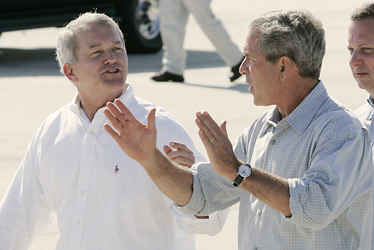 L-R: ex-Congressman Mark Foley, President George W. Bush, ex-FEMA director Mike "Heckuva Job" Brown.
Rumors of Opera's Death Are Greatly Exaggerated
How do you make opera relevant for a modern audience? Honestly, I think it’s a phony question.
 Conventional wisdom says that opera is a dying art form, that the audiences are aging and shrinking. But that’s not borne out by the facts: over the past half-century, opera in America has grown exponentially in popularity, from two opera houses in 1952 to 114 professional companies in 43 states, which give nearly 3,000 annual performances attended by 6.6 million people. American opera audiences grew 8.2% from 1992 to 2002, the largest audience increase of all performing arts disciplines.
The repertoire has greatly diversified. Fifty years ago, Handel was deemed hopelessly obsolete: now it’s standard fare. Fifty years ago, you couldn’t have found a production of Idomeneo to cancel.
Does this mean opera’s continued popularity is secure? Hardly. Andre Bishop, Artistic Director of Lincoln Center Theater, wrote in October’s Metropolitan Opera Playbill, “Opera is still vital, still magnificently compelling. But like everything else in life it must proceed with caution as it advances into the 21st century.”
For some, that means making opera “relevant.” I confess, I just don’t think that’s either a good idea, important, or even, in many cases, possible. Il Trovatore, with its disaster of a plot, wasn’t relevant when it was new in 1853, and never will be. But it is a lot of fun when it’s well-cast. Wagner’s Ring, with its near limitless interpretive possibilities, will never not be relevant.
 Those who are interested in seeing opera kept alive must be realistic: opera isn’t for everyone, anymore than baseball or bungi-jumping or blogging or any other pastime. We also should not be concerned about the median age of the opera audience: opera tends to be something people come to appreciate later in life; go back and look at historical photos of the audience at the Old Met in its heyday: everyone’s old.
That’s not to devalue arts education or youth outreach programs. People need to be exposed to opera, and we need to keep emphasizing that opera isn’t (just) fat ladies in horns. But we also do opera a disservice when we try to pretend that The Magic Flute, a treatise on wisdom as profound as the Ring, is a kid-friendly cartoon opera.
Peter Gelb, the Metropolitan Opera’s new general manager, says, “In order to support the timelessness of the great operas, we must keep pace with current theatrical ideas and innovations when staging them.” This is true, but that doesn’t mean pasting external ideas onto existing operas in order to make them “relevant,” which is what happened with the Berlin Idomeneo. If Hans Neuenfels wanted to express his opposition to organized religion with an opera production, he should have picked Don Carlo.
Playwright John Guare agrees: “Opera to me works as the highest form of theater when everybody involved – the composer, set designer, cast, director – are all telling the same story.”
 So how do we keep opera alive? Bishop is correct when he writes, “Music is the art form that comes closest to expressing that which is inexpressible.” That’s a strength that needs to be emphasized. But he also astutely notices “the athletic requirements of classical singing.” Opera needs to be compared not just with other forms of theatrical entertainment, but with sports. Opera fans reminisce about Corelli and Tebaldi the way sports fans talk about DiMaggio and Mays. Semiramide might not be relevant, but “Bel raggio lusinghier” is certainly athletic, and if Tristan is a marathon, Violetta is something of a triathlon.
Opera also needs better PR. We can start by reclaiming the word “diva” from pop-culture, where it refers to any bitch with a CD. Divadom is part temperament, to be sure, but one gains the title through artistry. Diva emerita Beverly Sills says talk shows should feature opera singers as regular guests and performers. “There are plenty of interesting artists around with interesting stories to tell.”
Opera can be many things: funny, tragic, fascinating, profound – even relevant. But if you want to keep opera alive, stop telling people it’s dead.
Conventional wisdom says that opera is a dying art form, that the audiences are aging and shrinking. But that’s not borne out by the facts: over the past half-century, opera in America has grown exponentially in popularity, from two opera houses in 1952 to 114 professional companies in 43 states, which give nearly 3,000 annual performances attended by 6.6 million people. American opera audiences grew 8.2% from 1992 to 2002, the largest audience increase of all performing arts disciplines.The repertoire has greatly diversified. Fifty years ago, Handel was deemed hopelessly obsolete: now it’s standard fare. Fifty years ago, you couldn’t have found a production of Idomeneo to cancel.
Does this mean opera’s continued popularity is secure? Hardly. Andre Bishop, Artistic Director of Lincoln Center Theater, wrote in October’s Metropolitan Opera Playbill, “Opera is still vital, still magnificently compelling. But like everything else in life it must proceed with caution as it advances into the 21st century.”
For some, that means making opera “relevant.” I confess, I just don’t think that’s either a good idea, important, or even, in many cases, possible. Il Trovatore, with its disaster of a plot, wasn’t relevant when it was new in 1853, and never will be. But it is a lot of fun when it’s well-cast. Wagner’s Ring, with its near limitless interpretive possibilities, will never not be relevant.
Those who are interested in seeing opera kept alive must be realistic: opera isn’t for everyone, anymore than baseball or bungi-jumping or blogging or any other pastime. We also should not be concerned about the median age of the opera audience: opera tends to be something people come to appreciate later in life; go back and look at historical photos of the audience at the Old Met in its heyday: everyone’s old.That’s not to devalue arts education or youth outreach programs. People need to be exposed to opera, and we need to keep emphasizing that opera isn’t (just) fat ladies in horns. But we also do opera a disservice when we try to pretend that The Magic Flute, a treatise on wisdom as profound as the Ring, is a kid-friendly cartoon opera.
Peter Gelb, the Metropolitan Opera’s new general manager, says, “In order to support the timelessness of the great operas, we must keep pace with current theatrical ideas and innovations when staging them.” This is true, but that doesn’t mean pasting external ideas onto existing operas in order to make them “relevant,” which is what happened with the Berlin Idomeneo. If Hans Neuenfels wanted to express his opposition to organized religion with an opera production, he should have picked Don Carlo.
Playwright John Guare agrees: “Opera to me works as the highest form of theater when everybody involved – the composer, set designer, cast, director – are all telling the same story.”
So how do we keep opera alive? Bishop is correct when he writes, “Music is the art form that comes closest to expressing that which is inexpressible.” That’s a strength that needs to be emphasized. But he also astutely notices “the athletic requirements of classical singing.” Opera needs to be compared not just with other forms of theatrical entertainment, but with sports. Opera fans reminisce about Corelli and Tebaldi the way sports fans talk about DiMaggio and Mays. Semiramide might not be relevant, but “Bel raggio lusinghier” is certainly athletic, and if Tristan is a marathon, Violetta is something of a triathlon.Opera also needs better PR. We can start by reclaiming the word “diva” from pop-culture, where it refers to any bitch with a CD. Divadom is part temperament, to be sure, but one gains the title through artistry. Diva emerita Beverly Sills says talk shows should feature opera singers as regular guests and performers. “There are plenty of interesting artists around with interesting stories to tell.”
Opera can be many things: funny, tragic, fascinating, profound – even relevant. But if you want to keep opera alive, stop telling people it’s dead.
Wednesday, October 04, 2006
Foley
This whole Mark Foley thing is disgusting.
First, stop using the word “pedophile,” whether you personally think a 16 year-old is a child, or not. Forty-one percent of 15 and 16 year-olds are sexually active, and 16 is the age of consent for many European countries, as it so happens to be in Washington, D.C. Let’s reserve “pedophile” for people who actually prey on sexually immature children. In our own culture, historically girls were frequently married off at the age of 12. (Hurray for traditional marriage that hasn’t changed in thousands of years, right?)
The principal scandal is about sexual harassment, unsolicited romantic or sexual overtures from a person in a position of authority toward a more junior person. Partisan politics and sexual orientation ought to have been irrelevant. In the business world, when a supervisor is informed that an employee has been behaving inappropriately, disciplinary action must be taken. Supervisors who failed to interfere have been successfully sued by harassment victims.
Of course partisanship has reared its ugly head, with some Republicans accusing Democrats of releasing this information to the media just before an election. Perhaps that is the case, but let’s not get away from the facts here: a Congressman made inappropriate sexual comments to pages via the internet; Congressional leadership knew about it and did nothing. Claiming this is an election tactic is like a defense attorney blaming a witness for reporting a crime.
Democrats should refrain from exploiting this to partisan advantage, unless they are absolutely sure no one has any sixteen year-old skeletons in their closet, which is not a safe bet.
Still, the public recognizes that Republicans, who rode to power on a message of family values, circled their wagons and stuck their heads in the sand, preferring to attempt to avoid a scandal. What they didn’t realize was that disciplining a congressman for inappropriate behavior looks better in the public eye than covering it up. A lot better. The scandal should have been Foley’s; now it’s the GOP’s.
First, stop using the word “pedophile,” whether you personally think a 16 year-old is a child, or not. Forty-one percent of 15 and 16 year-olds are sexually active, and 16 is the age of consent for many European countries, as it so happens to be in Washington, D.C. Let’s reserve “pedophile” for people who actually prey on sexually immature children. In our own culture, historically girls were frequently married off at the age of 12. (Hurray for traditional marriage that hasn’t changed in thousands of years, right?)
The principal scandal is about sexual harassment, unsolicited romantic or sexual overtures from a person in a position of authority toward a more junior person. Partisan politics and sexual orientation ought to have been irrelevant. In the business world, when a supervisor is informed that an employee has been behaving inappropriately, disciplinary action must be taken. Supervisors who failed to interfere have been successfully sued by harassment victims.
Of course partisanship has reared its ugly head, with some Republicans accusing Democrats of releasing this information to the media just before an election. Perhaps that is the case, but let’s not get away from the facts here: a Congressman made inappropriate sexual comments to pages via the internet; Congressional leadership knew about it and did nothing. Claiming this is an election tactic is like a defense attorney blaming a witness for reporting a crime.
Democrats should refrain from exploiting this to partisan advantage, unless they are absolutely sure no one has any sixteen year-old skeletons in their closet, which is not a safe bet.
Still, the public recognizes that Republicans, who rode to power on a message of family values, circled their wagons and stuck their heads in the sand, preferring to attempt to avoid a scandal. What they didn’t realize was that disciplining a congressman for inappropriate behavior looks better in the public eye than covering it up. A lot better. The scandal should have been Foley’s; now it’s the GOP’s.
Tuesday, October 03, 2006
Speaking of Idomeneo...
Last night I attended the Metropolitan Opera’s 61st performance of Mozart’s Idomeneo – the opera recently canceled by the Deutsche Oper Berlin for fear of Islamic terrorists – in the drab, slow, unimaginative original production by Jean-Pierre Ponnelle from 1982. But more about that later.
The singing was at a respectably high level. Though the title role’s tessitura is unusually baritonal for Mozart, Ben Heppner sang the part’s few high notes with ease and ringing tone; unfortunately, his is a rather monochromatic interpretation. While he tackled the more florid original version of Idomeneo’s big aria “Fuor del mar” with impressive and accurate coloratura – especially for the world’s pre-eminent Tristan – overall his phrasing was not particularly sensitive or expressive. The truth is, the qualities that make him a sturdy Wagnerian – bright tone and stamina – are insufficient for the more subtle demands of Mozart.
Dorothea Röschmann as Ilia, on the other hand, was superb. Hers is a meatier voice than has been associated with this part: she sings the Countess and Elvira, instead of Susanna and Zerlina. Her long opening recitative was impassioned and vibrant, and she is capable of easy lyrical singing as well as husky, full-throated chest tones. She was ably partnered by Kristine Jepson as the prince Idamante. Though not as vital an actress as Röschmann, she has a lovely warm, even tone and phrases delicately.
Olga Makarina, as Elettra, also possesses a beautiful voice, capable of impressively gentle, silvery sustained phrases, which served her well in the second act serenade; however, her lighter vocal resources were overpowered by the demands of her first and last arias. At times I wished she and Röschmann had switched parts.
As Idomeneo’s counselor Arbace, Jeffrey Francis sang his aria “Se il tuo duol” with immaculate coloratura and a ringing top; Simon O’Neill was a grand, old-school High Priest, with a crystalline declamatory style in the best Pavarotti tradition; someone needs to tell Stephen Milling, as the Voice of Neptune, not to double single consonants.
James Levine in the pit continues to refine his performance of this marvelous score; the Met Chorus was fabulous in the earth-shaking “O voto tremendo,” but there were problems with balance and blend earlier on.
In my post on the severed-head fiasco with the Berlin production, I got into a discussion in the comments section over making operas relevant for modern audiences. Idomeneo is about the moral choices we face when our city is attacked by a sea monster sent by a god we disobeyed.
Of course, there are themes that could resonate for audiences today: the humane treatment of prisoners of war, and the trouble that comes from leaders who choose to do what’s easy instead of what’s right. I’m not sure how Jesus’ severed head serves to illuminate any of that.
The Ponnelle production makes precisely zero attempt at modern relevance. Actually, it’s anti-relevance: the staging is meant to evoke the kind of stylized representation that an audience of Mozart’s day might have seen. It’s a valid idea, but in execution it falls flat. The park-and-bark aria delivery can be excused when the singing is ravishing (and honestly, when Ilia is sitting there singing about “gentle breezes,” you don’t have a way to make that exciting), but much of the chorus staging is execrable. The second act ends with the rousing “Corriamo, fuggiamo” – “Run, flee!” In this staging, they all slowly spread themselves out on the stage and lie down as the curtain falls. What part of “Run away from the sea monster!” didn’t Ponnelle understand?
The singing was at a respectably high level. Though the title role’s tessitura is unusually baritonal for Mozart, Ben Heppner sang the part’s few high notes with ease and ringing tone; unfortunately, his is a rather monochromatic interpretation. While he tackled the more florid original version of Idomeneo’s big aria “Fuor del mar” with impressive and accurate coloratura – especially for the world’s pre-eminent Tristan – overall his phrasing was not particularly sensitive or expressive. The truth is, the qualities that make him a sturdy Wagnerian – bright tone and stamina – are insufficient for the more subtle demands of Mozart.
Dorothea Röschmann as Ilia, on the other hand, was superb. Hers is a meatier voice than has been associated with this part: she sings the Countess and Elvira, instead of Susanna and Zerlina. Her long opening recitative was impassioned and vibrant, and she is capable of easy lyrical singing as well as husky, full-throated chest tones. She was ably partnered by Kristine Jepson as the prince Idamante. Though not as vital an actress as Röschmann, she has a lovely warm, even tone and phrases delicately.
Olga Makarina, as Elettra, also possesses a beautiful voice, capable of impressively gentle, silvery sustained phrases, which served her well in the second act serenade; however, her lighter vocal resources were overpowered by the demands of her first and last arias. At times I wished she and Röschmann had switched parts.
As Idomeneo’s counselor Arbace, Jeffrey Francis sang his aria “Se il tuo duol” with immaculate coloratura and a ringing top; Simon O’Neill was a grand, old-school High Priest, with a crystalline declamatory style in the best Pavarotti tradition; someone needs to tell Stephen Milling, as the Voice of Neptune, not to double single consonants.
James Levine in the pit continues to refine his performance of this marvelous score; the Met Chorus was fabulous in the earth-shaking “O voto tremendo,” but there were problems with balance and blend earlier on.
In my post on the severed-head fiasco with the Berlin production, I got into a discussion in the comments section over making operas relevant for modern audiences. Idomeneo is about the moral choices we face when our city is attacked by a sea monster sent by a god we disobeyed.
Of course, there are themes that could resonate for audiences today: the humane treatment of prisoners of war, and the trouble that comes from leaders who choose to do what’s easy instead of what’s right. I’m not sure how Jesus’ severed head serves to illuminate any of that.
The Ponnelle production makes precisely zero attempt at modern relevance. Actually, it’s anti-relevance: the staging is meant to evoke the kind of stylized representation that an audience of Mozart’s day might have seen. It’s a valid idea, but in execution it falls flat. The park-and-bark aria delivery can be excused when the singing is ravishing (and honestly, when Ilia is sitting there singing about “gentle breezes,” you don’t have a way to make that exciting), but much of the chorus staging is execrable. The second act ends with the rousing “Corriamo, fuggiamo” – “Run, flee!” In this staging, they all slowly spread themselves out on the stage and lie down as the curtain falls. What part of “Run away from the sea monster!” didn’t Ponnelle understand?
Monday, October 02, 2006
No Truth, No Consequences
Is the War on Iraq helping or hurting efforts to keep Americans safe from terrorist attacks?
Last week, the federal government partially declassified a National Intelligence Estimate, wherein all 16 government intelligence agencies concluded that the war against Iraq not only isn’t helping to stop terrorism, it’s making everything worse. “I strongly disagree,” said the President.
Bush maintains that Iraq is the central front in the War on Terror, even as he conceded on the fifth anniversary of 9/11 that “Saddam Hussein was not responsible for the attacks.” If only now he would concede: Saddam Hussein had not threatened the United States; Saddam Hussein had no WMD’s, certainly not anywhere near the stockpiles of which he was officially accused in 2003; Saddam Hussein had no relationship with al-Qaeda, nor could he have had one, if you understand what al-Qaeda’s motives are; the Clinton policy of containment was effective.
Tens of thousands of Iraqis – some of them bad, misguided people, to be sure, but many of them innocent bystanders, women, children, pro-democracy types – are dead. There have been dire consequences, but not for the people responsible for either 9/11 or the invasion of Iraq.
More Iraqi civilians died per month, every month, this summer than American casualties on 9/11; American military casualties in Iraq have now surpassed the 9/11 toll.
Who is responsible for 9/11? The hijackers are dead, of their own free will. Osama bin Laden is still free, five years later, most likely in the mountains on the Pakistan-Afghanistan border; both countries the President considers “allies” in the War on Terror.
Who is responsible for the War on Iraq? Saddam Hussein is in prison, but the violence continues. Abu Musab al-Zarqawi is dead, but the violence escalates.
President Bush told the world that Saddam Hussein possessed: “as much as 500 tons of sarin, mustard and VX nerve agent”; “25,000 liters of anthrax – enough doses to kill several million people”; “38,000 liters of botulinum toxin”; and “30,000 munitions capable of delivering chemical agents.” None of this was true. President Bush was re-elected.
Of those enormous quantities of deadly weapons, Secretary of Defense Donald Rumsfeld said, "We know where they are. They're in the area around Tikrit and Baghdad and east, west, south and north somewhat." He remains in office, soon to be the longest-serving Secretary of Defense in history. CIA Director George Tenet called the intelligence on Iraq’s WMD capability a “slam-dunk.” He was given a Medal of Honor.
In March 2003, Vice President Cheney said, Saddam Hussein was "trying once again to produce nuclear weapons.” “We know that when the inspectors assessed this after the Gulf War, he was far, far closer to a crude nuclear device than anybody thought -- maybe six months from a crude nuclear device,” said Condoleezza Rice. Cheney is still in office; Rice was promoted to Secretary of State.
“We do not torture,” said President Bush. But we do. And we send completely innocent people to nations we accuse of being terror supporters to be tortured. This week we legalized torture and banned habeas corpus.
Who will stand up for the victims of this lethal folly? Until we hold our government accountable, and see our President condemned for his crimes, we ourselves will be guilty of gross negligence. American democracy is government of the people, by the people, for the people. You have the power. You have the responsibility. Take it.
Last week, the federal government partially declassified a National Intelligence Estimate, wherein all 16 government intelligence agencies concluded that the war against Iraq not only isn’t helping to stop terrorism, it’s making everything worse. “I strongly disagree,” said the President.
Bush maintains that Iraq is the central front in the War on Terror, even as he conceded on the fifth anniversary of 9/11 that “Saddam Hussein was not responsible for the attacks.” If only now he would concede: Saddam Hussein had not threatened the United States; Saddam Hussein had no WMD’s, certainly not anywhere near the stockpiles of which he was officially accused in 2003; Saddam Hussein had no relationship with al-Qaeda, nor could he have had one, if you understand what al-Qaeda’s motives are; the Clinton policy of containment was effective.
Tens of thousands of Iraqis – some of them bad, misguided people, to be sure, but many of them innocent bystanders, women, children, pro-democracy types – are dead. There have been dire consequences, but not for the people responsible for either 9/11 or the invasion of Iraq.
More Iraqi civilians died per month, every month, this summer than American casualties on 9/11; American military casualties in Iraq have now surpassed the 9/11 toll.
Who is responsible for 9/11? The hijackers are dead, of their own free will. Osama bin Laden is still free, five years later, most likely in the mountains on the Pakistan-Afghanistan border; both countries the President considers “allies” in the War on Terror.
Who is responsible for the War on Iraq? Saddam Hussein is in prison, but the violence continues. Abu Musab al-Zarqawi is dead, but the violence escalates.
President Bush told the world that Saddam Hussein possessed: “as much as 500 tons of sarin, mustard and VX nerve agent”; “25,000 liters of anthrax – enough doses to kill several million people”; “38,000 liters of botulinum toxin”; and “30,000 munitions capable of delivering chemical agents.” None of this was true. President Bush was re-elected.
Of those enormous quantities of deadly weapons, Secretary of Defense Donald Rumsfeld said, "We know where they are. They're in the area around Tikrit and Baghdad and east, west, south and north somewhat." He remains in office, soon to be the longest-serving Secretary of Defense in history. CIA Director George Tenet called the intelligence on Iraq’s WMD capability a “slam-dunk.” He was given a Medal of Honor.
In March 2003, Vice President Cheney said, Saddam Hussein was "trying once again to produce nuclear weapons.” “We know that when the inspectors assessed this after the Gulf War, he was far, far closer to a crude nuclear device than anybody thought -- maybe six months from a crude nuclear device,” said Condoleezza Rice. Cheney is still in office; Rice was promoted to Secretary of State.
“We do not torture,” said President Bush. But we do. And we send completely innocent people to nations we accuse of being terror supporters to be tortured. This week we legalized torture and banned habeas corpus.
Who will stand up for the victims of this lethal folly? Until we hold our government accountable, and see our President condemned for his crimes, we ourselves will be guilty of gross negligence. American democracy is government of the people, by the people, for the people. You have the power. You have the responsibility. Take it.
Sunday, October 01, 2006
Sunday Photo Blogging: Monarchs!

There have been thousands of monarchs fluttering through Manhattan recently -- I guess this must be their migration. I took these photos in the Heather Garden at Ft. Tryon Park this past Thursday afternoon.





Wednesday, September 27, 2006
Bring Me the Head of the Director
Newspapers around the world are reporting that the Deutsche-Oper Berlin has canceled a scheduled production of Mozart's Idomeneo for fear of offending Muslims.
Idomeneo is the story of the King of Crete who, upon returning home from the Trojan War, is shipwrecked. He vows to Neptune that if he survives, he will sacrifice the first living thing he encounters in gratitude. When he washes up on the shore, the first creature he sees is his own son, Idamante. The plot concerns his attempts to wrangle out of the pledge and the catastrophes that ensue, along with a love triangle between Idamante and Ilia, a captured Trojan princess, and Electra, well-known refugee of the House of Atreus. As Crete lies under siege by a terrible sea monster, the king confesses that he himself is to blame for the disaster, and the only solution is to sacrifice the prince. Idamante bravely submits to his fate, but in the final moments Neptune grants a reprieve, on the condition that Idomeneo step down in favor of Idamante's succession and marriage to Ilia. All ends happily (except for Electra, who goes spectacularly insane).
The opera is a masterpiece; long neglected as boring old-fashioned opera seria, it entered the standard repertory after the Metropolitan Opera first performed it in the 1980s with Luciano Pavarotti in the title role. Composed when Mozart was in his early 20s, it contains some of his very best music for the stage, including a showy Handelian da capo aria for the tenor ("Fuor del mar"), brilliant and unusual ensembles (especially "Vedro, rammingo e solo"), spectacular choral writing, and the thrilling mad scene for Electra ("O smania...D'Oreste, d'Ajace").
You can see why this is so offensive to Muslims, right?
No? Well, the concern arose because this particular production had a scene involving the severed head of the Prophet Mohammed.
The director, Hans Neuenfels, ought to be ashamed of himself. Seriously. This is a Trojan War story, taking place somewhere around 1200 BC. Mohammed lived from 570 to 632 CE. What possible relevance could Mohammed have to an episode from Greek mythology? But it's not just Mohammed: the production also features the severed heads of Jesus Christ (4 BCE - 30 CE), the Buddha (563 BCE to 483 BCE), and a few other religious figures.
You know, it's okay for art to be provocative, but there should be a valid artistic reason for it. If you want to do a provocative opera, there's many out there. If you don't like the ones that exist, find yourself a composer and make a new one that says what you want it to say. But don't desecrate a great masterpiece by dragging in irrelevant, anachronistic sacrilege, especially of a variety that will serve only to further inflame current tensions while adding absolutely nothing at all to the performance experience.
The opera house has overreacted by canceling the production. How central to the concept could the severed heads have been, given that none of these people are ever mentioned in the text or stage directions? Revise the production. If it requires a severed head, I say start with Hans Neuenfels.
Idomeneo is the story of the King of Crete who, upon returning home from the Trojan War, is shipwrecked. He vows to Neptune that if he survives, he will sacrifice the first living thing he encounters in gratitude. When he washes up on the shore, the first creature he sees is his own son, Idamante. The plot concerns his attempts to wrangle out of the pledge and the catastrophes that ensue, along with a love triangle between Idamante and Ilia, a captured Trojan princess, and Electra, well-known refugee of the House of Atreus. As Crete lies under siege by a terrible sea monster, the king confesses that he himself is to blame for the disaster, and the only solution is to sacrifice the prince. Idamante bravely submits to his fate, but in the final moments Neptune grants a reprieve, on the condition that Idomeneo step down in favor of Idamante's succession and marriage to Ilia. All ends happily (except for Electra, who goes spectacularly insane).
The opera is a masterpiece; long neglected as boring old-fashioned opera seria, it entered the standard repertory after the Metropolitan Opera first performed it in the 1980s with Luciano Pavarotti in the title role. Composed when Mozart was in his early 20s, it contains some of his very best music for the stage, including a showy Handelian da capo aria for the tenor ("Fuor del mar"), brilliant and unusual ensembles (especially "Vedro, rammingo e solo"), spectacular choral writing, and the thrilling mad scene for Electra ("O smania...D'Oreste, d'Ajace").
You can see why this is so offensive to Muslims, right?
No? Well, the concern arose because this particular production had a scene involving the severed head of the Prophet Mohammed.
The director, Hans Neuenfels, ought to be ashamed of himself. Seriously. This is a Trojan War story, taking place somewhere around 1200 BC. Mohammed lived from 570 to 632 CE. What possible relevance could Mohammed have to an episode from Greek mythology? But it's not just Mohammed: the production also features the severed heads of Jesus Christ (4 BCE - 30 CE), the Buddha (563 BCE to 483 BCE), and a few other religious figures.
You know, it's okay for art to be provocative, but there should be a valid artistic reason for it. If you want to do a provocative opera, there's many out there. If you don't like the ones that exist, find yourself a composer and make a new one that says what you want it to say. But don't desecrate a great masterpiece by dragging in irrelevant, anachronistic sacrilege, especially of a variety that will serve only to further inflame current tensions while adding absolutely nothing at all to the performance experience.
The opera house has overreacted by canceling the production. How central to the concept could the severed heads have been, given that none of these people are ever mentioned in the text or stage directions? Revise the production. If it requires a severed head, I say start with Hans Neuenfels.
Monday, September 25, 2006
In Praise of Slick Willy
You know, I never considered myself a Bill Clinton "fan." We have him to thank for "Don't Ask, Don't Tell" and DOMA. He did some things I definitely disagreed with, and then there was that whole distasteful cigar business.
But then I see him on TV every once in a while, and I think about our current Nincompoop in Chief, and I think, "Oh my God, I would kill to have a President who could think in complete sentences again."
But then I see him on TV every once in a while, and I think about our current Nincompoop in Chief, and I think, "Oh my God, I would kill to have a President who could think in complete sentences again."
Ask and You Might Receive
In my previous post, I did not mean to imply that we can’t petition God for things we want, or that we have no reasonable hope of obtaining better circumstances with God’s help.
The Bible is explicit that we can ask God for things: Paul told the Philippians, “Have no anxiety for anything, but in everything by prayer and supplication with thanksgiving let your requests be made known to God.”
The catch is understanding that God can say no, and understanding why. Just as we would criticize parents who gave in to a child’s every whim, God knows what’s in our best interests, and often says no to our requests for our own good. Requests are never denied because He doesn’t like us or we didn’t ask in the right way or didn’t pray hard/often enough. His grace is unconditional.
The “Prosperity Gospel” of American Evangelicalism runs afoul of sound theology not because we aren’t allowed to ask God for what we want, but because of the tendency to treat God like a genie who’s there to grant wishes, with the corollary that if your wishes don’t come true, it’s because you didn’t ask in the right way, you didn’t believe hard enough, you didn’t pray often enough, you prayed at the wrong church, or you’re simply just a sinner.
This is dangerous thinking. It leads wealthy people to believe that they are in God’s favor, and causes them to look down on the poor because they think God is punishing them with poverty for their sins or lack of faith. It causes people to become bitter if they feel God is simply denying their requests, or sometimes they turn away from faith altogether because they conclude if prayers aren’t answered the way we would like, that no one is listening.
We have to ask for godly things: patience, wisdom, compassion, understanding. These requests are never denied.
Jesus taught, “Ask and it will be given you; seek, and you will find; knock, and it will be opened to you.” Yet on the night of His betrayal, He prayed, “My Father, if it be possible, let this cup pass from me; nevertheless, not as I will, but as thou wilt.” We all know how that turned out. But where would our salvation be if the request had been granted? We have to trust that God’s wisdom far surpasses our own.
So Pastor Osteen isn’t wrong to invite people to the Christian faith with the promise of the chance to improve their lives, fix their marriages, find a better job, or whatever. He insists that “one of God’s top priorities is to shower blessings on Christians in this lifetime.” That’s true, but Christians must understand, being wealthy isn’t a blessing, it’s a cross to bear.
The Bible is explicit that we can ask God for things: Paul told the Philippians, “Have no anxiety for anything, but in everything by prayer and supplication with thanksgiving let your requests be made known to God.”
The catch is understanding that God can say no, and understanding why. Just as we would criticize parents who gave in to a child’s every whim, God knows what’s in our best interests, and often says no to our requests for our own good. Requests are never denied because He doesn’t like us or we didn’t ask in the right way or didn’t pray hard/often enough. His grace is unconditional.
The “Prosperity Gospel” of American Evangelicalism runs afoul of sound theology not because we aren’t allowed to ask God for what we want, but because of the tendency to treat God like a genie who’s there to grant wishes, with the corollary that if your wishes don’t come true, it’s because you didn’t ask in the right way, you didn’t believe hard enough, you didn’t pray often enough, you prayed at the wrong church, or you’re simply just a sinner.
This is dangerous thinking. It leads wealthy people to believe that they are in God’s favor, and causes them to look down on the poor because they think God is punishing them with poverty for their sins or lack of faith. It causes people to become bitter if they feel God is simply denying their requests, or sometimes they turn away from faith altogether because they conclude if prayers aren’t answered the way we would like, that no one is listening.
We have to ask for godly things: patience, wisdom, compassion, understanding. These requests are never denied.
Jesus taught, “Ask and it will be given you; seek, and you will find; knock, and it will be opened to you.” Yet on the night of His betrayal, He prayed, “My Father, if it be possible, let this cup pass from me; nevertheless, not as I will, but as thou wilt.” We all know how that turned out. But where would our salvation be if the request had been granted? We have to trust that God’s wisdom far surpasses our own.
So Pastor Osteen isn’t wrong to invite people to the Christian faith with the promise of the chance to improve their lives, fix their marriages, find a better job, or whatever. He insists that “one of God’s top priorities is to shower blessings on Christians in this lifetime.” That’s true, but Christians must understand, being wealthy isn’t a blessing, it’s a cross to bear.
Friday, September 22, 2006
Do Unto Others?
From the Associated Press, filed 30 minutes ago:
PALU, Indonesia (AP) -- Christian mobs torched cars, blockaded roads and looted Muslim-owned shops in violence touched off by Friday's executions of three Roman Catholics convicted of instigating attacks on Muslims.
PALU, Indonesia (AP) -- Christian mobs torched cars, blockaded roads and looted Muslim-owned shops in violence touched off by Friday's executions of three Roman Catholics convicted of instigating attacks on Muslims.
Wednesday, September 20, 2006
BYOB
Yesterday I heard our company receptionist on the phone with a caller.
"We are a civil rights advocacy organization for the LGBT community....No, the B stands for bisexual."
What the...?
"We are a civil rights advocacy organization for the LGBT community....No, the B stands for bisexual."
What the...?
Tuesday, September 19, 2006
Happy Blogoversary to Me!
Today The Last Debate celebrates its second anniversary: your source for Bush-bashing, gay rights legal mumbo jumbo, Wagnerian symbolism, subway horror stories, culture war critiques, random whining, and of course, kitten pictures. Thanks for reading!
Andy
Andy
Twelve Steps to Heaven
Does God want you to be rich?
That was the provocative title of Time Magazine’s September 18 cover story, which examined a movement within American Evangelicalism known as the “Prosperity Gospel.”
The article is disappointing, principally because it fails to find any major Evangelical minister who will strongly answer in the affirmative that yes, God wants you to be wealthy. The authors try hard to nail mega-pastor Joel Osteen as a leading proponent of prosperity theology, though he tells them, “I preach that anybody can improve their lives,” adding, “but I don’t think I’d say God wants us to be rich.” They are left with pointing out “the room’s warm lamplight reflects softly off his crocodile shoes,” even as they concede that Osteen’s congregation raised over $1 million for Hurricane Katrina relief.
While the article doesn’t uncover scandal and hypocrisy – after all, stubbornly literal Evangelicals are not likely to have missed the New Testament’s many, many, many condemnations of and warnings about wealth – they unwittingly touch on a larger theology: Christianity as Self-Help program.
Your Best Life Now, Osteen’s best-selling book, opens by informing the reader that to obtain your “best life,” see your “marriage restored,” or “your dreams come to pass,” just “start looking at life through the eyes of faith.”
Certainly, all Christians believe that through faith we find guidance, and that among the gifts of the Holy Spirit are numbered patience and persistence. But mainstream Christianity has never promised that God will make your problems go away.
Indeed, historically Christians have believed that through suffering we have an opportunity to put our beliefs into practice and grow spiritually. If you’re looking for a trouble-free life, Jesus is not the answer.
Still, some Christians maintain that it just takes faith to achieve the impossible. Pray your way to weight loss, a better job, or heterosexuality! Would anyone question the faith of Matthew, Mark, Luke or John? Here are their fates, respectively: gored with a halberd, beaten to death, hanged, boiled in oil. Paul was beheaded and Peter, founder of the church, was crucified upside down.
The “better life” that Christianity promises follows this one; in the meantime, our faith offers us radical strategies for dealing with adversity. In this, some Evangelicals are perhaps profoundly mistaken about basic doctrine. Popular televangelist Joyce Meyer asked Time, “Who would want something where you’re miserable, broke and ugly and you have to muddle through until you get to heaven? I believe God wants to give us nice things.” But muddling through, quite frankly, is what God expects us to do.
Ben Phillips of Southwestern Baptist Theological Seminary cuts right to the heart of the heresy: “God becomes the means to an end, not the end in himself.” Publisher’s Weekly derided Osteen’s book, calling it “a treatise on how to get God to serve the demands of self-centered individuals.”
Ask not what God can do for you, but what you can do for God.
That was the provocative title of Time Magazine’s September 18 cover story, which examined a movement within American Evangelicalism known as the “Prosperity Gospel.”
The article is disappointing, principally because it fails to find any major Evangelical minister who will strongly answer in the affirmative that yes, God wants you to be wealthy. The authors try hard to nail mega-pastor Joel Osteen as a leading proponent of prosperity theology, though he tells them, “I preach that anybody can improve their lives,” adding, “but I don’t think I’d say God wants us to be rich.” They are left with pointing out “the room’s warm lamplight reflects softly off his crocodile shoes,” even as they concede that Osteen’s congregation raised over $1 million for Hurricane Katrina relief.
While the article doesn’t uncover scandal and hypocrisy – after all, stubbornly literal Evangelicals are not likely to have missed the New Testament’s many, many, many condemnations of and warnings about wealth – they unwittingly touch on a larger theology: Christianity as Self-Help program.
Your Best Life Now, Osteen’s best-selling book, opens by informing the reader that to obtain your “best life,” see your “marriage restored,” or “your dreams come to pass,” just “start looking at life through the eyes of faith.”
Certainly, all Christians believe that through faith we find guidance, and that among the gifts of the Holy Spirit are numbered patience and persistence. But mainstream Christianity has never promised that God will make your problems go away.
Indeed, historically Christians have believed that through suffering we have an opportunity to put our beliefs into practice and grow spiritually. If you’re looking for a trouble-free life, Jesus is not the answer.
Still, some Christians maintain that it just takes faith to achieve the impossible. Pray your way to weight loss, a better job, or heterosexuality! Would anyone question the faith of Matthew, Mark, Luke or John? Here are their fates, respectively: gored with a halberd, beaten to death, hanged, boiled in oil. Paul was beheaded and Peter, founder of the church, was crucified upside down.
The “better life” that Christianity promises follows this one; in the meantime, our faith offers us radical strategies for dealing with adversity. In this, some Evangelicals are perhaps profoundly mistaken about basic doctrine. Popular televangelist Joyce Meyer asked Time, “Who would want something where you’re miserable, broke and ugly and you have to muddle through until you get to heaven? I believe God wants to give us nice things.” But muddling through, quite frankly, is what God expects us to do.
Ben Phillips of Southwestern Baptist Theological Seminary cuts right to the heart of the heresy: “God becomes the means to an end, not the end in himself.” Publisher’s Weekly derided Osteen’s book, calling it “a treatise on how to get God to serve the demands of self-centered individuals.”
Ask not what God can do for you, but what you can do for God.
Sunday, September 17, 2006
Holy Gay Jewish Weddings, Batman!
One of the time-honored slogans of the right-wing anti-marriage-equality camp is, "God made Adam and Eve, not Adam and Steve!"
Well, someone should tell that to the Berger-Franks.
I don't normally read the wedding section of The New York Times (the closest I come is watching that classic Sex and the City episode, "until recently, the bride had a life of her own!"), but The Times put a color photo link on the online homepage.
They story of how they met and fell in love is pretty cute, actually.
Adam Berger, an investment strategist, and Stephen Frank, a lawyer, are of course not actually legally married, thanks to the New York Court of Appeals. (They have been partners for 10 years.) Some might ask, "But if they can live together and go through a religious commitment ceremony, why does it matter that they're not 'legally' married?"
Well, since we've spent the last couple of weeks pondering September 11th and its lessons and meanings, we might want to take a look at what happened to some of the partners of gay victims of the attacks.
Equality matters.
* Do not, under any circumstances, view the recent movie Adam & Steve with Parker Posey. It immediately sprang into the top 5 Worst Movies I Have Ever Seen, knocking Waterworld down into #6.
Well, someone should tell that to the Berger-Franks.
I don't normally read the wedding section of The New York Times (the closest I come is watching that classic Sex and the City episode, "until recently, the bride had a life of her own!"), but The Times put a color photo link on the online homepage.
They story of how they met and fell in love is pretty cute, actually.
Adam Berger, an investment strategist, and Stephen Frank, a lawyer, are of course not actually legally married, thanks to the New York Court of Appeals. (They have been partners for 10 years.) Some might ask, "But if they can live together and go through a religious commitment ceremony, why does it matter that they're not 'legally' married?"
Well, since we've spent the last couple of weeks pondering September 11th and its lessons and meanings, we might want to take a look at what happened to some of the partners of gay victims of the attacks.
Equality matters.
* Do not, under any circumstances, view the recent movie Adam & Steve with Parker Posey. It immediately sprang into the top 5 Worst Movies I Have Ever Seen, knocking Waterworld down into #6.
Sunday Photo Blogging: Palm Springs
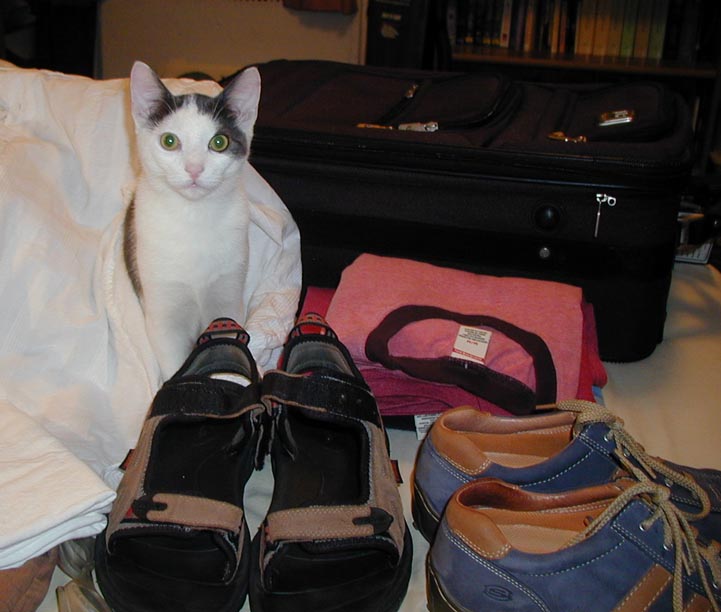
"What do you mean I'm not going with you to Palm Springs?!?!?!?"
I didn't take many pictures in Palm Springs, because -- aside from going to The Living Desert -- we really didn't "do" very much other than lay out beside this glorious pool below. Still, here's a couple of shots to give you an idea.

So, basically, here's where I spent Labor Day weekend. More specifically, on the second chaise from the right. This was taken around 6:30 a.m., when the sun was just creeping over the privacy hedge, leaving the backyard relatively cool. It was a perfect setting for some morning yoga. Actually, it was just the perfect setting, period.



Friday, September 15, 2006
I [heart] New York (not really)
So, somehow I got talked into going to the Lower East Side for happy hour tonight. (My dear sweet friend Duke, whom I've known for 14 years, was guest-bartending.) It's hard to imagine New York City as "remote," but let me tell you, the netherworld between the JMZ and FV trains is as isolated as a Saharan oasis.
Anyway, it was great to see Duke and many friends, a few of whom are bloggers.
Around 8:30 I took off to come home and feed my (very angry) kittens. I got on the F at Houston (that's HOW-stun, for you rubes) and only needed to go two stops to West 4th to get on my home-bound train. As soon as I sat down, I realized I was in for a show.
A tall, overweight man was yelling into the corner of the train at an empty set of seats.
"You think I'm fucking scared of you? Huh? You think I'm fucking scaaaared of you? Well, you're fucking right, you're a scary, scary dangerous person. Yeah you, asshole."
Did I mention he was yelling at an empty bench?
At Broadway/Lafayette he turned in my direction and headed toward the open doors. I could see that the front of his trousers were stained with urine. At least he was getting off...
...oh, hold that thought, the doors closed and he was still on the train.
"Yeah, I see you, motherfucker, I see you looking at me. You're a scary, dangerous man. I know you're armed, I see that fucking gun, asshole. If I were smart, I'd have gotten off this train, but I guess I'm not, eh? So go ahead. Fucking shoot me, dickwad. Shoot me, asshole, I guess I'm fucking begging for it. Do it. Waste me, asshole."
Then he threw up all over himself.
At this point we were at West 4th, so I got out. He stayed on.
The End.
Anyway, it was great to see Duke and many friends, a few of whom are bloggers.
Around 8:30 I took off to come home and feed my (very angry) kittens. I got on the F at Houston (that's HOW-stun, for you rubes) and only needed to go two stops to West 4th to get on my home-bound train. As soon as I sat down, I realized I was in for a show.
A tall, overweight man was yelling into the corner of the train at an empty set of seats.
"You think I'm fucking scared of you? Huh? You think I'm fucking scaaaared of you? Well, you're fucking right, you're a scary, scary dangerous person. Yeah you, asshole."
Did I mention he was yelling at an empty bench?
At Broadway/Lafayette he turned in my direction and headed toward the open doors. I could see that the front of his trousers were stained with urine. At least he was getting off...
...oh, hold that thought, the doors closed and he was still on the train.
"Yeah, I see you, motherfucker, I see you looking at me. You're a scary, dangerous man. I know you're armed, I see that fucking gun, asshole. If I were smart, I'd have gotten off this train, but I guess I'm not, eh? So go ahead. Fucking shoot me, dickwad. Shoot me, asshole, I guess I'm fucking begging for it. Do it. Waste me, asshole."
Then he threw up all over himself.
At this point we were at West 4th, so I got out. He stayed on.
The End.
Suckitude
I'm sorry my blog has *S-U-C-K-E-D* lately. I've been in kind of a slump. Life has been...shall we say, disappointing recently, and my brain just refuses to come up with any kind of interesting, coherent thought.
Case in point, last night I ended up watching about an hour of Punjabi TV.
You know those cable music channels on TV? Sometimes I check out the opera channel just to see what's on, if it's an interesting recording that I don't have. I don't know which channel it is, it's somewhere in the 600's, so I just flip to 600 and scroll down.
Last night I hit "page up" by accident instead of "page down" on the remote and landed on an Indian channel. There was a pretty, smiling woman in a red sari, singing and clapping. She had a voice kind of like Minnie Mouse. I gathered it was some kind of religious thing, because sometimes they would cut away from the singer and flash a picture of Lakshmi on the screen.
Next up was some kind of sports show. It looked like a cross between tag and Red Rover. Basically there were these hot, buff, young shirtless Indian guys (yeah, that's why I didn't change channels), and four of them would link arms and a single guy would try to touch one of the guys in the middle, or at least that's what it looked like. It seemed neither very difficult, complicated, interesting or fun, but hot shirtless guys trying to touch each other...well, color me intrigued!
After that was some kind of talk-show, with two rather rumpled old guys sitting across from each other. I didn't know what they were talking about and it didn't look like they were going to take their shirts off (which is a good thing) so I gave up and went to bed.
And that's kind of how my life has been.
Case in point, last night I ended up watching about an hour of Punjabi TV.
You know those cable music channels on TV? Sometimes I check out the opera channel just to see what's on, if it's an interesting recording that I don't have. I don't know which channel it is, it's somewhere in the 600's, so I just flip to 600 and scroll down.
Last night I hit "page up" by accident instead of "page down" on the remote and landed on an Indian channel. There was a pretty, smiling woman in a red sari, singing and clapping. She had a voice kind of like Minnie Mouse. I gathered it was some kind of religious thing, because sometimes they would cut away from the singer and flash a picture of Lakshmi on the screen.
Next up was some kind of sports show. It looked like a cross between tag and Red Rover. Basically there were these hot, buff, young shirtless Indian guys (yeah, that's why I didn't change channels), and four of them would link arms and a single guy would try to touch one of the guys in the middle, or at least that's what it looked like. It seemed neither very difficult, complicated, interesting or fun, but hot shirtless guys trying to touch each other...well, color me intrigued!
After that was some kind of talk-show, with two rather rumpled old guys sitting across from each other. I didn't know what they were talking about and it didn't look like they were going to take their shirts off (which is a good thing) so I gave up and went to bed.
And that's kind of how my life has been.
Wednesday, September 13, 2006
Victory!
Hillary Clinton won the New York Democratic primary with only 87% of the vote! I bet that showed her.
Sigh.
Sigh.
Tuesday, September 12, 2006
President Bush Gets it Right
“Whatever mistakes have been made in Iraq, the worst mistake would be to think that if we pulled out, the terrorists would leave us alone.”
Last night, on the fifth anniversary of the terrorist attacks against New York and Washington, D.C., President Bush addressed the nation. He used the occasion to emphatically defend the invasion of Iraq, even though, as he stated clearly, “Saddam Hussein was not responsible for the 9/11 attacks.”
The President is correct that withdrawal from Iraq, either phased or immediate, would not end the threat of terrorist attacks against American soil, though that is because Iraq is, or was, utterly tangential to the anti-terror struggle. He is right to pledge that America will see this project through. We may have done the Iraqi people the favor of removing a cruel dictator, but they have paid for this favor with tens of thousands of civilian lives and their entire national infrastructure. To leave now would be to leave promises unfulfilled and a full-scale civil war in our wake. Having attacked them on baseless allegations, we have a moral obligation to repair the damage and secure the country.
Unfortunately, this was the only sentence in the entire address that the President got right. Everything else points to the sad, terrifying truth that we have a deluded madman leading the country.
“The war against this enemy is more than a military conflict,” said the President, and he called it “a war unlike any we have fought before.” It was John Kerry in 2004 who argued that military power alone was the wrong strategy for the War on Terror, and then Vice President Cheney mocked him for wanting a more “sensitive” approach. Yet the President has waged an utterly conventional war, long on firepower and short on strategy, with sensitivity nowhere to be found. “It is the decisive ideological struggle of the 21st century,” Bush elaborated, though apparently he thinks it can be won with bombs and missiles.
Bush described the ideological struggle as “driven by a perverted vision of Islam – a totalitarian ideology that hates freedom, rejects tolerance and despises dissent.” Sounds a lot like the Republican base, to me: their greatest enemy is the American Civil Liberties Union, they decry “tolerance” as oppressive liberal politically correct double-speak for gay marriage, and disagreeing with the President is tantamount to treason.
Bush said that the Iraq war is related to 9/11 because “the regime of Saddam Hussein was a clear threat.” Oh? He’d made no threats against the United States, had no weapons capability and no relationship to Al Qaeda. Hussein wasn’t attacked because he was a threat; he was attacked because he was the easiest target, a household name in America, an unstable despot with deluded ambitions, in charge of a government that would collapse in hours with a ragtag army of ill-trained, ill-equipped, underpaid troops who would dissolve into the dunes as soon as their paychecks stopped. He was attacked precisely because he was the least threatening of all.
The President assailed pre-9/11 foreign policy: “Years of pursuing stability to promote peace had left us with neither. So we changed policies.” Here is the heart of his insanity: if patience and diplomacy don’t get results fast enough, abandon them in favor of mass slaughter and chaos. To win hearts and minds in an ideological conflict, wage conventional warfare with invasion, occupation and cluster bombs. Torture, but call it something else.
“[The war] will not be over until either we or the extremists emerge victorious,” Bush declared. But until the American government chooses to recognize the actual causes for which the terrorists are fighting, instead of lamely asserting “dangerous enemies have declared their intention to destroy our way of life,” and until we recognize that even the best-intentioned American foreign policy has had unforeseen consequences for the middle east, until we begin to respect the wills and cultures of people outside the United States, until we begin to redress the wrongs that have been wrought, we won’t even have taken the first step along Bush’s much-touted path of moderation. It’s one group of extremists against another, and it will never end.
Last night, on the fifth anniversary of the terrorist attacks against New York and Washington, D.C., President Bush addressed the nation. He used the occasion to emphatically defend the invasion of Iraq, even though, as he stated clearly, “Saddam Hussein was not responsible for the 9/11 attacks.”
The President is correct that withdrawal from Iraq, either phased or immediate, would not end the threat of terrorist attacks against American soil, though that is because Iraq is, or was, utterly tangential to the anti-terror struggle. He is right to pledge that America will see this project through. We may have done the Iraqi people the favor of removing a cruel dictator, but they have paid for this favor with tens of thousands of civilian lives and their entire national infrastructure. To leave now would be to leave promises unfulfilled and a full-scale civil war in our wake. Having attacked them on baseless allegations, we have a moral obligation to repair the damage and secure the country.
Unfortunately, this was the only sentence in the entire address that the President got right. Everything else points to the sad, terrifying truth that we have a deluded madman leading the country.
“The war against this enemy is more than a military conflict,” said the President, and he called it “a war unlike any we have fought before.” It was John Kerry in 2004 who argued that military power alone was the wrong strategy for the War on Terror, and then Vice President Cheney mocked him for wanting a more “sensitive” approach. Yet the President has waged an utterly conventional war, long on firepower and short on strategy, with sensitivity nowhere to be found. “It is the decisive ideological struggle of the 21st century,” Bush elaborated, though apparently he thinks it can be won with bombs and missiles.
Bush described the ideological struggle as “driven by a perverted vision of Islam – a totalitarian ideology that hates freedom, rejects tolerance and despises dissent.” Sounds a lot like the Republican base, to me: their greatest enemy is the American Civil Liberties Union, they decry “tolerance” as oppressive liberal politically correct double-speak for gay marriage, and disagreeing with the President is tantamount to treason.
Bush said that the Iraq war is related to 9/11 because “the regime of Saddam Hussein was a clear threat.” Oh? He’d made no threats against the United States, had no weapons capability and no relationship to Al Qaeda. Hussein wasn’t attacked because he was a threat; he was attacked because he was the easiest target, a household name in America, an unstable despot with deluded ambitions, in charge of a government that would collapse in hours with a ragtag army of ill-trained, ill-equipped, underpaid troops who would dissolve into the dunes as soon as their paychecks stopped. He was attacked precisely because he was the least threatening of all.
The President assailed pre-9/11 foreign policy: “Years of pursuing stability to promote peace had left us with neither. So we changed policies.” Here is the heart of his insanity: if patience and diplomacy don’t get results fast enough, abandon them in favor of mass slaughter and chaos. To win hearts and minds in an ideological conflict, wage conventional warfare with invasion, occupation and cluster bombs. Torture, but call it something else.
“[The war] will not be over until either we or the extremists emerge victorious,” Bush declared. But until the American government chooses to recognize the actual causes for which the terrorists are fighting, instead of lamely asserting “dangerous enemies have declared their intention to destroy our way of life,” and until we recognize that even the best-intentioned American foreign policy has had unforeseen consequences for the middle east, until we begin to respect the wills and cultures of people outside the United States, until we begin to redress the wrongs that have been wrought, we won’t even have taken the first step along Bush’s much-touted path of moderation. It’s one group of extremists against another, and it will never end.
Friday, September 08, 2006
Why I Won't Vote for Hillary
I once heard a minister at a public event say, “It’s illegal for me to tell you who to vote for, but I can tell you who not to vote for: don’t vote for anyone who doesn’t vote for you.”
Next week is New York’s Democratic Primary, and I intend to vote against Hillary Clinton.
Senator Clinton is certain to win the primary, and faces no serious Republican challenger in November. There are advantages to having her as our state senator: certainly she comes with clout, connections and a public profile that could never be summoned by any of her rivals for the seat. She has been an important advocate for the people of New York on a variety of different issues, ranging from anti-terror funding to post-9/11 environmental quality.
However, on two issues of great importance to me, Senator Clinton has been an enormous disappointment.
In early July, the New York State Court of Appeals handed down an utterly idiotic decision, claiming the state constitution, despite all its guarantees of equal protection, does not “require” same-sex marriage. They handed the issue off to our do-nothing assembly in Albany, along with a series of recommendations about how a “rational legislature” might find that it was “reasonable” to restrict marriage to heterosexuals because only straight people have children by accident.
The ruling, a classic case of judicial activism, where judges ignore evidence and abandon established constitutional analysis in favor of “assumptions,” “intuition” and “experience” [those words lifted from the decision itself] in order to reach a pre-determined conclusion, was met with utter silence from Senator Clinton.
Sure, she’ll show up for the annual pride parade in Manhattan, inserting herself into the march several blocks past the starting point and remaining just long enough to wave at the New York Times photographers before disappearing, but when it really counts, she’s not there. Can’t let the fundamental civil rights of her constituents interfere with her national ambitions. On her website, if you look up her positions on Civil and Constitutional Rights, you will see not one mention anywhere of LGBT people or issues. Nor will you find a mention under Children & Families.
On the war against Iraq, I do not accept her explanation that she – along with the rest of the Democratic party – voted to give President Bush the authority to use military force against Iraq as “diplomatic leverage.” First, the act itself was unconstitutional, as only Congress has the power to declare war, and that power does not include delegation of its responsibility to the executive branch.
Second, I am disgusted that the woman who coined the phrase “vast right-wing conspiracy” could trust those same nefarious conspirators to competently execute an experimental war of choice while assisting them in its promotion as a war of necessity. If anyone should have known not to trust these guys, it was Hillary Clinton. Instead, during the crucial months before our invasion, she failed to ask the important questions that needed to be asked about the post-invasion occupation or to challenge the White House’s assertions about the imminence of the threat and its significance to the larger war on terror.
Today, as a major leader of congressional Democrats, she continues to fail to put forward a valid, alternative plan for the repair and reconstruction of Iraq. Withdrawal, phased or immediate, is not a solution to the problems of our own making. It’s a political trick: declare “victory” and bring the troops home (minus 2,600 and counting).
I'm going to vote for Jonathan Tasini for Senator in the Democratic Primary. While I do not agree with his call for immediate withdrawal of U.S. troops from Iraq, what Congress needs are representatives who don’t and won’t trust the Bush Administration. Furthermore, Mr. Tasini expressly supports marriage equality for all people.
I do not expect Mr. Tasini to win, but it would be nice if Senator Clinton at least got the message that some of us aren’t happy.
Next week is New York’s Democratic Primary, and I intend to vote against Hillary Clinton.
Senator Clinton is certain to win the primary, and faces no serious Republican challenger in November. There are advantages to having her as our state senator: certainly she comes with clout, connections and a public profile that could never be summoned by any of her rivals for the seat. She has been an important advocate for the people of New York on a variety of different issues, ranging from anti-terror funding to post-9/11 environmental quality.
However, on two issues of great importance to me, Senator Clinton has been an enormous disappointment.
In early July, the New York State Court of Appeals handed down an utterly idiotic decision, claiming the state constitution, despite all its guarantees of equal protection, does not “require” same-sex marriage. They handed the issue off to our do-nothing assembly in Albany, along with a series of recommendations about how a “rational legislature” might find that it was “reasonable” to restrict marriage to heterosexuals because only straight people have children by accident.
The ruling, a classic case of judicial activism, where judges ignore evidence and abandon established constitutional analysis in favor of “assumptions,” “intuition” and “experience” [those words lifted from the decision itself] in order to reach a pre-determined conclusion, was met with utter silence from Senator Clinton.
Sure, she’ll show up for the annual pride parade in Manhattan, inserting herself into the march several blocks past the starting point and remaining just long enough to wave at the New York Times photographers before disappearing, but when it really counts, she’s not there. Can’t let the fundamental civil rights of her constituents interfere with her national ambitions. On her website, if you look up her positions on Civil and Constitutional Rights, you will see not one mention anywhere of LGBT people or issues. Nor will you find a mention under Children & Families.
On the war against Iraq, I do not accept her explanation that she – along with the rest of the Democratic party – voted to give President Bush the authority to use military force against Iraq as “diplomatic leverage.” First, the act itself was unconstitutional, as only Congress has the power to declare war, and that power does not include delegation of its responsibility to the executive branch.
Second, I am disgusted that the woman who coined the phrase “vast right-wing conspiracy” could trust those same nefarious conspirators to competently execute an experimental war of choice while assisting them in its promotion as a war of necessity. If anyone should have known not to trust these guys, it was Hillary Clinton. Instead, during the crucial months before our invasion, she failed to ask the important questions that needed to be asked about the post-invasion occupation or to challenge the White House’s assertions about the imminence of the threat and its significance to the larger war on terror.
Today, as a major leader of congressional Democrats, she continues to fail to put forward a valid, alternative plan for the repair and reconstruction of Iraq. Withdrawal, phased or immediate, is not a solution to the problems of our own making. It’s a political trick: declare “victory” and bring the troops home (minus 2,600 and counting).
I'm going to vote for Jonathan Tasini for Senator in the Democratic Primary. While I do not agree with his call for immediate withdrawal of U.S. troops from Iraq, what Congress needs are representatives who don’t and won’t trust the Bush Administration. Furthermore, Mr. Tasini expressly supports marriage equality for all people.
I do not expect Mr. Tasini to win, but it would be nice if Senator Clinton at least got the message that some of us aren’t happy.
Thursday, September 07, 2006
Palm Springs
Before I say anything else, a HUGE thank you to my friends Kevin and John, who invited me out to their weekend retreat in Palm Springs and were such amazingly generous hosts that I spent far less money on my vacation than I would have had I just stayed at home in New York.
Really, the trip couldn’t have been better. By nature I am an early riser, so with jet lag working in my favor, I arose about 6 each morning, still feeling like I had slept in. Each day began with a little yoga by the pool in the backyard under the palm trees, and then I would walk about 20 minutes (a mind-boggling distance, by southern California standards) to the nearby Albertson’s to get coffee.
Architecture and décor in Palm Springs is something the mo’s refer to as “Mid Century Modern,” a style whose most influential interior designer seems to have been Judy Jetson. I think my desert tastes are more in line with Santa Fe, where architecture tries to be in harmony with the natural surroundings while drawing heavily on native influences. Palm Springs doesn’t harmonize with the desert, it waters itself into atonal tropical lushness.
Every afternoon was spent reclining by the pool, sipping cocktails, and going for a quick swim when the 100º + heat became too intense. I really, really, really enjoyed being that lazy. During the entire trip, I never once checked email or read a newspaper or paid any attention to the world at large. The days would conclude with hot-tubbing under the stars, champagne or cocktail in hand, until my brain was gently boiled into mush and I slipped quickly into deep, relaxed sleep.
Highlights of the trip included visiting The Living Desert, a very chi-chi brunch at Spencer’s, and drinks at Toucan’s, the only bar in the country that accepts Medicare. Really, the best part was just soaking up the sun while getting better acquainted with my iPod.
Monday we drove back to K&J’s place in West Hollywood, and then had a couple of drinks at The Abbey and Fiesta’s, where I met up with my old pal Audrey, whom I’ve known since sixth grade. Audrey then took me off to a barbecue in Sherman Oaks, where I impressed the Angelenos by saying I live on Manhattan’s chic Upper North Side.
*****
Even though I still think Southern California is a bit weird, I just feel so much more at home out west than I do in New York, despite living here almost 13 years. Neither area has the perky efficiency of customer service in the Northwest, but in LA it’s due to a relaxed, easy-going attitude, instead of hostile apathy generously mixed with incompetence. New York, in typical fashion, welcomed me back by losing my luggage.
Really, the trip couldn’t have been better. By nature I am an early riser, so with jet lag working in my favor, I arose about 6 each morning, still feeling like I had slept in. Each day began with a little yoga by the pool in the backyard under the palm trees, and then I would walk about 20 minutes (a mind-boggling distance, by southern California standards) to the nearby Albertson’s to get coffee.
Architecture and décor in Palm Springs is something the mo’s refer to as “Mid Century Modern,” a style whose most influential interior designer seems to have been Judy Jetson. I think my desert tastes are more in line with Santa Fe, where architecture tries to be in harmony with the natural surroundings while drawing heavily on native influences. Palm Springs doesn’t harmonize with the desert, it waters itself into atonal tropical lushness.
Every afternoon was spent reclining by the pool, sipping cocktails, and going for a quick swim when the 100º + heat became too intense. I really, really, really enjoyed being that lazy. During the entire trip, I never once checked email or read a newspaper or paid any attention to the world at large. The days would conclude with hot-tubbing under the stars, champagne or cocktail in hand, until my brain was gently boiled into mush and I slipped quickly into deep, relaxed sleep.
Highlights of the trip included visiting The Living Desert, a very chi-chi brunch at Spencer’s, and drinks at Toucan’s, the only bar in the country that accepts Medicare. Really, the best part was just soaking up the sun while getting better acquainted with my iPod.
Monday we drove back to K&J’s place in West Hollywood, and then had a couple of drinks at The Abbey and Fiesta’s, where I met up with my old pal Audrey, whom I’ve known since sixth grade. Audrey then took me off to a barbecue in Sherman Oaks, where I impressed the Angelenos by saying I live on Manhattan’s chic Upper North Side.
*****
Even though I still think Southern California is a bit weird, I just feel so much more at home out west than I do in New York, despite living here almost 13 years. Neither area has the perky efficiency of customer service in the Northwest, but in LA it’s due to a relaxed, easy-going attitude, instead of hostile apathy generously mixed with incompetence. New York, in typical fashion, welcomed me back by losing my luggage.
Wednesday, September 06, 2006
Flying
I used to really love flying.
I don’t enjoy airports as much anymore, thanks to the heightened security, my crowd anxiety, and the realization that airports attract fuckwits like some kind of idiot magnet.
Last Thursday, flying from New York’s La Guardia to Dallas-Fort Worth, I sat next to a normal-looking woman who, when I sat down, turned to me and in the most hideously irritating voice imaginable said, “You should know I’m not a very good flyer.”
Great.
I had just drifted off to sleep when The Voice, like a bucket full of ice water, splashed across my ears with a hideous screech, “Do you have Pepsi?” I wasn’t thirsty, but now that I was awake and irritated, a whiskey soda was in order. The flight attendant moved on with the cart, and then The Voice called out, “Excuse me! Excuse me! Hey! Excuse me! Do you have Diet Pepsi?”
She turned to me and said, “Do you think my luggage is okay? I always worry my luggage won’t show up or will get lost.” “I’m sure it’s fine, in all my years of flying, I’ve never had a problem,” I replied, as I put my headphones quickly back on.
Later, “What time to we get to Dallas?” I said, “About 4:30, I think.” “But it’s almost 5 now!” she squealed in despair. “Not in Dallas,” I responded. Then the beverage cart came around again. “Do you have Pepsi?”
As they handed her the can, she cackled, “Don’t you have Diet?” Then, after they had moved on to the next row, “Excuse me! Excuse me! Hey! What time do we arrive in Dallas?” “4:30,” the attendant said.
Returning yesterday, I found myself checking in at the Burbank airport behind a very angry woman. “I can’t believe you’re telling me I can’t get on an airplane that doesn’t leave for another 15 minutes.”
“Ma’am, I’m sorry,” the representative said in a tired, frustrated voice. “FAA regulations forbid us from checking in passengers with luggage less than 30 minutes prior to departure.”
“Look lady, I don’t think you understand. I am on my way to an interview that I cannot miss. I have GOT to be on this plane.
“I’m sorry, I wish I could help, but I have to follow the rules.”
“Fine, I hope you realize you’re ruining my career,” the woman snarled, as she stormed off, hauling out her cellphone. I could hear her seconds later shouting, “…and these assholes won’t let me on the plane!”
Remember when I said in all my years of traveling I’d never had a luggage problem?
After an unexplained one-hour delay on the trip back through Dallas, I found myself tired and eager to go home in La Guardia’s noisy, chaotic baggage claim. About 20 minutes later, the carousel stopped turning, all the bags were gone, and about 8 of us from the flight stood there looking dumbly at each other.
I cannot imagine what kind of person intentionally takes a job in a lost luggage office in a New York airport, where basically you stand for hours on end deflecting the abuse hurled at you by this city’s dazzling array of self-important assholes. Still, it wouldn’t have killed her to at least say “I’m sorry” or to have expressed any sympathy at all for people who find themselves in a strange city with no clothes.
What I also don’t understand is how, in this day and age of Orange Level security and barcodes on bag-checks, etc., an airline representative can tell you that they don’t know where your bag is. “It’s probably on the next flight,” she told me. “What if it’s not?” I asked. “It’s probably on the next flight,” she said again, as if she were a broken Talking Brooklyn Barbie.
I guess my bag liked Texas so much it just opted for the later flight. Fifty minutes after the second plane landed, it popped out on the carousel. I returned my “lost luggage receipt” and cabbed it home, back to the relative sanity of my vampire cats.
I don’t enjoy airports as much anymore, thanks to the heightened security, my crowd anxiety, and the realization that airports attract fuckwits like some kind of idiot magnet.
Last Thursday, flying from New York’s La Guardia to Dallas-Fort Worth, I sat next to a normal-looking woman who, when I sat down, turned to me and in the most hideously irritating voice imaginable said, “You should know I’m not a very good flyer.”
Great.
I had just drifted off to sleep when The Voice, like a bucket full of ice water, splashed across my ears with a hideous screech, “Do you have Pepsi?” I wasn’t thirsty, but now that I was awake and irritated, a whiskey soda was in order. The flight attendant moved on with the cart, and then The Voice called out, “Excuse me! Excuse me! Hey! Excuse me! Do you have Diet Pepsi?”
She turned to me and said, “Do you think my luggage is okay? I always worry my luggage won’t show up or will get lost.” “I’m sure it’s fine, in all my years of flying, I’ve never had a problem,” I replied, as I put my headphones quickly back on.
Later, “What time to we get to Dallas?” I said, “About 4:30, I think.” “But it’s almost 5 now!” she squealed in despair. “Not in Dallas,” I responded. Then the beverage cart came around again. “Do you have Pepsi?”
As they handed her the can, she cackled, “Don’t you have Diet?” Then, after they had moved on to the next row, “Excuse me! Excuse me! Hey! What time do we arrive in Dallas?” “4:30,” the attendant said.
Returning yesterday, I found myself checking in at the Burbank airport behind a very angry woman. “I can’t believe you’re telling me I can’t get on an airplane that doesn’t leave for another 15 minutes.”
“Ma’am, I’m sorry,” the representative said in a tired, frustrated voice. “FAA regulations forbid us from checking in passengers with luggage less than 30 minutes prior to departure.”
“Look lady, I don’t think you understand. I am on my way to an interview that I cannot miss. I have GOT to be on this plane.
“I’m sorry, I wish I could help, but I have to follow the rules.”
“Fine, I hope you realize you’re ruining my career,” the woman snarled, as she stormed off, hauling out her cellphone. I could hear her seconds later shouting, “…and these assholes won’t let me on the plane!”
Remember when I said in all my years of traveling I’d never had a luggage problem?
After an unexplained one-hour delay on the trip back through Dallas, I found myself tired and eager to go home in La Guardia’s noisy, chaotic baggage claim. About 20 minutes later, the carousel stopped turning, all the bags were gone, and about 8 of us from the flight stood there looking dumbly at each other.
I cannot imagine what kind of person intentionally takes a job in a lost luggage office in a New York airport, where basically you stand for hours on end deflecting the abuse hurled at you by this city’s dazzling array of self-important assholes. Still, it wouldn’t have killed her to at least say “I’m sorry” or to have expressed any sympathy at all for people who find themselves in a strange city with no clothes.
What I also don’t understand is how, in this day and age of Orange Level security and barcodes on bag-checks, etc., an airline representative can tell you that they don’t know where your bag is. “It’s probably on the next flight,” she told me. “What if it’s not?” I asked. “It’s probably on the next flight,” she said again, as if she were a broken Talking Brooklyn Barbie.
I guess my bag liked Texas so much it just opted for the later flight. Fifty minutes after the second plane landed, it popped out on the carousel. I returned my “lost luggage receipt” and cabbed it home, back to the relative sanity of my vampire cats.
Tuesday, September 05, 2006
Crikey.
I am home. Exhausted. Had a wonderful time, and will tell all about it. Well...not *all.* : )
* * * * * * * * *
So sad to hear about the untimely passing of Steve "The Crocodile Hunter" Irwin. As an Animal Planet fan, I've seen his show many, many times. He will be much missed, and his death is very sad, though I suspect both he and his family knew that given the dangerous situations he put himself into on a regular basis, there was always the possibility that some critter or other would get the better of him at some point.
Through his hard work, he brought fascinating and unfamiliar animals and spectacular settings into our homes on a regular basis. An important strategy for conservation is educating the public about the diversity and magnificence of wildlife on the planet. And we can rest assured that he died doing what he loved.
* * * * * * * * *
So sad to hear about the untimely passing of Steve "The Crocodile Hunter" Irwin. As an Animal Planet fan, I've seen his show many, many times. He will be much missed, and his death is very sad, though I suspect both he and his family knew that given the dangerous situations he put himself into on a regular basis, there was always the possibility that some critter or other would get the better of him at some point.
Through his hard work, he brought fascinating and unfamiliar animals and spectacular settings into our homes on a regular basis. An important strategy for conservation is educating the public about the diversity and magnificence of wildlife on the planet. And we can rest assured that he died doing what he loved.
Subscribe to:
Posts (Atom)